The derivative of a function f at a point x is the limit of the ratio of the increment of the function Δf to the increment of the argument Δx as Δx tends to zero. It is denoted f'(x) or df/dx. If a function describes distance s(t), its first derivative s'(t) is instantaneous speed, and the second s''(t) is acceleration. Differentiation rules (sum, product, chain rule) allow finding derivatives analytically without directly computing limits.
History
In the 1660s, Newton developed his method of fluxions, and Leibniz in the 1670s created an independent formalism of differentials dx. A long dispute over priority stimulated the development of the British and continental schools. Augustin-Louis Cauchy in the 1820s gave a rigorous ε-δ definition of the limit, on which the modern definition of the derivative is based. Riemann introduced the concept of the integral, completing the theory.
How it works
Differentiation is a linear operation: (f+g)' = f'+g', (cf)' = cf'. Formulas for derivatives of elementary functions (power, trigonometric, exponential) are derived from the limit definition. For composite functions, the chain rule is applied: (f(g(x)))' = f'(g(x))·g'(x). The apparatus of derivatives allows solving optimization problems (setting the derivative equal to zero), constructing approximations, and studying the dynamics of physical systems through Newton's laws, which reduce to differential equations.
In practice
Analyzing population growth, finding the optimal price to maximize profit, and designing smooth highway curves—everywhere the derivative is needed.
Fun fact
The rate of growth of the planet's population at a given moment is the derivative of the function 'total number of inhabitants' with respect to time. Economists use the derivative for the concept of marginal cost—how much costs will increase when producing one more unit of output.
A crowd at the entrance to a narrow corridor behaves differently than in a spacious hall: some people get pressed against the walls, others are pushed forward. Roughly the same happens when an elongated particle finds itself in a fluid teeming with self-propelled dumbbells. Until now, it was unclear why such a particle moves faster along its long axis than across it, and how the crowd density affects its speed.
Two runners start a race on a course with changing incline. One starts earlier, the other later, and the judge measures their speeds without knowing about the staggered starts. So it is with virus variants: data arrive with delays, and if those delays are unequal, estimates of competitive advantage can be badly wrong.
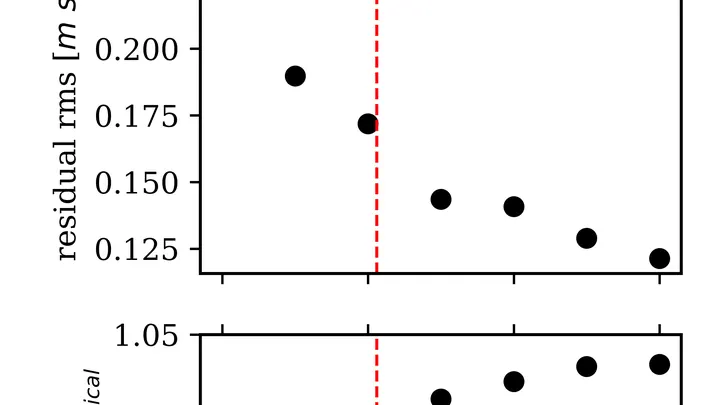
In a quiet observatory, a spectrograph catches the light of a distant star. The instrument spreads it into a rainbow — the spectrum. Lines in the spectrum shift slightly back and forth: an invisible planet is tugging the star. To spot this shift, astronomers compare the spectrum with a reference — a "portrait" of the star assembled from many observations.
A piece of aluminum alloy is heated, and it quietly tells you about its strength. You just need to listen to that story in how the metal absorbs heat.
The usual way to find out how strong an alloy is — pull it until it breaks. That takes time and destroys the sample.
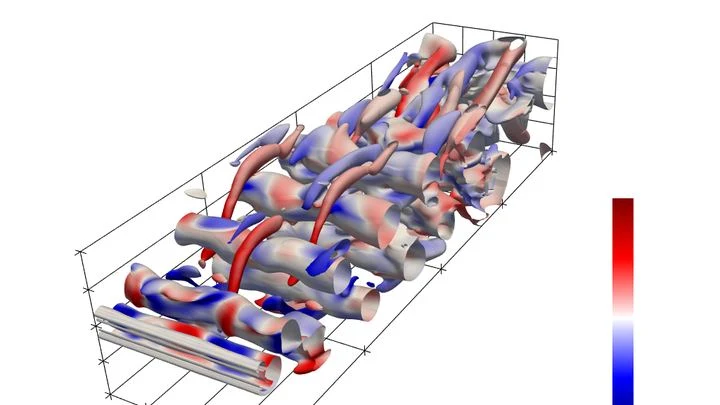
A thin plate stands across a flow of water or air. Behind it, a wake forms — a region where the flow becomes tangled and mixed. Usually, such a wake becomes turbulent when the flow speed is high enough, quantified by the Reynolds number.
When water churns behind a boat, the energy of motion is converted into heat through a cascade of vortices. Measuring how quickly this happens directly is difficult: you'd need to track all the vortices at once. So scientists use a simplification: they look at only one velocity component at a single point.
The wind blows steadily, but suddenly a gust hits, and leaves swirl up in a vortex. Inside such a gust, the air speed changes not smoothly but in jumps — sometimes sharply forward, sometimes sideways. These rare and strong bursts are called intermittency, and they are the main mystery of turbulence.