Magnetic field switches on superconductivity in graphene express
Superconductors usually don't get along with magnets: a strong field destroys the state in which current flows without resistance. But in thin layers of carbon, things are different. A team of physicists took six-layer graphene, six atomic planes stacked in a rhombohedral arrangement, and found that a magnetic field can not only quench superconductivity but also switch it on.
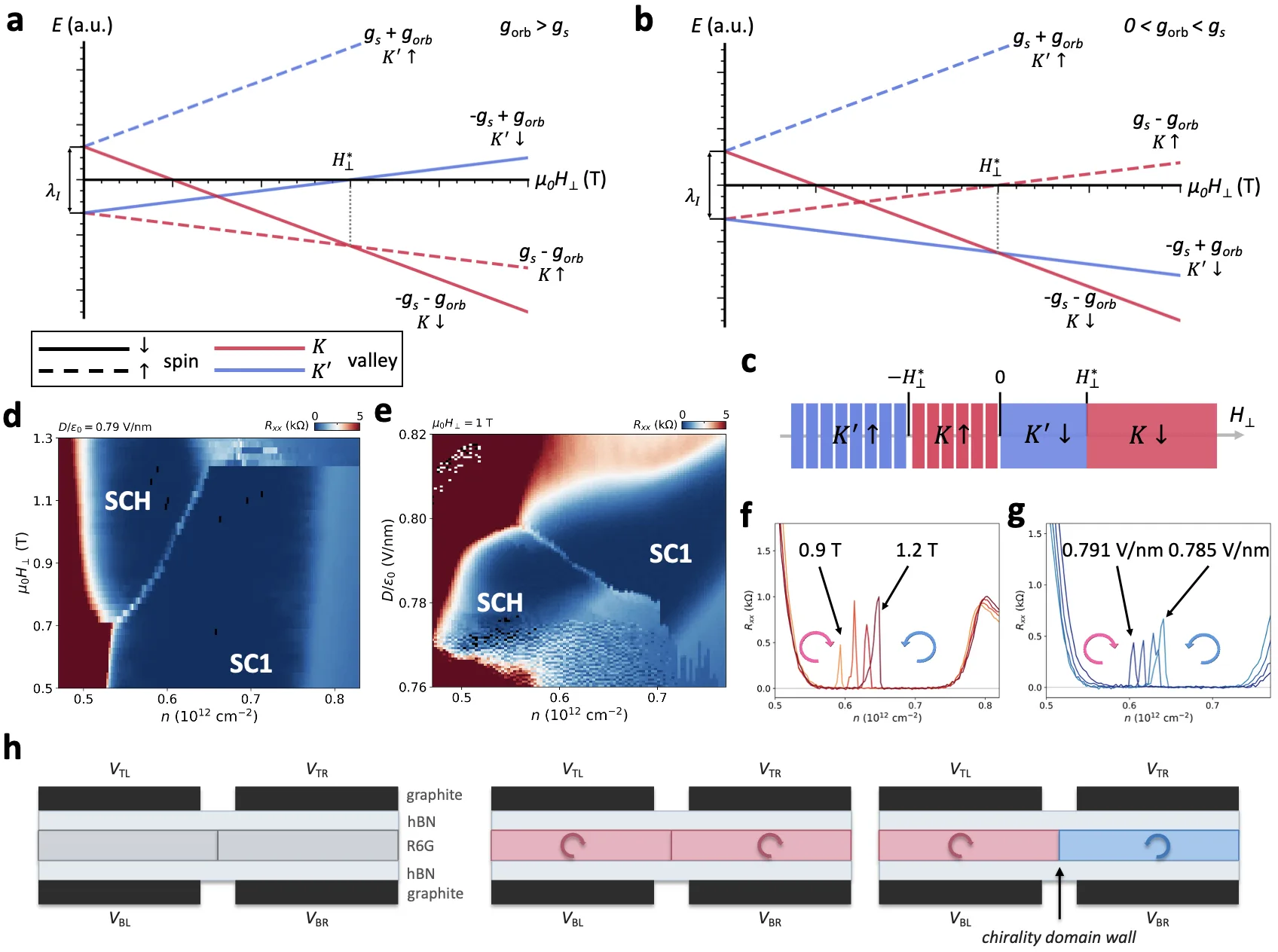
At zero field, this material already exhibits an unusual form of superconductivity — chiral superconductivity. Its electron pairs are twisted in one direction, like a spiral staircase, so the resistance changes depending on the direction of the current. But when the researchers applied a field of about 0.8 tesla, roughly the strength of an MRI machine, a second superconducting regime appeared. It persists up to 1.6 tesla and is controlled by three knobs: the field itself, the electron density, and the electrical displacement between layers.
Measurements showed that this field-induced superconductor emerges from a special magnetic state — a quarter-metal that is magnetized opposite to the original. Thus, in a single piece of graphene, the team obtained a quartet of superconducting phases: four different combinations of spin and valley (a quantum index reminiscent of electron flavor). Each can be selected by tuning external parameters. The authors attribute this to competition between two effects: spin-valley splitting (similar to the mechanism in topological insulators) and the interaction of magnetic moments with the field.
Original abstract
as written by the authors arXiv:2607.06520
Chiral superconductors break orbital time-reversal symmetry and may host topological quasiparticles with non-Abelian statistics. In rhombohedral graphene, superconductivity develops from a spin-valley-polarized quarter-metal (QM) parent state and features unique magnetic hysteresis of resistance that indicates orbital time-reversal-symmetry-breaking. Exploring and controlling the full spin-valley flavors of such superconductivity could enable novel superconducting and topological devices, but have remained unexplored. Here we report transport measurements on rhombohedral hexalayer graphene (R6G), which reveal a new superconducting state (SCH) that is induced by an out-of-plane magnetic field, in addition to chiral superconductivity (CSC) similar to those observed in thinner layers. This SCH state emerges above 0.8 T, persists up to 1.6 T and can be switched on/off by magnetic field $$H_\perp$$, carrier density $$n$$, and gate displacement field $$D$$. Quantum oscillations and anomalous Hall measurements show that SCH stems from a field-induced quarter-metal (QM$$'$$) parent phase, which carries orbital magnetization opposite to that of the zero-field QM. Across the full $$(n, D, H_\perp)$$ parameter space, superconductivity can be realized from all four spin-valley isospin flavors, establishing a switchable chiral-superconductor quartet in R6G. We interpret the parent-state switching as arising from competition between a Kane-Mele-like spin-valley splitting and magnetic-field coupling to spin-valley-dependent magnetic moments. Our work establishes rhombohedral graphene as a multi-knob platform for different isospin-polarized superconductivities, which enables programmable superconducting networks with possible Majorana modes along domain walls.
Six-layer graphene is about a hundred thousand times thinner than a soap bubble, yet it harbors four distinct superconducting personalities.
Programmable superconducting networks with Majorana modes resemble the quantum computers in Piers Anthony's 'Split Infinity', where states are switched by force fields.