Magnetic Fan on the Brink of Saturation express
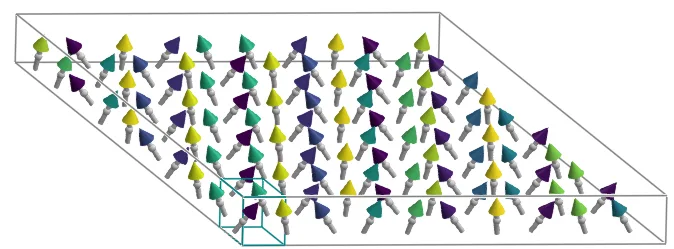
A row of soldiers turns in unison at the command. In magnetic materials, the soldiers are the spins of atoms — tiny magnetic arrows. In an ordinary magnet, they all point the same way, but in a triangular lattice, things are trickier: neighbors interfere with each other, leading to an intricate dance.
Physicists studied a crystal of Na₂BaCo(PO₄)₂ with cobalt ions at the corners of triangles. Using neutron diffraction (a method where a neutron beam illuminates the sample and the scattering reveals the spin arrangement), they peered inside the material under a strong magnetic field. When the field was directed along a specific magnetic axis, they found a surprise: just before all spins finally align with the field, an intermediate phase emerges. The spins do not stay still but form a wave — a 'fan' that smoothly opens as the field changes.
This wave travels along the boundary of the hexagonal Brillouin zone (an imaginary cell in momentum space that determines the crystal's periodicity). Its pitch changes with the field, which does not fit simple models. Calculations showed that key roles are played by dipole-dipole interactions (where each spin feels the magnetic field of its neighbors like a tiny magnet) and a special exchange anisotropy (the dependence of interaction strength on direction). The authors built a minimal model that reproduced the entire complex magnetic map, including this wave vector crawling along the boundary.
Thus, the fan phase found at the threshold of saturation reminds us that even seemingly simple crystals hide subtle mechanisms governing the collective behavior of spins.
Original abstract
as written by the authors arXiv:2607.23173
Using single-crystal neutron diffraction we report the observation of a field-tuned incommensurate phase in a field range just below magnetization saturation in the Ising-like triangular-lattice antiferromagnet Na$$_2$$BaCo(PO$$_4$$)$$_2$$. This phase occurs for magnetic fields applied along the Ising axis and exhibits an in-plane incommensurate propagation vector that moves along the hexagonal Brillouin zone boundary upon varying field, challenging the simple $$XXZ$$ antiferromagnetic description of the system. Within a semiclassical framework, we successfully identify this pre-saturation phase as a coplanar fan phase and study the role of dipole-dipole interactions and bond-dependent exchange anisotropy in its stabilization mechanism. We additionally present a minimal exchange model including interlayer couplings, which reproduces the complex magnetic phase diagram in field including the observed field-dependence of the incommensurate propagation vector in the fan phase.
The name of the mineral 'cobalt' comes from the German 'Kobold'—a mountain spirit that, according to folklore, spoiled silver ore by mixing in an unknown metal.