Contour Map of Stellar Nurseries: Computer Vision Finds Clusters in the Fireworks Galaxy ✛
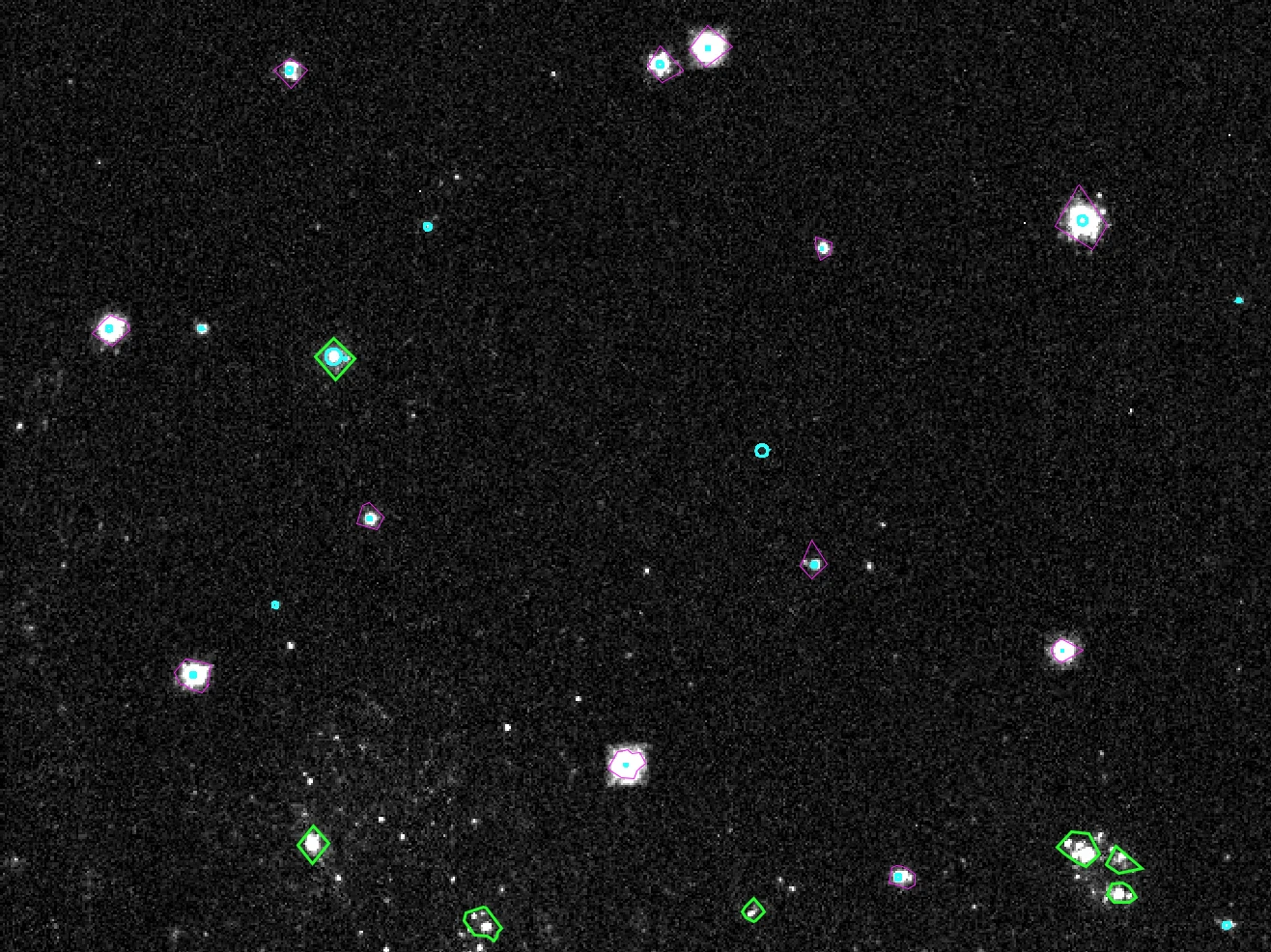
In the spiral galaxy Fireworks Galaxy — 6410 stellar nurseries. That's how many regions where massive stars are being born right now were identified by an algorithm on old ultraviolet radiation images from the Edwin Hubble. These aren't just blobs in a picture — each has a clear boundary, like a country on a contour map. The algorithm worked like a surveyor: it plotted star-points on a map, built a density relief, looked for drop-offs, and outlined the hills. This produced the first objective map of stellar nurseries in an entire galaxy.
A human couldn't manage it. In a scatter of bright points, the eye sees no boundaries. Young clusters hide in cosmic dust and blend into the background, while ultraviolet radiation light, visible only from space, picks out the hottest and newest ones. The WFC3 camera on the Hubble Space Telescope observed the galaxy in two shades of invisible light — where blue giants shine. The algorithm turned those points into a density map: where there were many stars, it formed a hill; where few, a valley. Then it was a matter of technique: the program traced contour lines, cut out noise, and output 6410 outlines.
The clusters are small. The median radius is 2.89 parsecs, about the distance from the Sun to Proxima Centauri. But inside are hundreds, even thousands of stars. Measuring the total brightness of each, astronomers built a luminosity function — a graph of 'how many objects of which brightness'. For bright clusters, it follows a power law with a slope of α = 2.22. This is steeper than universal models predicted, and suggests that in NGC 6946, fewer small star formation nurseries form — or they are destroyed faster.
Now the contour map is ready. You can travel from 'megacities' in the spiral arms to isolated 'farmsteads' on the outskirts. Future surveys will map neighboring galaxy the same way, and then stellar evolution will no longer be a guessing game.
NGC 6946 truly earns its Fireworks nickname: over the past century, it has produced 10 supernovae, more than any other known galaxy, making it a perfect laboratory for studying the link between the birth and death of massive stars.
The motif of galactic fireworks calls to mind scenes from Dan Simmons’ Hyperion, where entire star clusters become the stage for interstellar conflicts and ultraviolet bursts serve as beacons of ancient civilizations.