Contour Map of Stellar Nurseries: Computer Vision Hunts for Clusters in the Fireworks Galaxy ✛
Context
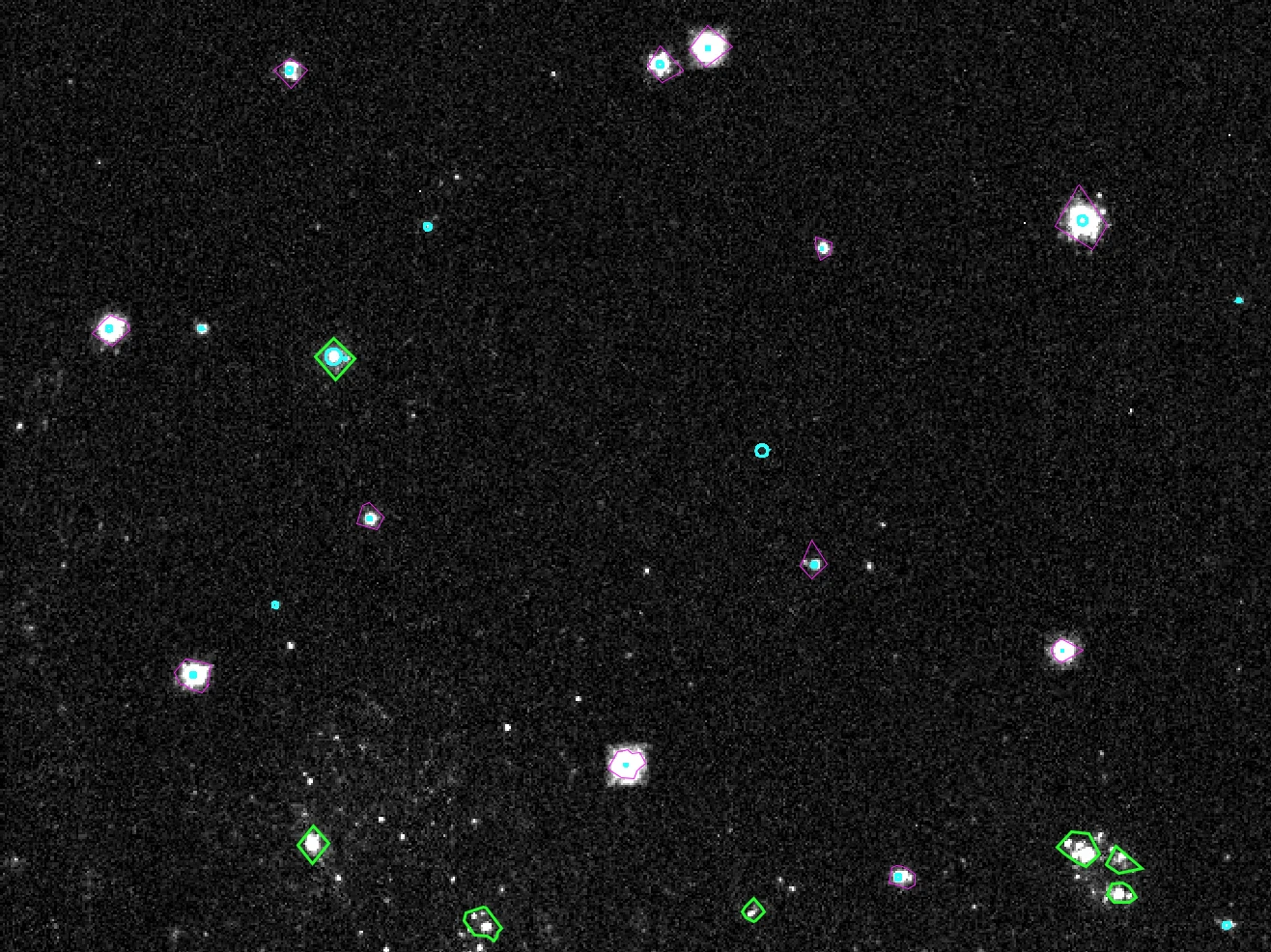
To understand how star clusters are born and die, astronomers need large, homogeneous samples. But picking out clusters in distant galaxies is tough: stars crowd together, projection effects play tricks, and light gets absorbed by interstellar medium. Young massive clusters are especially elusive, hiding inside gas-dust clouds. The traditional method—searching ‘by eye’—simply cannot keep up with today’s data deluge. Galaxy NGC 6946, nicknamed the Fireworks because of its frequent supernovae, is an ideal testbed for automated search. The new algorithm, like a cartographer, traces the outlines of regions with a higher density of young blue stars, visible in hard ultraviolet radiation.
Methods
The core is a classic Canny edge detector, tweaked to work not on pixels but on maps of stellar density. The input data are a catalog of point sources from photometry obtained by Hubble with the WFC3/UVIS camera in the F275W and F336W filters. A kernel density estimate (KDE) builds a smooth distribution map of the stars. Unsharp masking suppresses the background, accentuating the edges of concentrations. The map’s gradient is computed with the Sobel operator, followed by non-maximum suppression and double-threshold filtering using Otsu’s method. The detected boundaries are grouped by the mean-shift algorithm, and the convex hull closes the contours. To validate the method, 1,000 artificial clusters were injected into the data—generated from a Kroupa initial mass function and PARSEC isochrones for a distance of 7.8 Mpc with reddening. The numerical simulations show that the algorithm recovered 60.7% of the synthetic clusters at a false-alarm rate of 27.3%.
Results
The algorithm flagged 6,410 young star cluster candidates (age ≤25 Myr). Their luminosities span MF336W from about −10 to −4. The median half-light radius is 2.89 parsecs, typical for young massive clusters. The F275W−F336W color index of around 0.23 mag points to the presence of cosmic dust. For a robust sample (brighter than MF336W = −7.9), the luminosity function follows a power law with a slope α = 2.22±0.07 in the F336W filter and 2.26±0.08 in F275W. This slope is steeper than in other galaxies (for example, the LEGUS survey gives ~1.8–1.9), but it agrees with earlier measurements for NGC 6946. The power‑law trend holds down to MF336W ∼ −6, indicating the catalog’s depth.
Implications
The catalog is one of the largest homogeneous collections of young clusters for a single galaxy. It will allow researchers to study the mass function, disruption rates, and contribution to the galactic field without assuming any particular cluster shape. The absence of a break in the luminosity function challenges the idea of a universal Schechter function and underscores the value of ultraviolet radiation observations.
Future development
The algorithm is agnostic to cluster morphology and scales with ease. It can be applied to Hubble Space Telescope archives for dozens of spiral galaxies and to future data from Roman or Euclid. Once spectroscopic surveys arrive, we’ll be able to check whether these candidates are truly gravitationally bound and refine their ages.
Impact
The method will impact studies of hierarchical star formation, the dynamical evolution of clusters, and the calibration of star‑formation rate tracers.
Next steps
Apply the algorithm to neighboring galaxies from the LEGUS survey and compute the mass function with incompleteness correction.
Key open problems
The work touches on the universality of the initial mass function, environmental effects on cluster formation, and the mechanisms that destroy clusters within the first few tens of millions of years.
The knowledge machine's view
This section is addressed to the author of the paper and their colleagues. Neighbouring works were found by meaning-based search across our archive, not by word overlap. We do not review: we show the field around the work.
What the work does
This paper presents an algorithm for the automatic detection of young star clusters in the galaxy NGC 6946, based on an adapted Canny edge detector applied to stellar density maps constructed from Hubble ultraviolet data. The algorithm identified 6410 candidates, twice as many as previously known, and allowed measuring the luminosity function with a power-law slope of α ≈ 2.22.
Where its strength is
The method makes no a priori assumptions about cluster shapes and produces the largest homogeneous catalog of young clusters for a single galaxy, paving the way for statistical studies of their population and evolution.
Where it could go next
- The detection method could be extended to large galaxy samples to test the universality of the luminosity function. In our archive, there is a nearby paper where a neural network 'combine' extracts star clusters in hundreds of thousands of galaxies—perhaps your density-map-based approach could complement such large-scale surveys.based on: How a Neural Network Combine Harvests Stellar Sprouts Across Hundreds of Thousands of Galaxies arXiv:2607.04176
- The resulting catalog is an excellent basis for studying the relationship between clusters and their surrounding interstellar medium. Nearby, there is a study on how light from massive stars 'carves out' cradles in gas and dust clouds; matching your contours with gas and dust data could reveal how cluster radiation affects their environment.based on: A Cradle Carved by Light arXiv:2605.29904
Worth trying
- Compare the cluster contours from your algorithm with Hα and CO line emission maps to assess the feedback efficiency of young stars.
- Apply the method to Hubble archives for other nearby spiral galaxies and check whether the luminosity function slope varies with star formation rate.
Why this may matter
A homogeneous cluster catalog for a galaxy with active star formation is a benchmark sample for calibrating models of cluster evolution and their contribution to the galactic field; the proposed directions could turn a single result into a systematic tool.
Nearby works in our archive
- A Cradle Carved by Lightsimilarity 0.62
- Seven Stars from One Doughsimilarity 0.59
- Symphony of Shadows: Neutrino Telescopes Catch the Whisper of Dark Mattersimilarity 0.59
- Speed Filter of the Skies: How Swift Visitors Elude Telescopessimilarity 0.58
- How a Neural Network Combine Harvests Stellar Sprouts Across Hundreds of Thousands of Galaxiessimilarity 0.58
- Where Dwarfs Ignite Starssimilarity 0.58
The closest work in the archive sits at 0.62 by meaning — the usual level for our corpus.
Original abstract
as written by the authors arXiv:2607.26330v1
We present the integrated photometry, radii, and spatial distribution of young ($$\leq$$ 25 Myr) star cluster candidates in NGC 6946. NGC 6946, also known as the Fireworks Galaxy, is a highly star-forming galaxy with numerous young massive clusters. We have developed a modified computer vision algorithm using photometry from images taken with Hubble Space Telescope (HST) Wide Field Camera 3 Ultraviolet channel (WFC3/UVIS) F275W and F336W filters to identify and outline candidate clusters. We describe our technique in detail, including extensive testing with artificial clusters, where the algorithm recovers 60.7% of synthetic clusters and has a conservative false positive rate of 27.3% down to luminosities of M$$_{F336W} \sim -6$$. We identify 6410 cluster candidates down to much fainter magnitudes (M$$_{F336W} \sim -4$$) via the aforementioned algorithm which are more difficult to verify, but are still of interest as the luminosity function of these candidates is consistent with a standard power law with a slope of $$\sim$$2.
NGC 6946 truly earns its Fireworks nickname: over the past century, it has produced 10 supernovae, more than any other known galaxy, making it a perfect laboratory for studying the link between the birth and death of massive stars.
The motif of galactic fireworks calls to mind scenes from Dan Simmons’ Hyperion, where entire star clusters become the stage for interstellar conflicts and ultraviolet bursts serve as beacons of ancient civilizations.
Key numbers
- Cluster candidates detected: 6410
- Distance to the galaxy: 7.8 Mpc (~25 million light-years)
- Median half-light radius: 2.89 pc
- Luminosity function slope (F275W): 2.26±0.08
- 50% completeness limit (F336W): down to MF336W ~ -6