How the Jitters of Space Can Stifle the Birth of Black Holes express
When you blow up a balloon too quickly, its surface starts to quiver. Something similar happened to space in the first moments after the Big Bang: the universe expanded rapidly, and the very fabric of space began to ripple. This ripple, gravitational waves, doesn't just travel through the cosmos; it can also interfere with the birth of tiny black holes.
Normally, such holes could form when an especially dense clump of energy randomly appeared in the expanding universe. But calculations show that the jitters of space act like a headwind. They slow down the expansion right where a clump is trying to become a hole. The process resembles a self-regulating system: the stronger the expansion in a region, the more powerful the counter-wave that reins it in.
This effect changes the game for theorists. Previously, to get the right number of black holes, you had to fine-tune the expansion parameters very precisely, like tuning a radio, where the slightest turn of the dial takes you off the station. Now, nature itself turns the dial back, smoothing out the peaks. The fine-tuning that seemed suspicious becomes much less critical.
Original abstract
as written by the authors arXiv:2608.07264v1
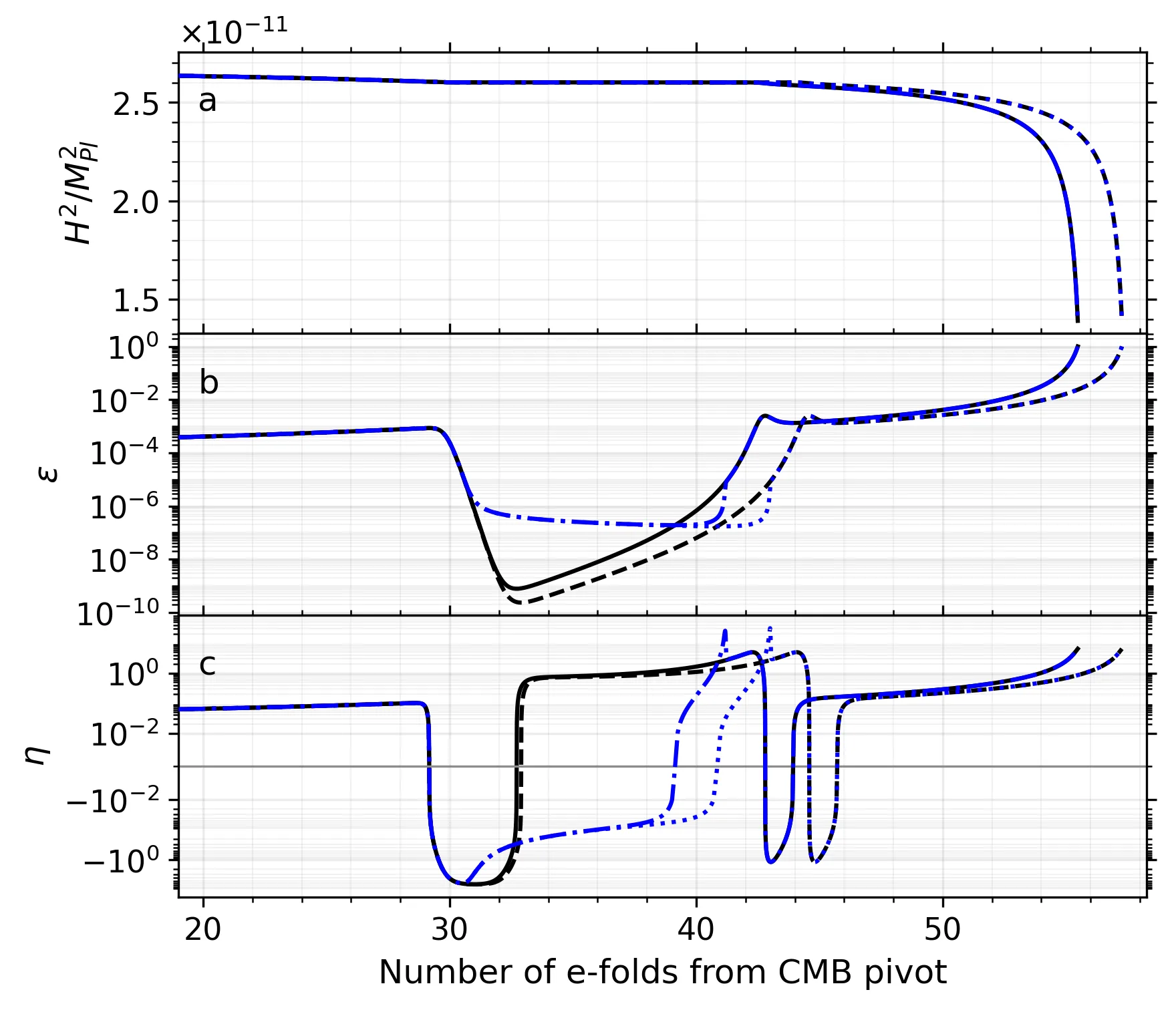
We discuss the impact of tensor-induced backreaction at second order in perturbation theory on primordial black holes production in single-field inflationary models, where the comoving curvature power spectrum is amplified by a transient ultra-slow-roll phase. Although the leading perturbative correction is mostly negligible in standard slow-roll evolution, it becomes important in non-attractor regimes, going in the direction of limiting the suppression of the first slow-roll parameter $$\varepsilon$$ and reducing the enhancement of the scalar power spectrum. We then go beyond the standard perturbative analysis by considering the background parameters as effective quantities with evolution self consistently determined by a closed system of backreaction equations. This analysis, which leads to a partial resummation of the effect beyond the perturbative treatment, confirms the limitation of the suppression of $$\varepsilon$$ by consistently showing how the effect remains important even after accounting for the effective evolution of the background in the evaluation of the backreaction itself. Finally, we discuss how, taking into account the tensor-induced backreaction, the fine-tuning associated with the value of the peak amplitude of the scalar power spectrum is strongly reduced.
The tiny black holes in question could be the size of an atom but weigh as much as a mountain. If such a hole passed through Earth, it would leave a tunnel thinner than a human hair.