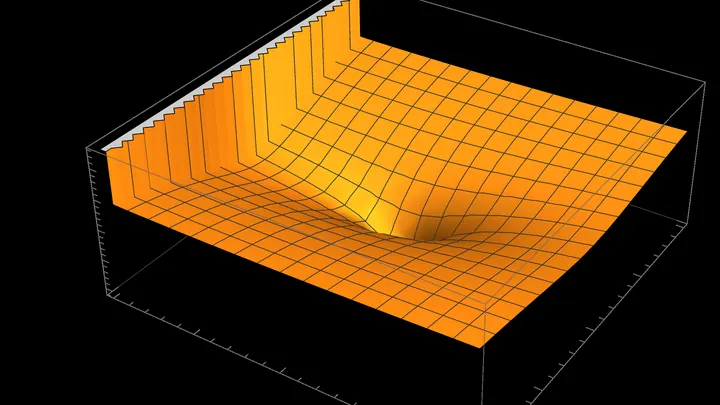
Negative energy is a hypothetical form of energy with a density less than zero, meaning it would have repulsive gravitational effects rather than attractive ones. In general relativity, the energy-momentum tensor determines spacetime curvature; negative energy would cause spacetime to curve in a way that repels matter. This exotic property is a key ingredient in speculative concepts like wormholes, warp drives, and certain cosmological models.
History
The concept of negative energy in general relativity dates to the 1950s with work on energy conditions by Raychaudhuri and others. The idea that negative energy could enable warp drives was popularized by Miguel Alcubierre in 1994, and the Casimir effect was predicted by Hendrik Casimir in 1948.
How it works
In quantum field theory, negative energy can arise locally due to quantum fluctuations — for example, the Casimir effect produces a region of negative energy density between closely spaced conducting plates. However, such effects are typically tiny and transient. To sustain macroscopic negative energy (as needed for a warp drive), one would require 'exotic matter' that violates energy conditions, such as the weak or null energy condition. Whether such matter can exist in bulk is an open question; quantum inequalities suggest limits on how much negative energy can be concentrated.
In practice
While no macroscopic negative energy has been created, the Casimir effect is measured in nanoscale devices and is relevant to microelectromechanical systems (MEMS). Negative energy also appears in theoretical studies of black hole thermodynamics and Hawking radiation.
Fun fact
The Casimir effect, which demonstrates negative energy density, is strong enough to cause tiny mechanical components in microdevices to stick together — a real engineering problem.
At the center of a neutron star, matter is compressed so tightly that a teaspoon weighs a billion tons. You'd think there's no better place to look for signs of quantum gravity. But between the laboratory and the fundamental scale lies a chasm of 10⁸⁰ in density.
Three doors lead into this room.
When you blow up a balloon too quickly, its surface starts to quiver. Something similar happened to space in the first moments after the Big Bang: the universe expanded rapidly, and the very fabric of space began to ripple.
In the far reaches of space, there exists a hypothetical object: an ultracold black hole. It is charged and resides in an expanding universe (de Sitter space). Its temperature hovers just above absolute zero — about one trillionth of a degree above it.
The universe sometimes resembles an old fabric: after rapid cooling, wrinkles could have remained — thin, almost invisible threads of monstrous density. They are called cosmic strings. Usually, at the center of such a string hides a singularity — a point where the laws of physics lose their meaning.
Two balls dropped from different heights fall to the ground with different accelerations. In space, things are more complicated: even emptiness makes bodies move differently.
At the heart of a warp drive lies Einstein's idea that massive bodies curve spacetime — the very stage on which all cosmic events unfold. Picture a bubble of such curved spacetime. Inside it, the ship floats without any G-forces, like a passenger in an airplane cabin who doesn't feel the headwind.
The black hole paradox has haunted physicists for decades. If a hole evaporates, where does its contents go? Discoveries by Stephen Hawking and Jacob Bekenstein showed that saving the laws of nature requires an unconventional move.
Imagine the universe as a woven blanket of invisible threads.
A black hole is like a perfect vacuum cleaner: anything that crosses its horizon vanishes without a trace. But this vacuum cleaner has a strange feature: its "dust bag" grows, and by the size of the bag you can tell how much has been sucked in. In black hole physics, this size is linked to entropy entropy — a measure of hidden information about what fell inside.
A black hole is like a bottomless well. You can measure how much water has flowed into it by watching the level from outside. But how do you find the mass of the water itself if you're standing inside the well? That's roughly the problem the authors of a new paper tackle.
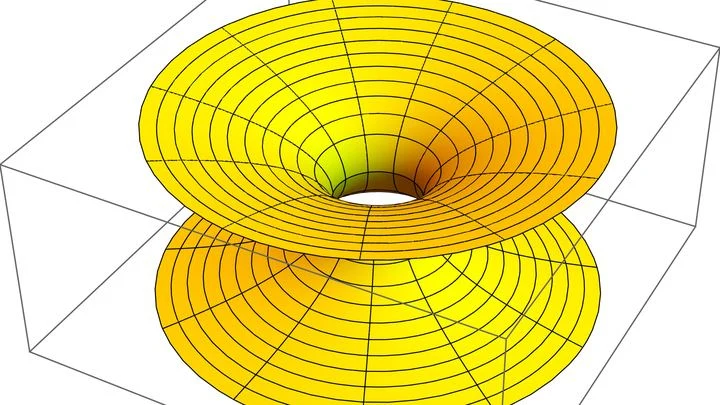
A wormhole is a hypothetical tunnel in curved spacetime connecting two distant regions of the universe and potentially shortening the journey between them.
Spacetime is like a giant sheet of paper. Fold it, and distant corners come together. Poke a pencil through, and you get a wormhole, a short tunnel through the folds. But the paper wants to spring back flat, snapping the passage shut. To keep it open, you need a rare “gasket”—matter with negative energy.
A black hole is like a perfect safe: anything that goes in seems lost forever. But at the microscopic level, it doesn't destroy information: it shuffles it with its internal degrees of freedom, much like a deck of cards after a thorough shuffle.
For nearly a century, astronomers have watched galaxies spin as if held together by invisible mass. Fritz Zwicky first noticed it, and Vera Rubin precisely measured the speeds of stars at the edges.
A wormhole is a tunnel through the fabric of spacetime, an idea expanded by John Wheeler and Kip Thorne. Just as a mountain passage tends to cave in, the throat of a wormhole wants to snap shut.
A hot coffee on the table cools down: heat spreads from the hot center to the edges. The authors suggest that the universe behaves in a similar way, just on scales of billions of light-years. Their model describes not the usual dark energy, but a smooth redistribution of energy within the cosmos, akin to the slow flow of heat from denser regions to rarefied ones.
The Universe is a vast city. In it, dark matter is the invisible framework of buildings, and dark energy is the force stretching the streets. For a long time they were considered independent, but new research has caught them in secret communication.
Back in the 1930s, Fritz Zwicky noticed that the speeds of galaxies in clusters were too high for the visible mass. Later, Vera Rubin confirmed this for individual galaxies.
Imagine an orchestra tuning up: the violins rise in pitch: that's the familiar 'chirp' of black hole mergers in LIGO detectors. Now picture a funeral march: a sound that descends, like a fading siren. That's exactly the gravitational-wave signature a system with one negative mass should leave.
Spacetime sometimes resembles a sheet of paper in which you can punch a hole and connect the edges with a short tube: you get a wormhole. In the simplest mathematical models of such wormholes, massless scalar fields appear — something like an invisible fog filling everything around.
Black holes are not eternal: they slowly lose energy, emitting entropy — a measure of hidden information — as heat. This process was predicted by Stephen Hawking. But until now, it remained a mystery what happens at the very end, when the hole has almost disappeared and must return the captured data.
A star that has exhausted its fuel falls into itself. Its outer layers fly apart, while the core compresses to unimaginable densities. It was once thought that this process ends in a point — a singularity where the laws of physics break down. New work shows that just before the very end, something strange happens inside the future black hole.
A boiling cauldron with the occasional bubble of steam popping: that's what the early universe resembled. All of space was filled with a field in a false vacuum state, like water superheated above its boiling point.
A giant whirlpool spins at tremendous speed. If you toss a rope into it, securing one end at the rim and leaving the other outside, the whirlpool will wind the rope around itself, making it spin. That's roughly how a cosmic string behaves near a rotating black hole.
When stars at the edges of galaxies rotate faster than calculations based on visible mass predict, standard cosmology invokes the hypothesis of hidden dark matter — invisible substance that reveals itself only through gravity. A new study offers an alternative that requires no new particles.
The familiar picture: gravity always attracts. But if a mass is in quantum superposition (that is, in two places at once, like an object in a double-exposure photograph) everything flips. Quantum theory allows a particle to be both here and there in a literal sense: its position is described by a wave function smeared across space.
Gravity always pulls — an apple falls down, planets orbit in circles. But by placing a source of gravity in two places at once, you can get the opposite. Physicists have proposed an experiment: a massive body is put into a quantum state, smeared across space like a cloud. Then a tiny particle is shot into that cloud.
Dark matter may not be particles but black holes from the Big Bang era. In the early Universe, which was like a swirling batter, they were like heavy lumps — barely moving, they gathered surrounding matter and spun it into the swift galaxy flows astronomers observe today.
The universe is expanding faster and faster, like yeast dough in the kitchen. This expansion is helped by dark energy — the cosmic sugar. Ever since astronomers like Adam Riess noticed the acceleration in the late 1990s, they've been searching for the cause.
A classic rocket is limited by the speed of light: as mass increases, acceleration demands infinite energy. But Einstein's equations allow a workaround — not pushing the ship through space, but making space itself move. The warp drive idea: compress the region ahead and expand it behind, creating a 'bubble' that glides through space faster than light.
Vortons are invisible cosmic hoops, closed loops of curved spacetime. Thinner than an atom but heavier than stars, these Big Bang relics spin like giant carousels, churning everything around them. Einstein's equations describe how particles dance near such a hoop: paths twist into spirals or dart chaotically.
A black hole is not a bottomless funnel but a cosmic cooking pot. Inside it, matter obeys laws familiar to us from the behavior of water: under some conditions it resembles boiling steam, under others — a cooling liquid.
The James Webb Space Telescope has spotted a scattering of compact objects in the early universe, nicknamed 'little red dots.' They are too red and too dim to be ordinary quasars, and astrophysicists are scratching their heads over what powers them.