The memory burden effect is a proposed phenomenon in which a black hole's evaporation is slowed down because the black hole retains information about its initial state. This effect is particularly relevant for primordial black holes, which are hypothesized to have formed in the early universe. The memory burden could influence their evaporation rate and even their role as dark matter candidates.
History
The concept is relatively recent, emerging from studies on black hole information paradox and quantum gravity. It has been explored in the context of primordial black holes and their potential to explain dark matter, with key contributions from researchers like Dvali and others in the late 2010s and 2020s.
How it works
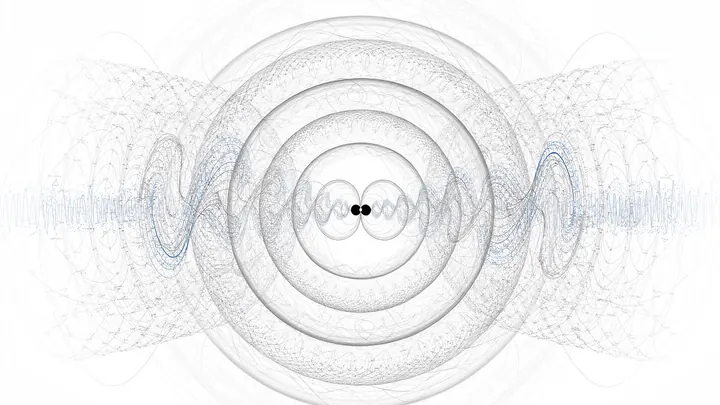
When a black hole evaporates via Hawking radiation, it loses mass and eventually disappears. The memory burden effect suggests that as the black hole emits radiation, it also encodes information about its initial configuration. This information storage creates a 'burden' that resists further evaporation, effectively slowing the process. This could lead to longer-lived black holes and alter their observable signatures, such as gravitational wave emissions.
In practice
The memory burden effect is used in theoretical models to predict the abundance and mass distribution of primordial black holes, which could be detected through gravitational waves or microlensing events.
Fun fact
The memory burden effect might explain why primordial black holes have not yet been observed to evaporate, even though they should have by now if they were light enough.
A campfire that doesn't go out all at once but smolders for hours because the wood inside still holds the heat of the past flame. That's roughly how the memory effect works for black holes. Normally, a tiny black hole with the mass of a mountain should evaporate in fractions of a second, scattering particles like sparks.
When you blow up a balloon too quickly, its surface starts to quiver. Something similar happened to space in the first moments after the Big Bang: the universe expanded rapidly, and the very fabric of space began to ripple.
The universe cooled like a giant bathtub after a hot start. At 400 000 years after the Big Bang, hydrogen was ready to recombine — protons capturing electrons to become neutral atoms. But somewhere in this dark water, a tap kept dripping.
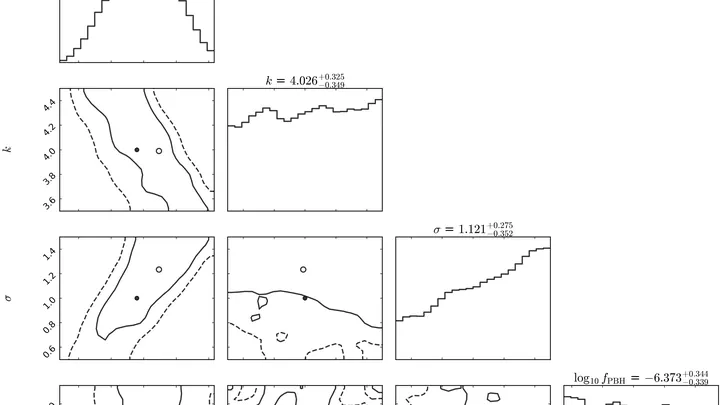
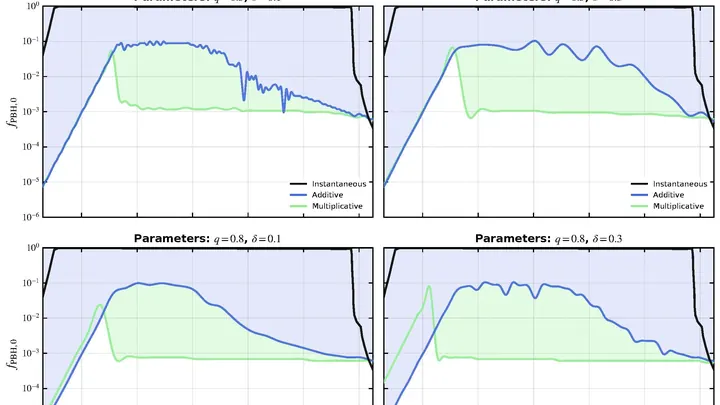
In a recent study, astrophysicists showed how pre-recombination physics, particularly early dark energy, affects the spectral running $$α_s$$ and, consequently, the viability of scenarios forming primordial black holes from an ultra-slow-roll (USR) phase during inflation.
After the Big Bang, the universe underwent a rapid expansion — inflation, smoothing out the cosmic microwave background and sowing the seeds of galaxies. But at the quantum level, chaotic fluctuations brewed in the inflaton field.
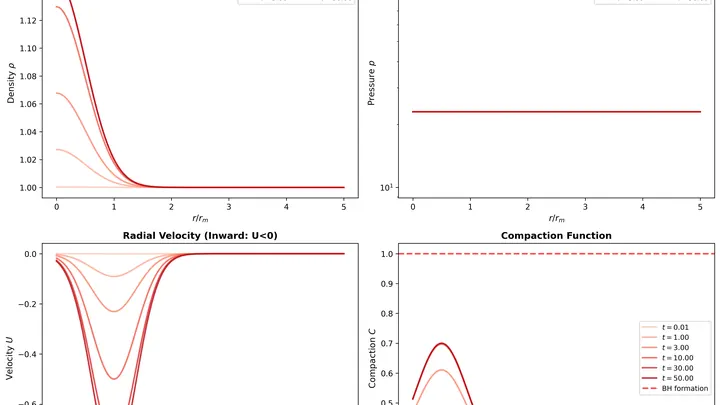
In the first moments after the Big Bang, the universe was filled with a hot, nearly uniform plasma. But in some places, the density could randomly be slightly higher. If such a clump gained critical mass, it collapsed into a black hole: this is how primordial black holes were born.
In the early Universe, tiny black holes could have been born — mountain-mass but atomic-nucleus-sized. Today they could serve as factories for dark matter. There are two mechanisms: the familiar evaporation (Hawking radiation) and the lesser-known superradiance.
A black hole is not an eternal vacuum cleaner. Left alone in the void, it slowly disappears, radiating energy like a puddle drying on asphalt. This process, predicted by Stephen Hawking, is called evaporation.
The universe is filled with invisible dark matter. Just as a drop of water, as it evaporates, leaves behind a tiny salt crystal, so too can a black hole evaporate, leaving behind a minuscule stable remnant.
A sugar cube weighs about a gram. But a black hole that could hide inside such a cube would weigh as much as a small mountain — billions of tons. Yet even such tiny things, born in the first instants after the Big Bang, should have vanished long ago.
A tiny black hole the size of an atomic nucleus but with the mass of a mountain emerged in the first moments after the Big Bang, when random clumps of energy collapsed into such objects.
A black hole doesn't just swallow everything around it: it also slowly evaporates, like a chunk of ice in the sun. As the hole shrinks, the quantum fields around it start behaving unusually. In a new study, physicists traced how entanglement, a special kinship between particles that persists even when they are far apart, changes.
A boiling cauldron with the occasional bubble of steam popping: that's what the early universe resembled. All of space was filled with a field in a false vacuum state, like water superheated above its boiling point.
The universe resembles a giant sponge: bright filaments of galaxies weave around enormous dark voids. Inside these filaments and walls hide clumps of invisible dark matter — halos. When dark matter particles collide and decay, they produce ordinary particles that telescopes can catch.
The Mpemba effect is surprising: hot water sometimes freezes faster than cold. Scientists built a simple model: a bead in a thick, honey-like medium, on a landscape with two dips and a wall at the edge. The bead moves viscously, unable to hop over the central bump.
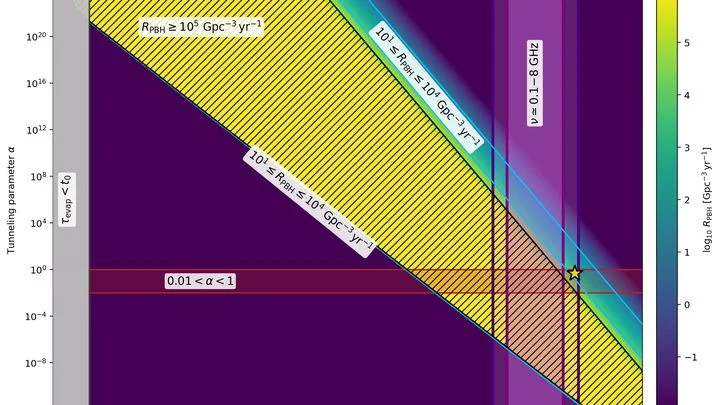
Some black holes are remnants from the Big Bang. Usually they fade via a slow radiation leak — predicted by Stephen Hawking. But a quantum switch could invert them into white holes, explosively releasing all energy like popcorn kernels that suddenly pop.
Dark matter may not be particles but black holes from the Big Bang era. In the early Universe, which was like a swirling batter, they were like heavy lumps — barely moving, they gathered surrounding matter and spun it into the swift galaxy flows astronomers observe today.
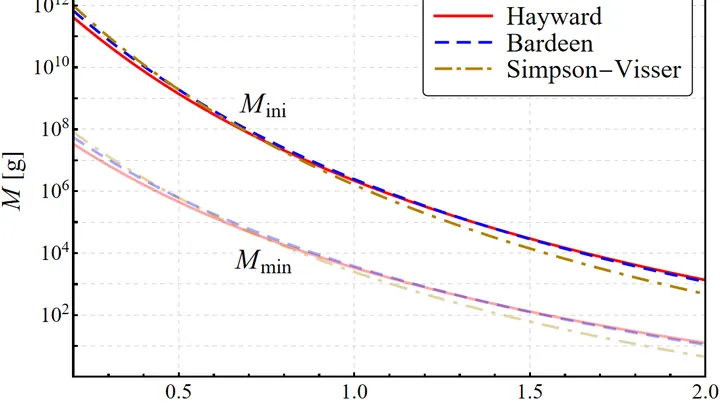
Primordial black holes, hypothetical objects that emerged in the first instants after the Big Bang from the collapse of superdense fluctuations, should have vanished long ago according to Stephen Hawking's classic prediction: they would completely evaporate via quantum radiation, much like a puddle of…
Every evening, in the city archive, the attendant places new folders on the shelves. If too many arrive during the day, the shelves sag, and the next morning the archive responds to requests more slowly. A black hole's memory works in much the same way: it doesn't just store information, it physically feels its weight.