quantity

barrow entropy

A modified entropy formula for black holes that accounts for quantum-gravitational effects via a deformation parameter.
42 related articles

Description

A surprising fact is that when Δ = 1, Barrow entropy makes a black hole's entropy proportional to its volume, not its area, which would drastically change how we think about black hole information storage.

Concept graph →

Related articles · 42

HEP Phenomenology2026-08-082 minarXiv:2608.08144express
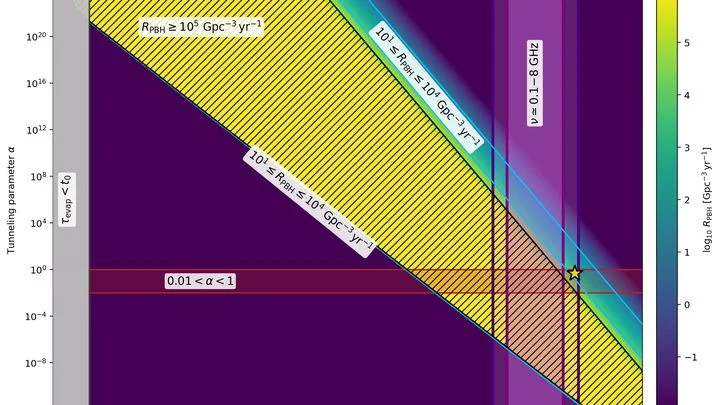
Black Holes That Didn't Evaporate
A campfire that doesn't go out all at once but smolders for hours because the wood inside still holds the heat of the past flame. That's roughly how the memory effect works for black holes. Normally, a tiny black hole with the mass of a mountain should evaporate in fractions of a second, scattering particles like sparks.

Cosmology2026-08-071 minarXiv:2608.07264express
How the Jitters of Space Can Stifle the Birth of Black Holes
When you blow up a balloon too quickly, its surface starts to quiver. Something similar happened to space in the first moments after the Big Bang: the universe expanded rapidly, and the very fabric of space began to ripple.
HEP Theory2026-08-062 minarXiv:2608.05913express
How Quantum Foam Gives Rise to Gravity
Quantum field theory is the language physicists use to describe elementary particles and their interactions. The authors of the work decided to slightly "tweak" this language: they introduced deformations, that is, small changes to the rules of the game.
High Energy2026-07-311 minarXiv:2607.28919express
How Black Holes Spit Out Energy
A whirlpool gulps down water, but splashes most of it back out. That's roughly how a black hole behaves when too much matter falls onto it. In a new study, astrophysicists ran 32 computer simulations to understand how a black hole's parameters — mass, spin, and "appetite"—control these cosmic fountains.
General Relativity2026-07-281 minarXiv:2607.25311express
How Black Holes Ring After a Strike
A stone falls into still water — ripples spread across the surface. A black hole behaves similarly when something falls into it or when it merges with another black hole. The hole begins to oscillate, and these oscillations propagate through space as gravitational waves.
HEP Theory2026-07-242 minarXiv:2607.22382express
Quantum Whisper Wakes a Black Hole
A black hole sitting on a thin cosmic membrane (brane) resembles a heavy ball stretching an elastic sheet. In classical physics, it is bald — only mass, charge, and rotation. But add a scalar field (an invisible substance like temperature), and the hole can spontaneously grow 'fur' from this field.
HEP Theory2026-07-232 minarXiv:2607.21734express
Complexity Gets Tangled Midway
Water turns to ice at zero degrees — sharply, with no intermediate states. Something similar happens to complexity when we take a random quantum state of an entire system and look only at a part of it. As long as that part occupies less than half the system, its complexity grows smoothly. But as soon as the fraction crosses 50%, a jump occurs.
General Relativity2026-07-232 minarXiv:2607.21770express
How Spacetime Roughness Governs Heat Flow
A light ray skimming along a black hole horizon doesn't just move: it carries heat and information. Physicists have long suspected that the geometry of such rays obeys strict rules, but the details remained blurry. The new work turns these rules into a sharp inequality.
The Shadow Theater of Black Holes: One Shadow, Two Plays
At the center of most galaxies lurk supermassive black holes — the overlords of gravity. Since 2019, thanks to interferometry with very long baselines, we’ve glimpsed their shadows: dark silhouettes set against a blazing gas backdrop. But what exactly is painting that shadow?
Cosmology2026-07-103 minarXiv:2607.09285
Ghost Garden: How Neutrino Showers Sprout Dark Matter Seeds
For a long time, cosmology was dominated by the belief, originating from Hawking: during the radiation era, primordial black holes do not grow.
HEP Theory2026-07-072 minarXiv:2607.06867express
Gravity as a Fluid at the Edge of the Universe
An endless ocean where every wave carries information about what happens in the depths. That is roughly how our Universe works under the holographic principle: the physics inside a volume can be described by processes on its boundary.
Gravitational Tango: How a Neural Network with Physical Intuition Heard the Rhythm of Black Holes
Isolating the signal from a single pair of supermassive black holes is like hearing a dancer's footsteps amid the roar of a hurricane. Somewhere in space, these monsters spin in a slow gravitational tango, distorting spacetime itself.
Mesoscale2026-07-023 minarXiv:2607.02188
Quantum Fingerprint: Anyon Entropy Reveals Their Topological Nature
The hunt for non-Abelian anyons is a quest for a quantum ghost that leaves only one clue: entropy. These particles live in two-dimensional systems at ultralow temperatures. Their exchange doesn't just flip the sign of the wavefunction — it entangles states, creating topological order.
Cosmology2026-06-293 minarXiv:2606.30087
Branching Inflation: How Stochastic Trees Revealed Exotic Black Holes
After the Big Bang, the universe underwent a rapid expansion — inflation, smoothing out the cosmic microwave background and sowing the seeds of galaxies. But at the quantum level, chaotic fluctuations brewed in the inflaton field.
High Energy2026-06-292 minarXiv:2606.30753express
Shadow and Ring: How to Weigh a Black Hole More Precisely
At the center of galaxy M87, 55 million light-years away, lurks a black hole with a mass of 6.5 billion Suns. In 2019, the Event Horizon Telescope (EHT) gave us its first portrait: an orange donut with a dark core. But the donut is not the abyss itself.
General Relativity2026-06-282 minarXiv:2606.29590express
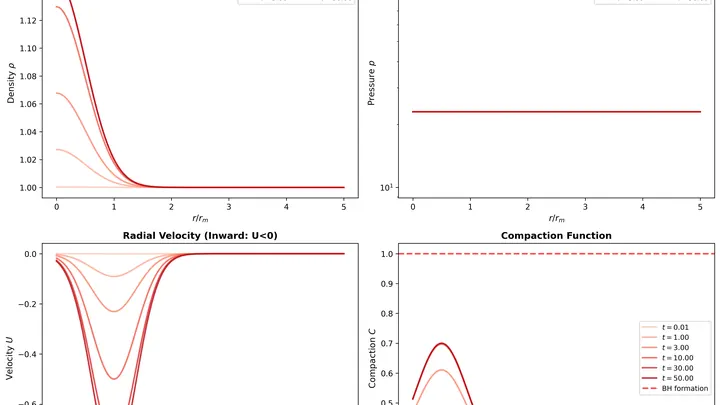
How Pressure Stops Black Holes from Being Born
In the first moments after the Big Bang, the universe was filled with a hot, nearly uniform plasma. But in some places, the density could randomly be slightly higher. If such a clump gained critical mass, it collapsed into a black hole: this is how primordial black holes were born.
Cosmic Molasses: How Viscosity Changes the Rules of Primordial Black Hole Birth
In the search for the nature of dark matter, one of the most intriguing hypotheses traces back to the first moments after the Big Bang. Back then, quantum fluctuations of the inflation field gave rise to clumps of matter that could collapse into primordial black holes.
General Relativity2026-06-132 minarXiv:2606.15381express
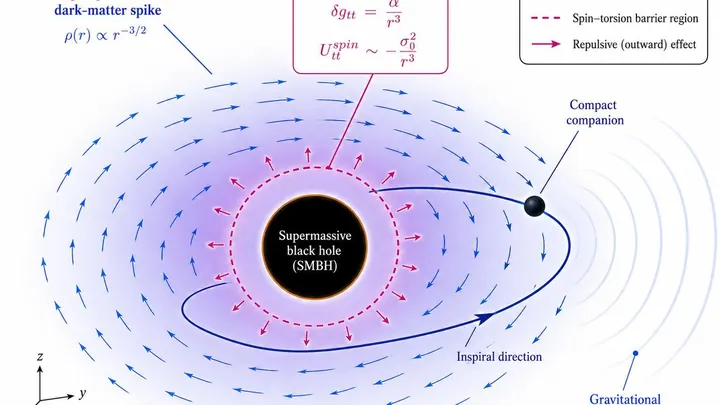
Dark Matter Spins Black Holes
A supermassive black hole drifts through a cloud of dark matter. In the usual picture, this invisible substance just adds mass and barely interacts with ordinary matter. But dark matter particles could have intrinsic rotation — spin.
General Relativity2026-06-122 minarXiv:2606.14815express
Quantum Corrections to a Black Hole in a Dark Web
A black hole is not just a cosmic vacuum cleaner. It is a region with such strong gravity that even light cannot escape it. But place it in a perfect fluid of dark matter and add a cloud of strings, thin filaments stretched across all of space, and the picture gets more complicated.
HEP Theory2026-06-121 minarXiv:2606.14834express
A Black Hole Remembers Only Its Spin
A black hole is like a spinning top: the faster it spins, the more noticeable its behavior. It has two boundaries — the outer and inner horizons, the edges beyond which even light cannot return. In the new work, physicists looked inside a rotating charged black hole and multiplied the areas of these two surfaces.
Quantum Physics2026-06-112 minarXiv:2606.13383express
What a Black Hole Breathes
A bonfire doesn't burn out all at once. If you glance at the flames at a random moment, all you see is a jumble of fire tongues, and you can never tell what exactly burned: a wet branch, an old magazine, or an armful of dry grass. But if you watch the fire hour after hour, rhythms emerge in its dance: a burst of heat, a lull, a change in color. These rhythms tell the story of what was thrown into the flames.
HEP Phenomenology2026-06-112 minarXiv:2606.13788express
Invisible Black Holes Leave a Mark in Gamma-Ray Light
A swarm of tiny ice balls is scattered across a warm room. Some melt faster, others slower, but when only wet spots remain, they all vanish in the same way: the last drop evaporates according to the same law. This is roughly how primordial black holes behave — hypothetical objects born in the first moments after the big bang.
Cosmology2026-06-031 minarXiv:2606.04707express
General Relativity2026-05-291 minarXiv:2606.00178express
Tunnels from Entropy: A New Key to Wormholes
Spacetime is like a giant sheet of paper. Fold it, and distant corners come together. Poke a pencil through, and you get a wormhole, a short tunnel through the folds. But the paper wants to spring back flat, snapping the passage shut. To keep it open, you need a rare “gasket”—matter with negative energy.
General Relativity2026-05-251 minarXiv:2605.26214express
The Horizon Can't Remember Without a Tremor
Light falling into a black hole carries information — for instance, the path a photon took. The horizon (the surface from which nothing returns) responds by changing its entropy — a measure of disorder, akin to the number of shuffled pages in a book.
General Relativity2026-05-211 minarXiv:2605.22434express
Gravity Born from Disorder: Physicists Find a Universal Recipe
Gravity isn’t fundamental: it’s a shadow cast by entropy, the measure of disorder. Back in the 1970s, Jacob Bekenstein and Stephen Hawking found that black holes store disorder on their surface, as if information is smeared across the shell.
Cosmology2026-05-192 minarXiv:2605.19463express
Tiny black holes that refuse to evaporate
A sugar cube weighs about a gram. But a black hole that could hide inside such a cube would weigh as much as a small mountain — billions of tons. Yet even such tiny things, born in the first instants after the Big Bang, should have vanished long ago.
Cosmology2026-05-152 minarXiv:2605.15772express
Tiny Black Holes Warm the Universe Longer Than Thought
A tiny black hole the size of an atomic nucleus but with the mass of a mountain emerged in the first moments after the Big Bang, when random clumps of energy collapsed into such objects.
High Energy2026-05-072 minarXiv:2605.07027express
Nuclear Reaction Draws the Line for Black Holes
Gravitational waves — ripples in spacetime predicted by Einstein — have exposed an abyss: black holes with masses between 60 and 120 solar masses are almost never born.
General Relativity2026-05-072 minarXiv:2605.08235express
The Horizon Breathes: How Black Hole Walls Move
A black hole is not a frozen sphere. It's more like a soap bubble, whose walls can expand and contract. It even has two layers: the outer horizon, beyond which light cannot return, and the inner one, hidden deeper. When the hole swallows matter or loses energy, both layers shift, like the film of a bubble changing size.
Cosmology2026-05-061 minarXiv:2605.04815express
Tiny Black Holes Don’t Warp the Cosmos
Right after the Big Bang, the Universe expanded incredibly fast — this phase was called inflation. In some microscopic regions, matter randomly clumped so much that it collapsed into primordial black holes. They are tiny — the size of a proton, yet as massive as an iceberg.
General Relativity2026-05-031 minarXiv:2605.02008express
How Modified Gravity Explains Our World
In the first second after the Big Bang, the universe was a boiling cauldron of energy. Particle-antiparticle pairs were born and instantly annihilated each other. But for every billion such pairs, one particle of matter survived, and that leftover became stars, planets, and people. New research blames modified gravity for this.
HEP Theory2026-04-292 minarXiv:2604.27046express
How a Black Hole Becomes Elastic
A stone falls into a pond, and ripples spread across the water. Similarly, a black hole resting in the void may encounter a gravitational wave or a cloud of gas. It does not remain indifferent: its surface (the event horizon) bends slightly, like a stretched membrane under the weight of a drop.
General Relativity2026-04-272 minarXiv:2604.24011express
How Tiny Black Holes Are Born from a Slowed-Down Expansion
A balloon is being inflated faster and faster. At first, it stretches smoothly, but at some point, the pump stutters — the speed drops, then picks up again. During this brief respite, tiny bubbles appear on the rubber. As inflation resumes, they turn into dense knots. Something similar happened to the universe itself right after the Big Bang.
General Relativity2026-04-171 minarXiv:2604.15965express
Dancing Black Holes Put the Universe's Geometry to the Test
The merger of two black holes is like a dance that ends in a powerful burst — a gravitational wave. This wave carries the imprint of how spacetime is curved around the objects. If the geometry differed from what we're used to, as if a ball rolled not on a flat floor but on wavy linoleum, the signal would be different.
Materials2026-03-271 minarXiv:2603.26855express
Bubbles vs. Pressure: Making Hydrogen Cheaper
Splitting water into hydrogen and oxygen with electricity is an age-old dream of clean fuel. But tiny gas bubbles stand in the way: they cling to the electrodes like foam on the side of a soda glass, interfering with the current's work. Each bubble is a tiny plug, blocking part of the surface where the reaction should occur.
General Relativity2026-03-231 minarXiv:2603.22516express
Ancient Black Holes Could Burst into White Holes
Some black holes are remnants from the Big Bang. Usually they fade via a slow radiation leak — predicted by Stephen Hawking. But a quantum switch could invert them into white holes, explosively releasing all energy like popcorn kernels that suddenly pop.
General Relativity2026-03-212 minarXiv:2603.20596express
What Black Holes Without Singularities Hide: From Hypotheses to Testing
Classical black holes, regions of spacetime with gravity so strong that even light cannot escape, according to general relativity, hide a singularity at their center: a point of infinite density and curvature where the known laws of physics break down.
Cosmology2025-12-072 minarXiv:2512.06941express
Long-Lived Black Holes: How the 'Memory Burden' Effect Slows Evaporation and Leaves a Mark in the Early Universe's Radio Signal
Primordial black holes, hypothetical objects that emerged in the first instants after the Big Bang from the collapse of superdense fluctuations, should have vanished long ago according to Stephen Hawking's classic prediction: they would completely evaporate via quantum radiation, much like a puddle of…