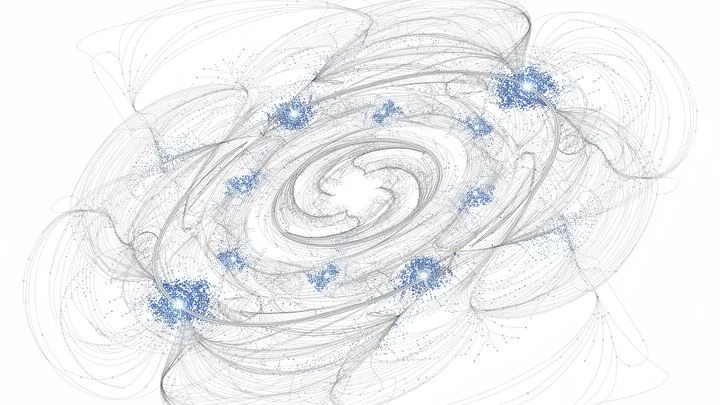
In astrophysics, a clump refers to a dense, localized region of gas or dust within a larger, more diffuse medium such as a stellar wind, molecular cloud, or interstellar medium. These clumps are often the sites of star formation, as their higher density allows gravity to overcome internal pressure and trigger collapse. In the context of stellar winds, clumps can form due to instabilities in the outflow and may significantly affect how the wind interacts with a companion star or the surrounding environment.
History
The concept of clumps in interstellar gas has been studied since the mid-20th century, with early work on the structure of the interstellar medium by astronomers like Bart Bok, who identified dense globules (Bok globules) as sites of star formation.
How it works
Clumps arise when density perturbations in a gas are amplified by cooling, turbulence, or shock waves. In a stellar wind, variations in the outflow speed or temperature can create dense knots that travel outward. When such a clump encounters a companion star, it can temporarily enhance accretion, leading to variability in brightness or X-ray emission. In molecular clouds, clumps are the precursors to protostars, and their collapse is governed by the balance between self-gravity and thermal pressure.
In practice
Understanding clumps is crucial for modeling star formation rates, predicting the evolution of stellar winds in massive stars, and interpreting observations of variable accretion in binary systems.
Fun fact
Clumps in the wind of a massive star can be so dense that they temporarily block a significant fraction of the star's X-ray emission, causing flickering on timescales of hours.
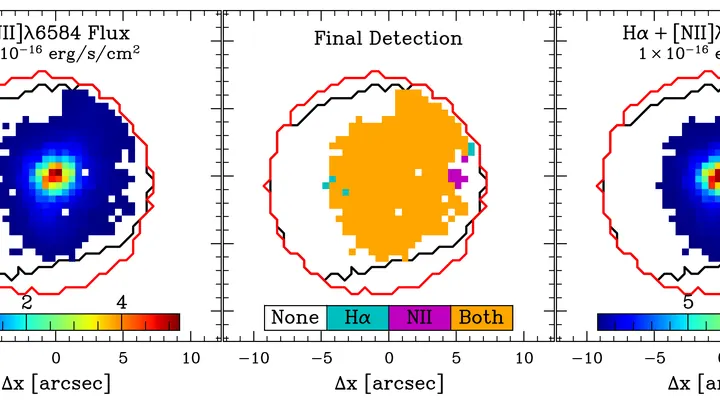
Light from a distant galaxy reaches us through its own dust. This dust is not a smooth haze but ragged clouds, like wisps of cotton. Old models treated it as a uniform mist, and then the galaxy didn't add up energetically: too much light disappeared in the ultraviolet and too little came back in the infrared.
Astronomers did what a cook does when they dice a potato instead of tossing it in whole.
The explosion of a massive star is not just a flash: it's a blow to the surrounding gas. But until now, no one had looked at how the gas itself moves at the sites of such explosions. Now astronomers have gathered data on 33 nearby supernovae and for the first time measured the turbulence of the cold molecular gas around them.
The universe sounds with silence. The lion's share of matter — about 85%—remains invisible, manifesting only through gravity. Back when Vera Rubin Vera Rubin showed that galaxies spin as if wrapped in unseen mass.
Imagine an ancient manuscript, where a new story is written over an old text. Over time, the upper layer wears thin, and lines of the past show through. That’s exactly how globular clusters, the oldest stellar systems in the Universe, are structured, like a palimpsest.
In the young Universe, about ten billion years ago, galaxies resembled endless fields after a thunderstorm: everywhere, giant — thousands of light-years across — clumps of star formation were boiling up, where young stars were born with unbridled energy. Today, these patches are an almost vanished species: in nearby galaxies, raucous hotbeds are rare.
When a giant planet grows, it pulls in gas. Some of that gas swirls around it into a small disk — called a circumplanetary disk. It is in such disks that moons are thought to form. For the planet PDS 70 c, located 370 light-years away, such a disk was directly observed using the ALMA antenna array in the millimeter range.
A fire hose blasts into a snowdrift. The water doesn't just shove the snow aside — at the point of impact, spray, steam, and a roar are born. That's roughly how jets behave: narrow streams of matter shooting out from around a black hole at enormous speeds.
In astrophysics, some numbers seem random yet recur with the persistence of a spell. One such number is the ratio of X-ray brightness to H-alpha hydrogen emission in turbulent gas tails. From galactic winds to ‘jellyfish’ slicing through clusters, this ratio steadily holds at around three.
A neutron star is the collapsed core of a massive star, squeezed to the size of a city. In its heart, matter is packed so densely that atoms cease to exist, and protons and neutrons dissolve into a sea of quarks.
Two galaxy clusters collided like two swarms of bees flying through each other. One of them is the famous "Bullet." After the collision, the hot gas, which makes up most of the ordinary matter, slowed down and stayed in the center, while the galaxies, like small dense pebbles, flew on.
In cold clouds of interstellar gas, long, dense filaments stretch out. Inside them, like overcrowded incubators, future stars are maturing. For a long time, it was thought that within such filaments, everything was governed by gravity: matter smoothly flows toward the centers, where density increases and eventually a star ignites.
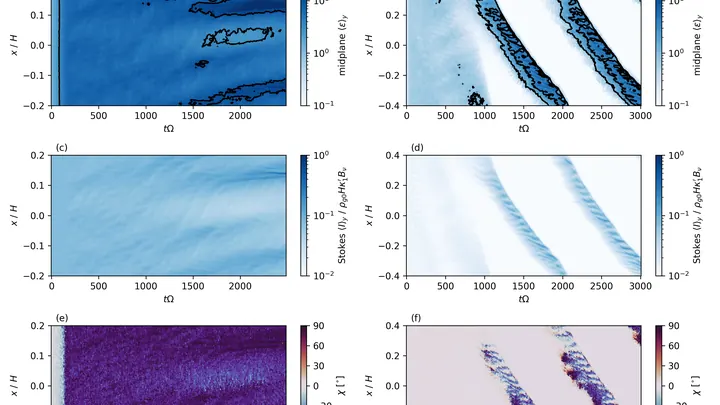
Around young stars, disks of gas and dust swirl — the building blocks for future planets. Inside these disks, dust grains don't just fly randomly: they align along invisible lines of gas flow. Recently, astronomers noticed that dust grains in such disks behave like badminton shuttlecocks — always turning their long side into the wind.
In a dark cloud where no star has yet ignited, gas begins to pull together toward a common center. This is how the most massive stars in the Galaxy are born: those tens of times heavier than the Sun. Astronomers pointed radio telescopes at the cloud SDC335.579-0.292 and saw gas molecules lining up into streams falling inward.
In the cold gas clouds where giant stars are born, everything is churning with motion. Gas compresses, swirls, and fragments into clumps — the future stars. For a long time, it was thought that the magnetic field brought order here: like invisible threads, it stretched clumps perpendicular to itself. But new observations showed the opposite.
Planets are born from dust. In a disk around a young star, tiny dust grains collide, stick together, and gradually grow like a snowball rolling down a hill. But there's a catch: the gas in the disk moves faster than the dust and drags on it, preventing it from clumping into large chunks.
For dust to stick together, there needs to be enough of it.
When a massive star runs out of fuel, its core collapses and a shock wave races outward. But even before the star tears apart, particles that barely interact with ordinary matter may be born in its depths. If they decay into light, that energy leaks into the dense gas around the star.
This gas, like a blanket, wraps the star.
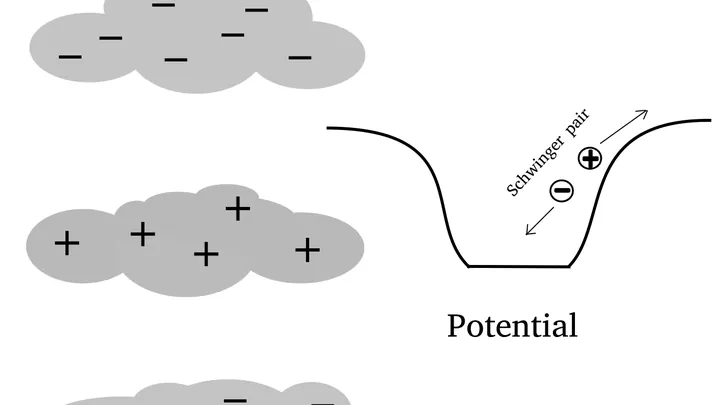
A thundercloud stores electricity like a battery before a flash. It can discharge in two ways: by lightning or by producing particles with a tiny charge: these are called millicharged particles. Such particles are nearly invisible to detectors, but their trace can be caught by how often lightning strikes.
The authors compared thunderstorms on different planets in the Solar System.
Inside cold clouds of gas and dust where new stars ignite, astronomers have spotted unexpectedly delicate structures. The ALMA telescope, working in the millimeter range, has revealed more than 323 ultra-thin dust filaments within 121 massive clumps.
A galaxy cluster is like a busy intersection where galaxy-cars race through a headwind of hot gas. This wind, called ram pressure, strips galaxies of their cold gas — the fuel for star formation. Astronomers from the SAMI survey traced how this happens in hundreds of galaxies across eight nearby clusters.
In the Antennae Galaxies, which are crashing into each other, giant gas clouds collided at a speed of 50 kilometers per second. It's like two trains hurtling toward each other — the impact compressed the gas, and it ignited with new stars.
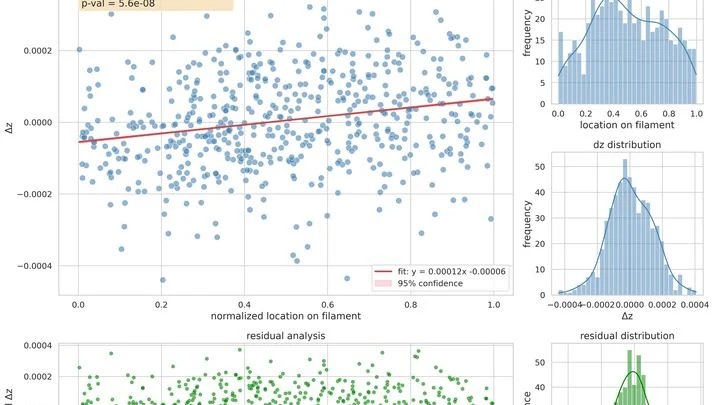
On large scales, the universe resembles a giant spiderweb: bright galaxy clusters are connected by long filaments of galaxies, gas, and dark matter. Previously, it was thought that matter flows along these filaments like water through pipes, heading toward the clusters.
The pulsar in the Crab Nebula blinks like a lighthouse: every 33 milliseconds it sends out a radio pulse, and it does so with the precision of atomic clocks. But sometimes its rotation stumbles: the star suddenly speeds up slightly, as if something inside it is shifting.
A hair dryer aimed at a block of ice strips vapor and droplets from its surface, and the ice slowly melts. The wind from the center of our Galaxy works in much the same way: it picks up cold gas clouds and carries them away, heating and shredding them along the way.
Astronomers decided to systematically search this flow for molecules, the coldest and densest form of gas, for the first time.
Dark matter is the invisible framework of the Universe. It doesn't emit light, but its gravity keeps galaxies from flying apart. A new hypothesis: dark matter consists of dark photons — ghostly particles that are invisible under ordinary conditions.
In a cloud, billions of droplets swirl around, collide, and merge: that's how rain is born. But exactly how turbulence, those invisible air swirls, helps or hinders droplet growth has been unclear. In the lab, researchers recreated a slice of a cloud and tracked every droplet.
The universe exists in a state of false vacuum, like water behind a dam. Behind it lies the true vacuum — an abyss with different laws. Normally, water can only seep through the pores in a thin trickle (a quantum effect), barely changing the level.
In the dense swarm of old stars known as the globular cluster M15, astronomers have spotted not just stars but layers of time. Some stars were born earlier, others later, and their chemical composition reveals their origin with the precision of an archaeologist reading the strata of an ancient settlement.
In the dark cloud NGC 6334I-North, 5500 light-years from Earth, the ALMA radio interferometer spotted something unexpected: around a young massive star, a disk of gas and dust is swirling, and inside it are seven dense clumps. Each one could become a star. This is what the birth of a stellar family looks like, and an unusually large one at that.
Two pendulums linked by a spring of light begin to swing in unison without ever touching. In the quantum world, such synchronization means something more: particles lose their individuality and become a single object.