Pear-Shaped Echo in Neighboring Nuclei express
The atomic nucleus isn't always round like a billiard ball. Some nuclei stretch out like a rugby ball, while others become pear-shaped — with one end thicker than the other. Such pear-shaped (octupole) deformation is a rare and important case: it can reveal the inner workings of nuclear forces and even help test why the Universe has more matter than antimatter.
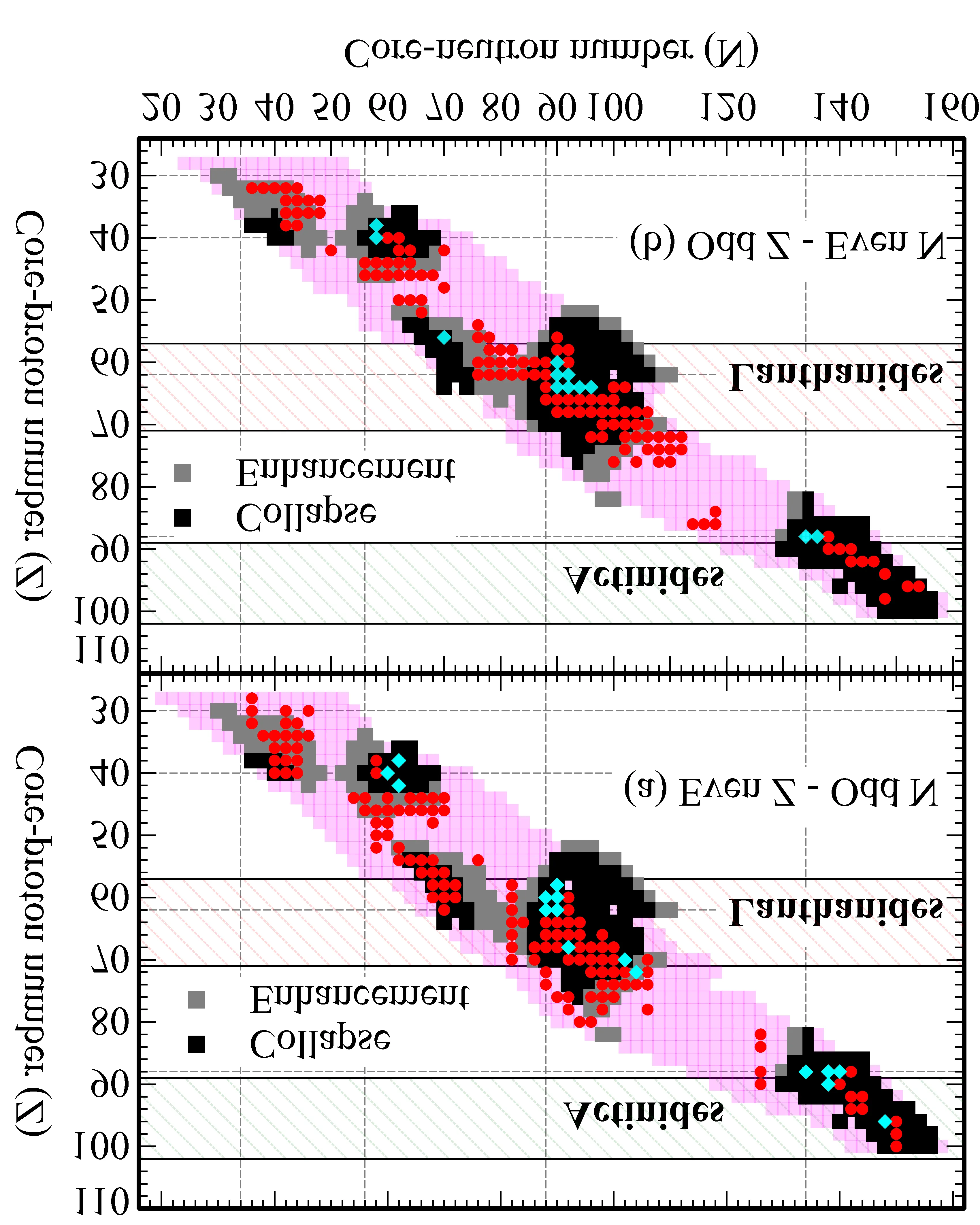
But catching a pear-shaped nucleus is tricky. Its shape shows up in spectra, the sets of energies that a nucleus emits or absorbs, but the signal often gets lost among other effects. The authors of the new study found a workaround. They noticed a pattern in the spectra of odd nuclei (with an odd number of protons or neutrons) that live next to even pear-shaped nuclei. It turns out that an odd nucleus, like a sensitive echo sounder, reflects the shape of its even neighbor: its spectrum changes in a predictable way if a pear-shaped nucleus is nearby.
This connection works like a simple empirical compass. You don't need complex calculations for every candidate, just look at the spectrum of the odd nucleus, and you can tell whether to search for pear-shaped deformation in its even partner. The authors have already predicted several such spots in the isotope table, especially in regions with excess neutrons or proton deficiency, where experiments haven't been done yet. Now physicists have a map with “dig here” markers, which will speed up the search for new pear-shaped nuclei and the testing of theories.
A pear-shaped nucleus means its center of mass and center of charge don't coincide, like a spinning top with a handle shifted to one side. This creates conditions for searching for an electric dipole moment, which could explain the mystery of the disappearance of antimatter.
In Philip K. Dick's novel “The Dark Echo,” alien technology uses the asymmetry of atomic nuclei to create space-warping engines — much like pear-shaped nuclei, which could provide a key to new physics.