The leadnucleus is the atomic nucleus of the element lead, typically referring to the isotope lead-208, which is doubly magic (it has 82 protons and 126 neutrons, both closed shells). Because of this stability, it serves as a standard target in nuclear and particle physics experiments. Its large size and high proton number make it ideal for probing the strong force and the internal structure of nucleons under extreme conditions.
History
Lead has been used in nuclear physics since the early 20th century, notably in Ernest Rutherford's experiments, but the specific use of lead-208 as a benchmark for nuclear structure studies became prominent in the latter half of the century with the development of electron scattering and heavy-ion colliders.
How it works
In experiments, a beam of particles (such as protons, pions, or other nuclei) is directed at a lead target. The interactions reveal how the nucleus deforms under stress, how gluons are distributed inside it, and how its shape affects its size. By measuring scattered particles and their energies, physicists infer properties like the nuclear deformability and the equation of state of nuclear matter.
In practice
Leadnuclei are used as targets in particle accelerators (e.g., at CERN's LHC) to study quark-gluon plasma and the strong force, and in nuclear reactors as shielding and coolant.
Fun fact
Lead-208 is the heaviest known doubly magic nucleus, making it exceptionally stable and spherical in its ground state.
In a tank holding three tons of liquid xenon, buried deep underground, something stirred one day. Not the xenon itself, but one of its atomic nuclei: it received a kick with an energy of 248 thousand electronvolts and recoiled like a billiard ball struck by an invisible cue ball.
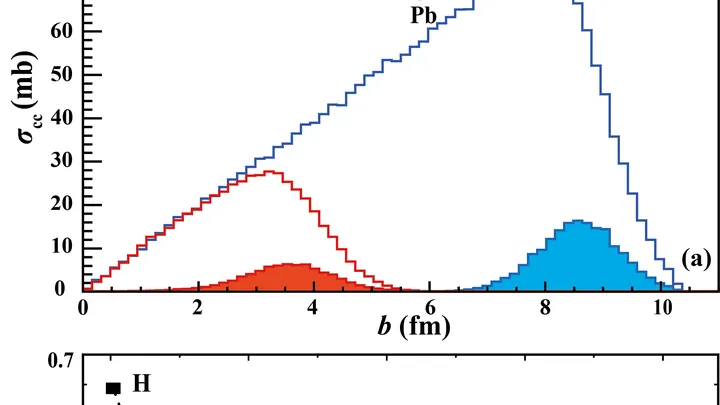
To determine the size of the proton cloud in an atomic nucleus, physicists collide an unstable nucleus with a target and observe how many protons it loses. The larger the projectile nucleus, the more often it grazes target nuclei and loses particles.
A perovskite solar cell is like a young athlete: it performs brilliantly at first, but tires with age. Over eight hours, its performance drops noticeably, with no visible cause like cracks or dust. Scientists took one cell and recorded its performance at 0, 90, 280, and 480 minutes of its life.
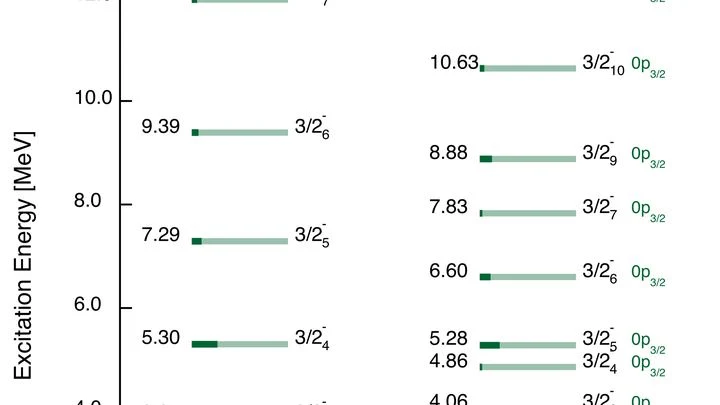
The atomic nucleus is not a bag of marbles but an ordered structure where protons and neutrons fill shells, much like electrons in an atom. When a shell is filled, the nucleus becomes especially stable, and the number of particles is called magic. For calcium with 20 protons, the classic magic neutron numbers are 20 and 28.
The atomic nucleus isn't always round like a billiard ball. Some nuclei stretch out like a rugby ball, while others become pear-shaped — with one end thicker than the other.
Ultra-sensitive scales try to detect the difference between two nearly identical grains of sand. One is a perfect mirror reflection of the other. In the world of elementary particles, such mirror reflection is called P-parity, and its violation is one of the great mysteries of physics.
Catching a single molecule in a beam of light and nearly stopping its motion is like trying to hold a dandelion fluff in a gust of wind. A particle that's too hot slips out of the trap, so physicists first tame its thermal jitters with laser cooling.
The authors applied a technique called Sisyphus cooling to strontium hydroxide (SrOH) molecules.
At the center of every atom lies a nucleus — a dense ball of protons and neutrons. These particles don't just crowd together randomly; they fill strict energy levels, much like floors in a skyscraper. When a floor is completely filled, the nucleus becomes especially stable — physicists call this a magic number.
Deep inside a neutron star, matter is squeezed so tightly that familiar protons and neutrons give way to new players. Hyperons are born there — particles that harbor a strange quark.
An atomic nucleus is not just a ball of protons and neutrons. It has a shape, and that shape can change. The tin-116 nucleus was long considered almost perfectly spherical: it has 50 protons — a 'magic' number that usually gives a nucleus spherical symmetry. But a new ultra-precise measurement showed otherwise.
The atomic nucleus is not just a jumble of protons and neutrons. The particles inside arrange themselves in layers, like spectators in a stadium: the lower rows are filled, and each new proton or neutron looks for a spot on a higher tier. When a row is completely filled, the nucleus becomes especially stable — physicists call this a magic number.
Two pendulums on a shared string trade motion: push one, and the second starts swinging, and a moment later the first gets a push back. In a thorium-229 atom, energy flows nearly loss-free between the electron shell and the nucleus.
In nuclear physics, the belief long reigned that two neutrons cannot form a bound state — they attract too weakly and immediately fly apart. However, on the surface of neutron-rich nuclei, where the matter density drops to a thousandth of normal nuclear density, the situation changes dramatically.
Atomic nuclei are rarely perfect spheres. More often, they resemble a slightly squashed ball — the electric charge inside is unevenly distributed, and protons may shift a bit, creating a tiny 'pear-shaped' bulge.
The world's most accurate pendulum isn't a steel rod: it's a tiny atomic nucleus. The isotope thorium-229 has a special excited state: to nudge the nucleus into it, you need surprisingly little energy — about what an ultraviolet laser delivers.
A pendulum that almost nothing can knock off balance (not shaking, not heat, not magnetic fields) because it is hidden in the very heart of the atom. That is the kind of pendulum physicists used when they first switched on a nuclear clock. Previously, the best clocks, optical ones, relied on electron transitions.
The James Webb Space Telescope peered into the era when the expansion of the Universe stretched the light of distant objects into the red, and found a scattering of strange sources — 'little red dots'. Their spectra broke the usual patterns: they are blue in the ultraviolet, but deep red in the optical, as if seen through a cherry veil.
The most precise modern clocks count time by the oscillations of electrons in atoms. But their rhythm can be thrown off, like a mechanical watch's spring gets jolted by shaking. Physicists found a more reliable pendulum: the atomic nucleus.
A pot of boiling soup bubbles away, and you'd love to know how hot individual droplets are inside. But you can only dip your thermometer at the edge, where things are calmer. Laser fusion is a bit like that: a powerful laser pulse hits a target, creating a cloud of fast protons.
A pinch of salt falls into water, and sodium and chlorine ions scatter, surrounded by water molecules. Now, instead of an ion, a positron (an antiparticle, the electron's twin but with a plus instead of a minus) joins the molecular crowd.
The atomic nucleus is not a solid ball but a dense swarm of tiny particles called quarks, glued together by a special glue (the strong force). In light nuclei, such as calcium, this swarm is simply arranged: the numbers of the two quark types, up and down, are almost equal, like the white and black keys in an octave.
Imagine a multi-story building where protons and neutrons live on each floor. The floors are energy levels, and usually there's a stairwell of a certain height between the sixth floor and the one above — the so-called gap. In the oxygen-20 nucleus, this gap acts as a barrier that particles find hard to cross.
A laser beam as faint as a whisper of light has stirred a thorium-229 nucleus into a higher energy state. Most nuclei demand a blast of energy, but thorium-229 has such a tiny energy gap that even this gentle nudge works.
Nitrogen, the very gas we breathe, behaves like a finicky metal under a million atmospheres of pressure. In a diamond anvil cell, it is squeezed to 78–98 gigapascals and heated with a laser to 1800–2500 kelvin. Under these conditions, N₂ molecules rearrange into crystals that can store energy more densely than explosives.
To uncover the proton's true size, physicists swapped the electron in a hydrogen atom for its heavy copy — the muon. Acting like a magnifying glass with thousandfold power, the muon gets right up against the nucleus and 'probes' the proton with unprecedented precision.
Neutrinos are tiny particles that pass through the planet's bulk like light through a windowpane. Every second, billions of them fly through your pinky fingernail, but catching even one is no easy feat. To do it, scientists dug a two-kilometer-deep mine in Canada and installed the SNO+ detector.
When two neutron stars collide, a kilonova is born — a cosmic explosion that shines not only from heat but also from the decay of freshly created heavy elements. Among them is neodymium, a rare-earth metal that hides in minerals deep within the Earth, but in space, for a brief time, becomes the main conductor of light.
A tiny ghostly particle zips through a piece of germanium. Usually it leaves no trace, but sometimes, like a billiard ball, it smacks into an atom's nucleus. The nucleus recoils, and that jolt can be detected. At Oak Ridge National Laboratory, the Ge-Mini detector caught such recoils for two years.
Neutrinos are the most elusive of known particles.
A tiny glass sphere floats in a laser beam like a speck of dust in sunlight. Inside it is radioactive lead, which decays from time to time. Each decay ejects charged particles, and the sphere loses or gains a tiny electric charge.
When two lead nuclei collide at tremendous speed, a cloud of scorching matter is born for an instant — denser and hotter than the center of the Sun. Through this cloud fly jets of particles: narrow, laser-like beams knocked out by the impact. The CMS detector captures their tracks and shows how the jets change as they fight through the hot 'fog'.
A laser strikes a strontium atom, and two electrons fly out at once. Previously, it was thought that in such double ionization each electron acts on its own: one is knocked out first, the second later, randomly.
An atomic nucleus isn't always round. It can stretch out like a melon or flatten like a pumpkin. And its size depends on this shape — just as the size of a pie depends on the shape of the dough.
Scientists calculated the shapes and sizes of nuclei of berkelium isotopes — a heavy element produced in reactors.
A handful of modeling clay with one ball stuck far off to the side becomes loose and stretched out. That's roughly how the beryllium-11 nucleus is built: a single neutron dangles at the periphery, forming a "halo" around the dense core.
Physicists used a new method to bypass mathematical hurdles and precisely calculate the shape of this nucleus.
Inside an atom's nucleus, protons and neutrons stack in layers, like spectators in a packed hall. When a layer is full, the nucleus becomes especially stable — physicists call these 'full rows' magic numbers. One of them, 32, has long been elusive: in nuclei with 32 neutrons, its effect is weak, and in some neighbors it seems absent altogether.
When matter accumulates on the surface of a neutron star, the ultra-dense remnant of a dead star, an explosion occurs, akin to a giant thermonuclear bomb. In this inferno, nuclei of elements not found on Earth are born within seconds. To understand which ones, their masses must be known with great precision.
A bullet that doesn't just pierce one target but leaves marks in several layers of armor. That's roughly how superheavy dark matter behaves, and it's what the DarkSide-50 detector was built to catch for the first time. The usual suspects for dark matter (weakly interacting massive particles, or WIMPs) pass through matter almost unnoticed, occasionally bumping into a nucleus.
Conventional atomic clocks are essentially optical counters: they rely on spectroscopy — a method for measuring the frequency of radiation with high precision as electrons jump between energy levels.
Deep inside stars, light nuclei fuse, giving birth to helium and streams of neutrons. On Earth, we recreate this process by combining deuterium and tritium — special isotopes of hydrogen.
A thin film of thorium dioxide, just 10 nanometers thick, is deposited on a steel disk. A laser pulse strikes it, but instead of the expected glow, the detector catches a stream of electrons.
At Jefferson Lab, electrons are accelerated to 12 GeV and smash into protons to pry out their secrets. But existing detectors are like cameras with a narrow field of view: you either see a lot but dimly, or brightly but only a tiny patch. Electron scattering is the main tool, but statistics are insufficient for subtle effects.