Proton spectroscopy is a technique that probes the internal structure and dynamics of atomic nuclei by measuring the energy levels of protons with extraordinary precision. It uses methods borrowed from atomic clocks and laser spectroscopy to observe how nuclei respond to electromagnetic fields, revealing details about nuclear shape, size, and the forces that bind protons and neutrons. This approach has become a powerful tool for testing fundamental physics, such as the symmetry of nature under time reversal, and for developing next-generation nuclear clocks.
History
The field grew out of nuclear magnetic resonance and Mössbauer spectroscopy in the mid-20th century, but the modern era of ultra-precise proton spectroscopy began with the development of laser cooling and ion trapping in the 1980s and 1990s.
How it works
The technique typically involves trapping ions or atoms and using precisely tuned lasers to excite transitions between nuclear energy states. By measuring the frequency of light absorbed or emitted with extreme accuracy, researchers can map the energy level structure of the nucleus. In some cases, the nucleus is probed indirectly: for example, by knocking out electrons and detecting the resulting particles, or by embedding a nucleus in a crystal and observing its response to external stimuli.
In practice
Proton spectroscopy is used to develop ultra-stable nuclear clocks, which could one day outperform atomic clocks, and to search for new physics beyond the Standard Model by measuring nuclear electric dipole moments.
Fun fact
The thorium-229 nucleus has an excited state so close to the ground state that it can be triggered by ultraviolet light, making it the only known nucleus suitable for a nuclear clock.
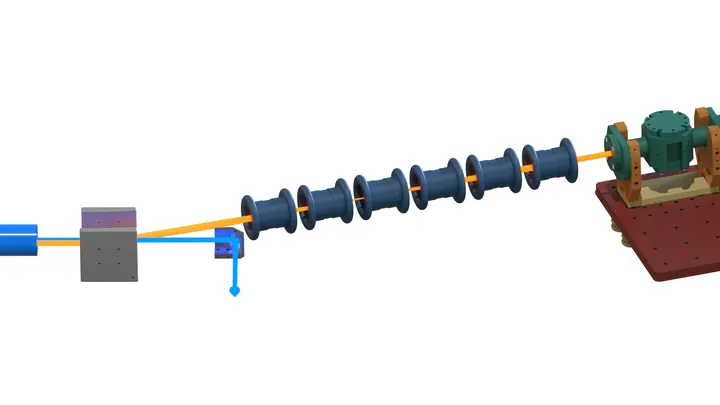
An aluminum sphere the size of a large globe sits in a neutron beam and answers each hit with a precise note. Inside the sphere there is nothing but nitrogen and eleven tiny steel balls, each the size of a pinhead. When a neutron enters the sphere, it knocks a particle out of a nitrogen atom, and that jolt turns into an electrical signal.
A neutron confined in a nucleus behaves differently from a free one. Its gluon cloud, which holds quarks together, compresses like a spring under load. Previously, this could only be assumed, but now physicists have directly observed the effect for the first time.
At Jefferson Lab, an electron beam struck liquid deuterium, knocking photons out of the nuclei.
The atomic nucleus is not a bag of marbles but an ordered structure where protons and neutrons fill shells, much like electrons in an atom. When a shell is filled, the nucleus becomes especially stable, and the number of particles is called magic. For calcium with 20 protons, the classic magic neutron numbers are 20 and 28.
The atomic nucleus isn't always round like a billiard ball. Some nuclei stretch out like a rugby ball, while others become pear-shaped — with one end thicker than the other.
Ultra-sensitive scales try to detect the difference between two nearly identical grains of sand. One is a perfect mirror reflection of the other. In the world of elementary particles, such mirror reflection is called P-parity, and its violation is one of the great mysteries of physics.
A pendulum that almost nothing can knock off balance (not shaking, not heat, not magnetic fields) because it is hidden in the very heart of the atom. That is the kind of pendulum physicists used when they first switched on a nuclear clock. Previously, the best clocks, optical ones, relied on electron transitions.
Ever since Paul Dirac theoretically predicted antimatter, physicists have been hunting for the tiniest differences between particles and their antiparticles.
Hydrogen is the simplest atom: one proton and one electron. You'd think there's nothing left to study. But it's precisely on hydrogen that physicists test the most delicate laws of the microcosm. The electron in an atom can occupy different energy levels, like steps on a ladder.
Tiny magnets inside atoms, nuclear spins, can 'freeze' for long minutes in a cold crystal. This hinders the quick tuning of quantum sensors: everything takes too long to reach the desired state. Physicists have found a way to nudge them with light.
A clock isn't just hands. Every atomic nucleus is a natural metronome: it oscillates with nearly perfect regularity. If you lift one such metronome a couple of meters, its rhythm speeds up ever so slightly — that's time warping, as predicted by Einstein.
When particles collide at enormous speeds, they produce a shower of new particles. Among them are antiprotons — twins of ordinary protons but with the opposite charge. Each of these particles has its own spin, like a tennis ball sent with a twist. But whether antiprotons are actually spun up at birth has never been checked.
From 2016 to 2018, at the Large Hadron Collider at CERN, protons collided at energies of 13 teraelectronvolts, as if two peas were accelerated to speeds where their impact spawns a whole swarm of new particles.
Inside the Sun, invisible nuclear transformations occur every second. One of them is the birth of boron-8: a beryllium-7 nucleus captures a passing proton and momentarily becomes a new element. This step kicks off a chain that ends with the emission of a neutrino — a particle capable of passing straight through Earth.
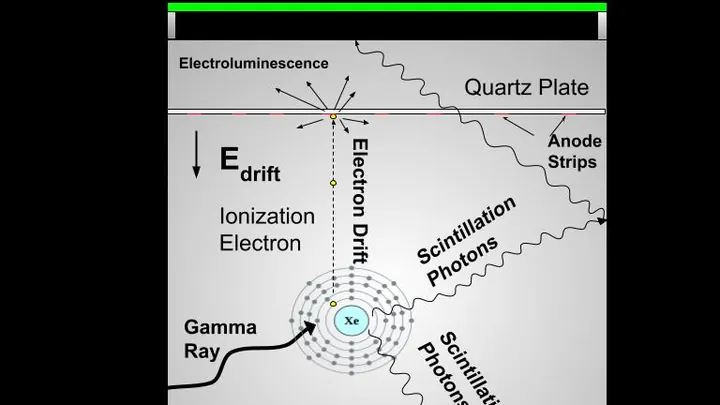
The camera that hunts for tumors works like a highly sensitive camera: it catches the faint glow from a substance that accumulates in diseased cells. In conventional machines, the light is born in a crystal — a solid piece that resembles glass. But a crystal doesn't always convey exactly where the light flashed, so the image comes out slightly blurry.
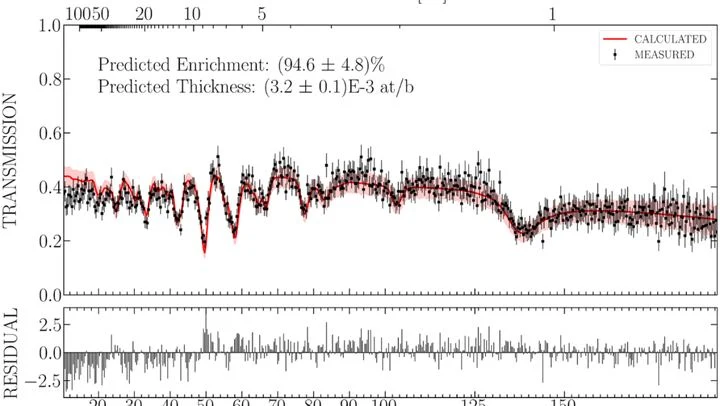
A customs officer can't take a suitcase apart to see what's inside. They shine X-rays through it and, from the shadows on the screen, tell: here's metal, here's organic matter. In much the same way, an inspector for future nuclear disarmament treaties should be able to check a warhead — without opening it or seeing its secret internals.
Neutrons are better suited for this than X-rays.
A single antiproton, trapped and cooled to near absolute zero, behaves like a tuning fork that needs a very precise strike to produce a clean note. Catching that 'note' directly is nearly impossible — the signal is too weak.
Standard chemotherapy hits the whole body like carpet bombing: both cancerous and healthy cells suffer. Scientists are hunting for more precise weapons — molecules that light up when they slip into a cancer cell's DNA, revealing its location. Such glowing probes could help doctors spot tumors early and even destroy them with pinpoint accuracy, leaving neighboring tissue untouched.
The helium atom is like a tiny solar system: electrons orbit the nucleus, but their orbits are governed by strict rules. Scientists have learned to observe these motions with incredible precision.
A cell hit by a proton beam is like a city after a pinpoint bombing: some blocks are leveled, others just have broken windows. Whether the city survives depends on which buildings are hit and how the strikes are distributed.
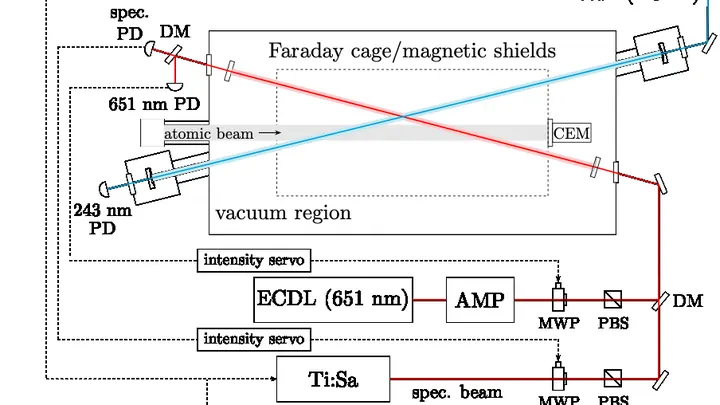
A laser beam passes through a glass cell containing rubidium vapor, and by how the atoms absorb light, you can determine their temperature. This is like measuring the speed of cars by the blur in a photograph: the faster the atoms move, the wider the absorption line becomes.
A muon is like an electron, but about 200 times heavier. When it stops in a piece of silicon, it gets pulled into the atomic nucleus like a nail to a magnet. The nucleus gains extra energy and starts to "boil": various particles fly out — protons, deuterons, tritons, and alpha particles.
Conventional atomic clocks are essentially optical counters: they rely on spectroscopy — a method for measuring the frequency of radiation with high precision as electrons jump between energy levels.
A thin film of thorium dioxide, just 10 nanometers thick, is deposited on a steel disk. A laser pulse strikes it, but instead of the expected glow, the detector catches a stream of electrons.
High above Earth, a satellite flies, and inside it is an instrument the size of a small wardrobe. It catches particles that have been racing through the galaxy for billions of years and finally slam into the detector. Such particles are called cosmic rays, and they bring news of distant stellar explosions.
The ATIC balloon rose over Antarctica and caught particles older than Earth itself. Among them are atomic nuclei from sulfur to chromium, and the higher their energy, the larger their fraction compared to iron. The standard 'leaky box' model predicted the opposite: heavy nuclei should dissolve like salt in water. But the data stubbornly rose.