The charge radius of an atomic nucleus quantifies how far the positiveelectric charge of its protons extends from the center. Unlike the matter radius, which reflects the distribution of both protons and neutrons, the charge radius specifically probes the proton distribution, offering a direct window into the electromagnetic structure of nuclear matter. It is a fundamental observable that tests models of nuclear forces and the behavior of strongly interacting particles.
History
The concept emerged in the early 20th century with Rutherford's nuclear model, but precise measurements began in the 1950s with electron scattering experiments at Stanford. Modern laser techniques have refined it to extraordinary precision, as seen in recent proton radius determinations.
How it works
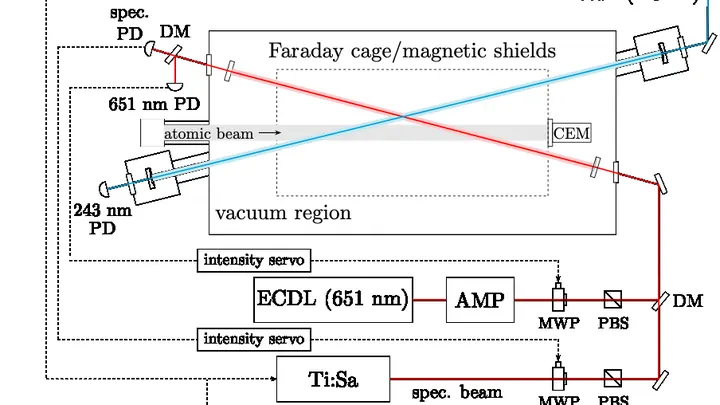
The charge radius is typically measured by scattering charged particles, such as electrons, off the nucleus. The way the scattered particles deviate from what a point-like charge would produce reveals the spatial spread of the charge. Alternatively, precise laser spectroscopy of atomicenergy levels can sense the tiny shifts caused by the nucleus's finite size, yielding the radius with exceptional accuracy.
In practice
Charge radii are crucial for understanding nuclear structure, testing quantum electrodynamics, and interpreting experiments in astrophysics and particle physics, such as those involving cosmic rays.
Fun fact
The proton's charge radius has been a subject of controversy, with different measurement methods yielding slightly different values, a puzzle known as the 'proton radius puzzle.'
Units by system: SI: m · CGS: cm · Planck: l p · natural: 1gev
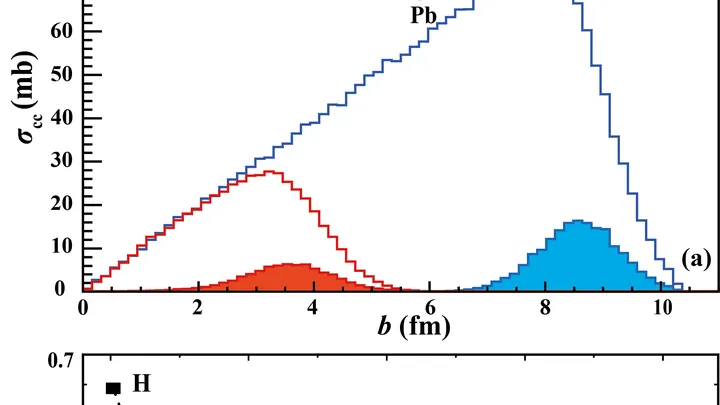
To determine the size of the proton cloud in an atomic nucleus, physicists collide an unstable nucleus with a target and observe how many protons it loses. The larger the projectile nucleus, the more often it grazes target nuclei and loses particles.
The atomic nucleus is not a bag of marbles but an ordered structure where protons and neutrons fill shells, much like electrons in an atom. When a shell is filled, the nucleus becomes especially stable, and the number of particles is called magic. For calcium with 20 protons, the classic magic neutron numbers are 20 and 28.
The atomic nucleus isn't always round like a billiard ball. Some nuclei stretch out like a rugby ball, while others become pear-shaped — with one end thicker than the other.
The atomic nucleus is usually pictured as a dense ball where protons and neutrons are mixed together. But in some isotopes, neutrons can stick out far beyond this ball, forming a diffuse shell — a neutron halo. This is especially common in nuclei with many more neutrons than protons.
Inside the atomic nucleus, protons and neutrons are packed so tightly that the forces between them resemble tightly coiled springs. Some springs compress and expand equally in all directions: these are the familiar central forces.
A pot of boiling soup bubbles away, and you'd love to know how hot individual droplets are inside. But you can only dip your thermometer at the edge, where things are calmer. Laser fusion is a bit like that: a powerful laser pulse hits a target, creating a cloud of fast protons.
Hydrogen is the simplest atom: one proton and one electron. You'd think there's nothing left to study. But it's precisely on hydrogen that physicists test the most delicate laws of the microcosm. The electron in an atom can occupy different energy levels, like steps on a ladder.
Two tin nuclei collide at about two-thirds the speed of light. For an instant, a hot, dense cloud forms, and protons fly out in all directions. If you catch pairs of protons and measure how often they fly off in the same direction, you can work out the size of that cloud. This method is called femtoscopy: it works like a microscope for nuclear scales.
To uncover the proton's true size, physicists swapped the electron in a hydrogen atom for its heavy copy — the muon. Acting like a magnifying glass with thousandfold power, the muon gets right up against the nucleus and 'probes' the proton with unprecedented precision.
When heavy nuclei collide in accelerators, a multitude of particles is produced, and physicists want to understand how electric charge moves through this chaos. Two trains crash into each other: the passengers (quarks) scatter, but their luggage (charge) may end up far from the crash site.
The atomic nucleus is not just a ball of protons and neutrons. Inside it, like a tiny magnet, there is its own distribution of magnetization. Until now, it has been difficult to see: nuclei live for tiny fractions of a second, and their magnetic field is weak. Now physicists at CERN have found a way to look inside.
An atomic nucleus isn't always round. It can stretch out like a melon or flatten like a pumpkin. And its size depends on this shape — just as the size of a pie depends on the shape of the dough.
Scientists calculated the shapes and sizes of nuclei of berkelium isotopes — a heavy element produced in reactors.
The proton is not a solid ball. Its charge, mass, and other properties are distributed differently in space, and each property has its own radius. Physicists have long been able to measure where the proton's charge is concentrated and where its mass lies.
The Large Hadron Collider doesn't just smash protons: it also collides entire atomic nuclei. When two nuclei smash together at tremendous speed, they create a tiny blob of matter so hot that protons and neutrons melt into a 'soup' of quarks and gluons.
In the dark cloud L43, where stars are born, dust grains twirl like tiny compasses. Light from a young star pushes them, while the magnetic field lines them up in a specific direction. When a grain is turned sideways to us, its heat reaches us polarized, like light passing through a narrow slit.
The helium atom is like a tiny solar system: electrons orbit the nucleus, but their orbits are governed by strict rules. Scientists have learned to observe these motions with incredible precision.
A muon is like an electron, but about 200 times heavier. When it stops in a piece of silicon, it gets pulled into the atomic nucleus like a nail to a magnet. The nucleus gains extra energy and starts to "boil": various particles fly out — protons, deuterons, tritons, and alpha particles.
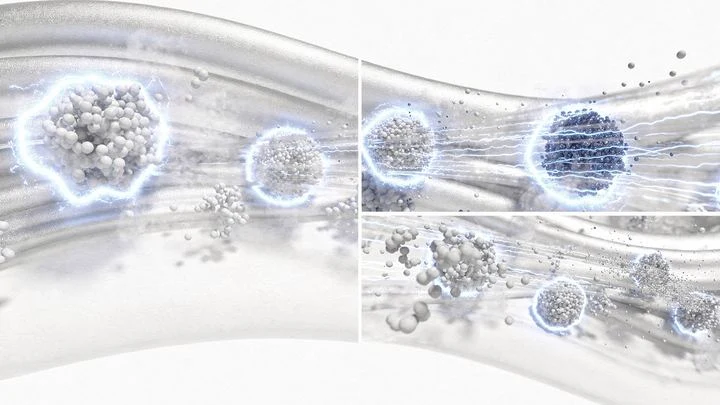
Cosmic rays are atomic nuclei accelerated to near-light speeds. They arrive at Earth from all directions, and their composition tells us what's happening in the far reaches of the Galaxy.
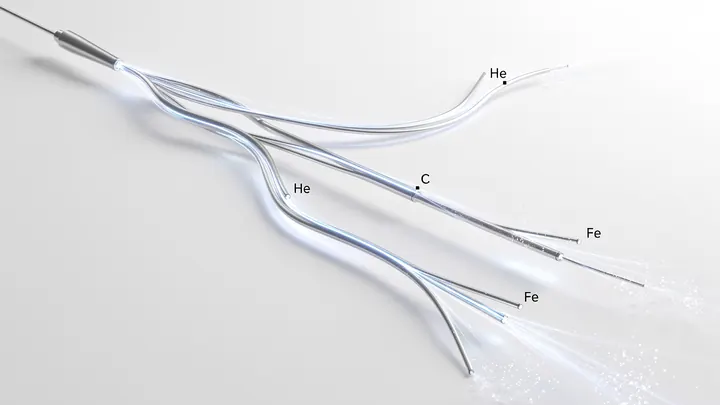
Like long-distance runners, atomic nuclei, from light helium to heavy iron, race toward us across the Galaxy. At the finish line, in a detector on a high-altitude balloon, we see that heavy nuclei arrive a bit more exhausted than light ones. The difference is small, but it repeats from flight to flight.