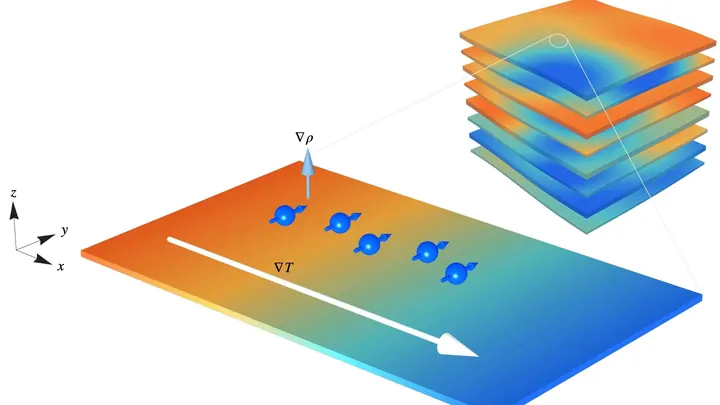
The neutron skin is a thin layer of excess neutrons that forms at the surface of a neutron-rich atomic nucleus. In stable nuclei, protons and neutrons are roughly balanced, but in heavy nuclei like lead-208, there are more neutrons than protons. These extra neutrons are pushed outward by the strong nuclear force and the Pauli exclusion principle, creating a 'skin' of neutron-rich matter around the core. The thickness of this skin is a key observable for understanding nuclear structure and the properties of neutron stars.
History
The concept of the neutron skin was first proposed in the 1950s by physicists studying nuclear structure, but precise measurements became possible only in the 21st century with advanced facilities like the Thomas Jefferson National Accelerator Facility (JLab).
How it works
The neutron skin arises from the competition between the strong nuclear force (which binds nucleons together) and the Coulomb repulsion between protons. In neutron-rich nuclei, the protons are pushed apart by electromagnetic repulsion, while the neutrons, being neutral, are not affected by this force. As a result, the neutron distribution extends slightly beyond the proton distribution, forming a skin. The thickness of this skin is measured via parity-violating electron scattering or through collisions with other nuclei, and it provides constraints on the equation of state of nuclear matter.
In practice
Measuring the neutron skin thickness helps calibrate models of neutron stars, which are essentially giant nuclei with neutron skins, and improves predictions for nuclear reactions used in energy production and astrophysics.
Fun fact
The neutron skin of lead-208 is only about 0.3 femtometers thick — that's 0.0000000000000003 meters, roughly a trillion times thinner than a human hair.
A neutron confined in a nucleus behaves differently from a free one. Its gluon cloud, which holds quarks together, compresses like a spring under load. Previously, this could only be assumed, but now physicists have directly observed the effect for the first time.
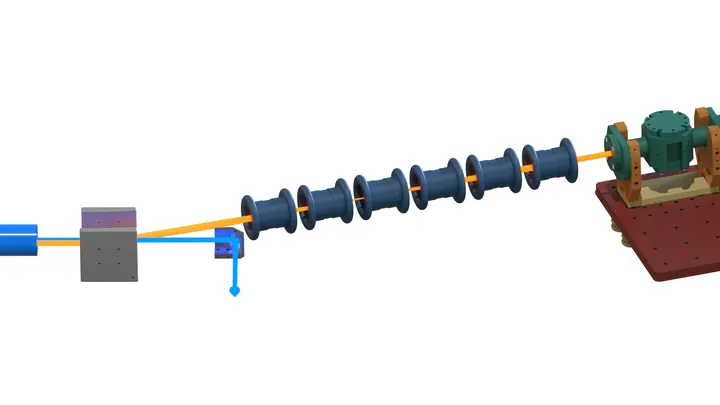
At Jefferson Lab, an electron beam struck liquid deuterium, knocking photons out of the nuclei.
After a nuclear explosion, soot rises into the sky. It settles high above the clouds, in the stratosphere, and stays there for years. This soot acts like a thick curtain: it blocks some sunlight and alters the chemistry of the sky.
Two nuclei with the same number of particles but different neutron skin shapes collide at speeds close to the speed of light. Ruthenium-96 and zirconium-96 are like twins, one with a slightly thicker coat. This difference changes how particles carry charge in the fireball of the collision.
The atomic nucleus is not a bag of marbles but an ordered structure where protons and neutrons fill shells, much like electrons in an atom. When a shell is filled, the nucleus becomes especially stable, and the number of particles is called magic. For calcium with 20 protons, the classic magic neutron numbers are 20 and 28.
The atomic nucleus isn't always round like a billiard ball. Some nuclei stretch out like a rugby ball, while others become pear-shaped — with one end thicker than the other.
The atomic nucleus is usually pictured as a dense ball where protons and neutrons are mixed together. But in some isotopes, neutrons can stick out far beyond this ball, forming a diffuse shell — a neutron halo. This is especially common in nuclei with many more neutrons than protons.
At the center of every atom lies a nucleus — a dense ball of protons and neutrons. These particles don't just crowd together randomly; they fill strict energy levels, much like floors in a skyscraper. When a floor is completely filled, the nucleus becomes especially stable — physicists call this a magic number.
The atomic nucleus is not just a jumble of protons and neutrons. The particles inside arrange themselves in layers, like spectators in a stadium: the lower rows are filled, and each new proton or neutron looks for a spot on a higher tier. When a row is completely filled, the nucleus becomes especially stable — physicists call this a magic number.
An electron flying through a heavy nucleus behaves like a tennis ball sent through a picket fence. If the pickets are unevenly spaced (denser here, sparser there) the ball will deflect differently.
Atomic nuclei are not always like billiard balls. Some are elongated, like cigars, others are flattened. But xenon-129 resembles a potato — a bumpy triaxial ellipsoid.
Inside a neutron star, matter is compressed so intensely that atomic nuclei fuse into long strands and flat sheets. Astrophysicists call these structures nuclear pasta. At their surface, the density of matter plummets to nearly zero, like diving out of thick jelly into thin air.
It's this sharp transition that creates the unusual effect.
At first glance, the atomic nucleus is a cramped communal apartment where protons and neutrons (together called nucleons) live by strict rules. Each occupies its own orbit, like electrons in an atom, and on average everything looks orderly.
An atomic nucleus is like a droplet with a thin coating — a neutron 'skin.' Inside the droplet, protons and neutrons are mixed evenly, but on the outside, like the froth on milk, a layer forms where neutrons are noticeably more abundant.
When a neutron or proton enters an atomic nucleus, it behaves like a ball hitting a rough wall: it can bounce off in different ways, depending on where it hits.
When two lead nuclei collide at tremendous speed, they flatten and shatter into thousands of particles. The shape of this debris depends on how the nuclei were structured before the impact. Inside the nucleus, protons and neutrons are not distributed identically: neutrons stick out slightly beyond the edge: this is called the neutron skin.
Titan, discovered by Christiaan Huygens in 1655, resembles a canvas that is constantly being repainted. Impacts from cosmic dust and asteroids leave crater marks on it. But an invisible artist, the moon's own forces, time and again covers everything with a fresh layer, erasing old strokes.
The ATIC balloon rose over Antarctica and caught particles older than Earth itself. Among them are atomic nuclei from sulfur to chromium, and the higher their energy, the larger their fraction compared to iron. The standard 'leaky box' model predicted the opposite: heavy nuclei should dissolve like salt in water. But the data stubbornly rose.