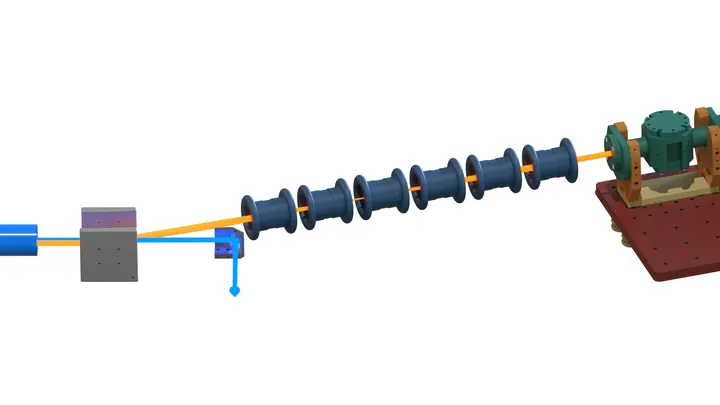
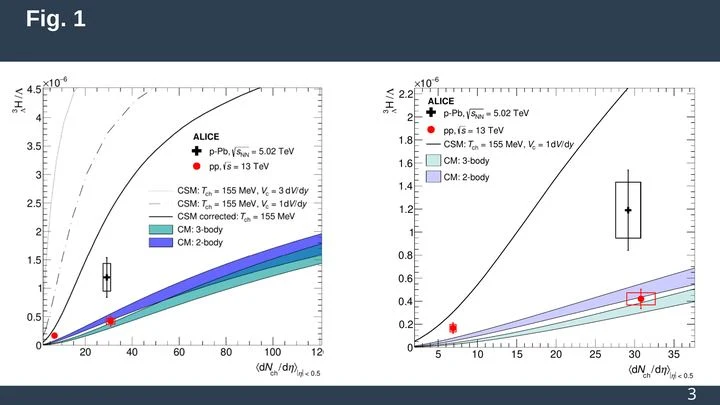
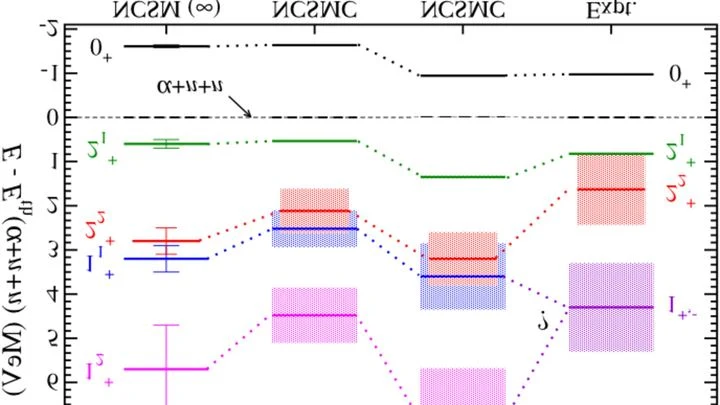
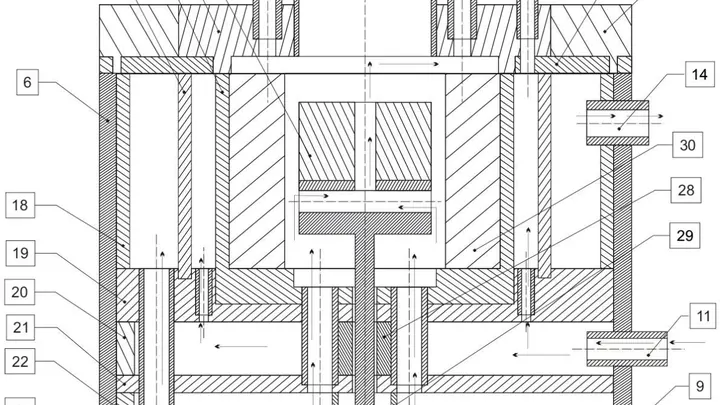
Halo nuclei are exotic atomic nuclei in which one or more neutrons orbit far from a compact core of protons and other neutrons, forming a diffuse, cloud-like 'halo'. This structure dramatically alters the nucleus's size, binding energy, and reaction behavior compared to ordinary nuclei. The most famous example is lithium-11, which has a core of three protons and six neutrons surrounded by two loosely bound neutrons extending over a radius comparable to that of a much heavier lead nucleus.
History
The concept emerged in the 1980s, notably through experiments by Isao Tanihata and colleagues at Lawrence Berkeley Laboratory, who measured unexpectedly large interaction cross-sections for lithium-11 in 1985.
How it works
In a halo nucleus, the valence neutrons are just barely bound to the core, with binding energies of only a few hundred keV (versus several MeV for typical nucleons). Quantum mechanics allows these weakly bound neutrons to tunnel far beyond the nuclear potential well, creating a probability distribution that extends to large distances. The core remains compact, while the halo neutrons contribute most of the nuclear radius but little to the binding energy.
In practice
Halo nuclei are studied in nuclear astrophysics to understand neutron-rich environments like neutron starcrusts, and they serve as testbeds for nuclear models used in predicting the properties of exotic isotopes.
Fun fact
The halo neutrons in lithium-11 can extend so far that the nucleus is roughly the same size as a lead-208 nucleus, despite having only 11 nucleons.
In a tank holding three tons of liquid xenon, buried deep underground, something stirred one day. Not the xenon itself, but one of its atomic nuclei: it received a kick with an energy of 248 thousand electronvolts and recoiled like a billiard ball struck by an invisible cue ball.
The atomic nucleus is not a bag of marbles but an ordered structure where protons and neutrons fill shells, much like electrons in an atom. When a shell is filled, the nucleus becomes especially stable, and the number of particles is called magic. For calcium with 20 protons, the classic magic neutron numbers are 20 and 28.
The atomic nucleus isn't always round like a billiard ball. Some nuclei stretch out like a rugby ball, while others become pear-shaped — with one end thicker than the other.
The atomic nucleus is usually pictured as a dense ball where protons and neutrons are mixed together. But in some isotopes, neutrons can stick out far beyond this ball, forming a diffuse shell — a neutron halo. This is especially common in nuclei with many more neutrons than protons.
Erwin Schrödinger pondered how life maintains order despite the second law of thermodynamics. He could never have imagined that part of the answer lies hidden in the instability of giant stars.
At the center of every atom lies a nucleus — a dense ball of protons and neutrons. These particles don't just crowd together randomly; they fill strict energy levels, much like floors in a skyscraper. When a floor is completely filled, the nucleus becomes especially stable — physicists call this a magic number.
For a long time, astronomers searched for the 'factories' of the most energetic cosmic rays — particles that carry the macrocosm compressed to the size of an atomic nucleus. Colossal star-forming regions like Cygnus OB2, where winds from young giants collide, were prime suspects.
In nuclear physics, the belief long reigned that two neutrons cannot form a bound state — they attract too weakly and immediately fly apart. However, on the surface of neutron-rich nuclei, where the matter density drops to a thousandth of normal nuclear density, the situation changes dramatically.
A supernova is the final explosion of a massive star, scattering its material over light-years. Inside the expanding shell, a neutron star remains, and the shell itself continues to plow through interstellar gas for thousands of years.
To uncover the proton's true size, physicists swapped the electron in a hydrogen atom for its heavy copy — the muon. Acting like a magnifying glass with thousandfold power, the muon gets right up against the nucleus and 'probes' the proton with unprecedented precision.
When a heavy atomic nucleus splits, it doesn't break into even halves. First, two fragments form that look like pears pressed together at their narrow ends. Then the junction begins to smooth out, like two droplets merging and the surface quickly leveling.
In that brief moment, the surface moves inward, and particles inside the nucleus can bounce off it, like a ball off an oncoming wall.
If an atomic nucleus is a family, then in an ordinary helium house live two protons and two neutrons, holding hands tightly. Now imagine that one family member is an oddball who loves to wander far from home.
An ordinary atomic nucleus is like a tight ball: protons and neutrons are packed closely together. But some light nuclei, such as helium-6, are different. Two neutrons seem to step aside and form a dilute cloud around the nucleus — called a halo.
An ordinary nuclear reactor is like a boiler where fuel burns evenly throughout the volume. Here the picture is different: a fission wave, a narrow zone where atoms split and release heat, slowly creeps along a cylindrical rod of uranium carbide. Ahead of the wave, the fuel is untouched; behind, it is already spent. So fire runs along a candle wick, leaving wax behind.
An atomic nucleus isn't always round. It can stretch out like a melon or flatten like a pumpkin. And its size depends on this shape — just as the size of a pie depends on the shape of the dough.
Scientists calculated the shapes and sizes of nuclei of berkelium isotopes — a heavy element produced in reactors.
A handful of modeling clay with one ball stuck far off to the side becomes loose and stretched out. That's roughly how the beryllium-11 nucleus is built: a single neutron dangles at the periphery, forming a "halo" around the dense core.
Physicists used a new method to bypass mathematical hurdles and precisely calculate the shape of this nucleus.
A beam of circularly polarized light hits a MAPbI3 perovskite crystal. The electrons inside start behaving like tiny spinning tops, their axes aligning along the beam. This phenomenon is known as optical spin orientation.
An atomic nucleus usually has a well-defined shape — elongated like a melon or flattened like a pumpkin. But silicon-30 behaves differently: it seems unable to make up its mind.
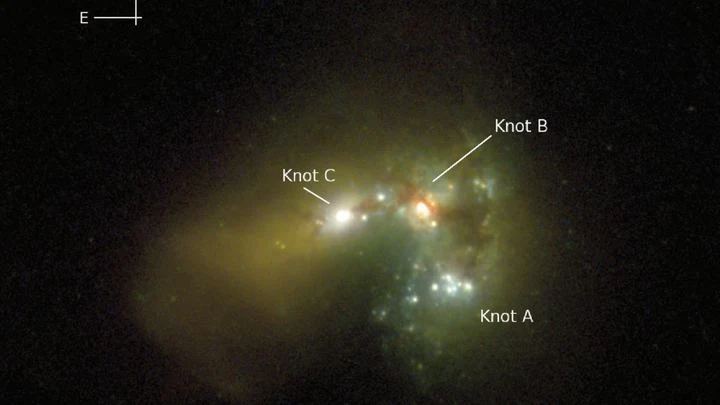
Two galaxies approach each other like a pair of dancers who drift apart and then are drawn back together. At the moment of a particularly close encounter, their gas compresses, and bright ultraviolet light bursts from within. This is exactly what happens in the Haro 11 system — the nearest pair of merging galaxies that lets such light escape.
In the dense, star-forming gas cloud W44, the ALMA telescope has spotted eight tiny clumps racing at enormous speeds. In position–velocity maps, each one looks like the letter V, just like the previously discovered 'Bullet'. This resemblance hints at a common origin.
In the stellar nursery HOPS-288, where three suns are forming, the ALMA telescope revealed two scorching regions around a pair of them. At –170°C, ice on cosmic dust melts, and reactions bubble up in the gas: organic molecules are born — methanol and methyl formate.
High above the Antarctic ice sheet, a balloon with a detector floated for twenty days. It caught tiny particles that had been traveling toward us for millions of years from distant stellar explosions. Now scientists have sorted through the catch and reported how much energy the protons and nuclei of different elements carried.