A Quiet Amplifier for a Weak Signal express
The coil in an MRI picks up radio signals from hydrogen atoms, like an antenna catching a distant radio station. But the signal is weak, and if the amplifier itself is noisy, the image comes out grainy. In low magnetic fields (which are cheaper and more compact than strong ones), such amplifiers are scarce and pricey.
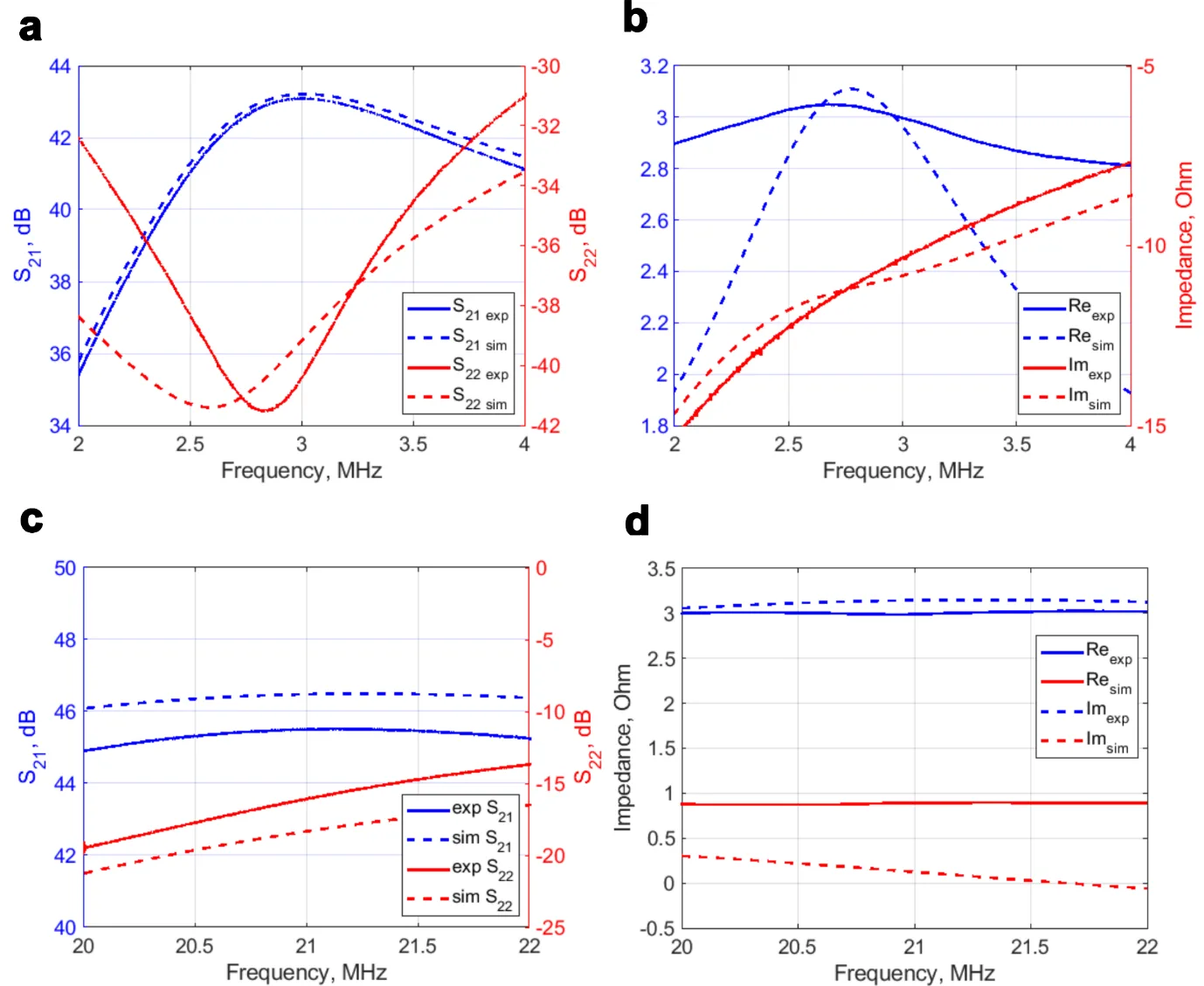
Engineers built an amplifier from ordinary bipolar transistors — the kind that cost pennies and are sold at any electronics store. The circuit is designed so that the amplifier adds almost no noise (less than 1.3 decibels) and has a low input impedance of 3 ohms. This is important: the coils in an array stop "shouting over" each other, and each one hears only its own section of the body.
The amplifier was tested at frequencies of 3 and 21.2 MHz and in a real scanner with a field of 0.5 tesla. The images came out sharp, and the signal was strong. Compared to a commercial amplifier for these frequencies, the homemade one performed better in terms of noise and was several times cheaper.
This approach paves the way for affordable MRI machines for clinics that can't afford superconducting magnets. After all, a low field is not only cheaper but also safer for patients with implants.
Original abstract
as written by the authors arXiv:2608.10225v1
Purpose: In magnetic resonance imaging (MRI), preamplifier decoupling is used to improve the signal-to-noise ratio of a multichannel receive coil array. In low-field and ultra-low-field MRI, low-noise amplifier (LNA) solutions with low input impedance (LII) are poorly represented and consist mostly of field-effect transistors. We propose a low-cost LNA based on a common-base circuit with bipolar transistors to achieve LII (<5 Ohm), a low noise figure (<1.3 dB), and high gain (>30 dB). Methods: The proposed LNA circuits were simulated, fabricated, and tested at frequencies of 3 MHz and 21.2 MHz. The decoupling capabilities of the proposed LNA were experimentally evaluated, and MR imaging was performed in a 0.5T MRI scanner alongside a comparative study with a commercial LNA. At 3 MHz, the LNA was evaluated by analyzing free induction decay signals. Results: Proposed LNA solutions demonstrate a low noise figure below 1.3 dB with an input impedance of 3 Ohm. It was also shown that the presented LNA circuit enables high SNR values in MR imaging. The developed amplifiers demonstrate superior performance compared to available commercial options within the selected HF band. Conclusion: Due to the availability and cost-effectiveness of the selected transistors, the proposed LNA circuit is highly suitable for low-field MRI applications.
At 0.5 tesla, the signal frequency from hydrogen is about 21 MHz, which is close to the shortwave radio band where amateur radio operators work.