Laserultrasound imaging is a non-invasive technique that uses laser light to both generate and detect ultrasound waves inside a material or body, replacing traditional piezoelectric transducers that require physical contact. The method relies on the photoacoustic effect: a short laser pulse is absorbed by the surface, causing rapid thermal expansion that launches an ultrasonic wave into the medium. A second laser, often a continuous-wave or pulsed beam, measures the tiny surface vibrations caused by returning echoes, effectively acting as an optical microphone.
History
The concept emerged from photoacoustic spectroscopy in the 1970s, but practical laser-ultrasound imaging systems were developed in the 1990s–2000s, particularly at the National Research Council of Canada and Lawrence Livermore National Laboratory, where researchers combined pulsed lasers with interferometric detection for industrial and medical applications.
How it works
A pulsed 'pump' laser strikes the surface, heating a thin layer and generating a broadband ultrasonic pulse that propagates inward. When this pulse reflects off internal structures (e.g., tumors, cracks, or tissue boundaries), it returns to the surface and causes minuscule displacements (nanometers or less). A second 'probe' laser beam is reflected off the same surface, and its phase or intensitymodulation is measured by an interferometer, converting the vibrations into an electrical signal. Scanning the pump and probe beams across the surface builds a 3D image of the interior, similar to conventional ultrasound but without any physical contact.
In practice
Used in non-destructive testing of aircraft components, composite materials, and welds, as well as in medical imaging for breast cancer detection and skin diagnostics where contact transducers are impractical.
Fun fact
The probe laser can detect surface vibrations as small as a picometer—about one-thousandth the diameter of a hydrogen atom.
A doctor looks at a screen and sees two images of the same part of the body. One shows where blood is rich in oxygen, the other shows how fast it rushes through the finest vessels. Previously, these images were made by different devices, and combining them was difficult. Now engineers have built a device that takes both images simultaneously.
A sponge slowly watered from a watering can gets soaked all the way through. But if you dump the same bucket of water on it all at once, the middle gets wet while the edges stay almost dry. That's roughly how a material with nonlinear absorption behaves: the more intense the flux, the more it gets stuck at the point of impact.
The coil in an MRI picks up radio signals from hydrogen atoms, like an antenna catching a distant radio station. But the signal is weak, and if the amplifier itself is noisy, the image comes out grainy.
A flashlight shines through frosted glass: the rays bend, lose brightness, and take different paths. That's roughly how high-intensity ultrasound passes through the skull to the brain. For years, calculating this path required bulky computer models that 'chew' on data for hours.
A light field, like a neat waffle iron, presses a regular pattern of bright and dark regions into space. Atoms get stuck in the brightest spots as if in tiny dimples: that's an optical lattice. It's a favorite tool for physicists who want to study quantum behavior of matter in its pure form.
A bell hidden in a thick box can be made to ring without opening the lid. Just send a sound wave through the walls, and the clapper will tremble. That's roughly how transcranial ultrasound works: sound passes through the skull bones and makes neurons deep in the brain 'ring'—generating electrical impulses.
Somewhere in the depths of the Milky Way, radio pulses flare up from time to time — rare, steady, like the ticks of a distant metronome. These long-period radio transients were discovered only recently, and they immediately puzzled astronomers.
Low-frequency radio waves (from 30 to 300 kilohertz) carry information through water and earth. But catching them with an ordinary antenna is hard: the wavelength reaches several kilometers, and a small receiver barely feels such a field.
To capture every detail of a statue's shape, you could break it into millions of tiny cubes and describe each one — slow, heavy, and your computer's memory would groan at the seams. That's how 3D medical scans are usually handled: a CT or MRI is a huge array of such cubes (voxels), and to create or improve an image, the machine has to plow through all of them.
Gravitational waves from merging black holes sound like bass chords, pulsars tap out a rhythm, and the cosmic microwave background carries echoes of the Big Bang. But there is a silent player — dark matter, whose presence is betrayed only by gravitational effects.
In absolute silence, you need to hear a feather drop. But someone keeps rustling a plastic bag. For the space-based LISA observatory, that 'rustling' will come from charged particles in space.
A laser isn't just about light. If you make a particle oscillate like a pendulum and those oscillations sustain themselves, you get a phonon laser. Sounds complicated, but the idea is simple: instead of light waves, the device emits orderly waves of mechanical vibrations — phonons.
The universe is permeated by invisible mass, dark matter, whose existence was first proposed by Fritz Zwicky in the 1930s, based on his observations of galaxies moving in clusters.
Photographing a delicate spiderweb trembling in the wind: that's roughly what it takes to look into the blood vessels of a living brain. Ultrasound localization microscopy (ULM) turns ordinary ultrasound into a tool capable of seeing individual capillaries, but only if you get the settings just right.
Listening to the cosmos requires patience and a finely tuned ear. Astronomers chose the most sensitive low-frequency instrument for this: the OVRO–LWA antenna array — 352 dipole antennas scattered across two and a half kilometers of California desert.
The Universe is pervaded by an invisible substance — ultralight dark matter, which doesn't collide with ordinary matter but can tremble like a taut string. Its oscillations alter the world's most fundamental properties: the electron charge, the speed of light — as if the tuning of a single cosmic note slightly drifts.
The scene is lit by spotlights, but the most interesting action happens in the shadows — where molecules invisible to the eye are hiding. The new camera picks up the heat of these "invisible" objects and turns it into ordinary light.
A tuning fork sounds incredibly pure, but touch it and the pitch changes almost instantly. Engineers faced a similar challenge: creating a laser that simultaneously possesses two seemingly incompatible properties — exceptional spectral purity (a very narrow emission line, like a tuning fork producing a single note without wobble) and the ability to rapidly tune that frequency.
Any light measurement runs into a fundamental limit: photons hit the camera sensor unevenly. This natural ripple (shot noise) blurs fine details, like trying to pick out a quiet instrument in an orchestra through the noise of the hall.
A pendulum swings with such precision that, had it been counting seconds since the Big Bang, it would have drifted by only half a second by today. That is the stability of the new portable ultraviolet laser — the heart of aluminum atomic clocks.
A hundred people are talking at once in a large hall. You try to hear one, but voices blend, some whisper, and you don't even suspect the existence of others. That's roughly how a conventional laser gas analyzer feels when dozens of substances mix in a combustion chamber or a factory pipe.
A swing only gets going if you push it in rhythm. Miss the beat, and your effort is wasted. Light interacts with an atomic nucleus in much the same way: a photon is usually absorbed only when its energy exactly matches the gap between nuclear levels. But what if the photon's energy doesn't fit? The authors of a new study have found a workaround.
A high-speed camera capable of capturing the motion of electrons is an attosecond interferometer. It sends two laser pulses at a substance with a tiny delay. The first, ultraviolet, acts like a flash, knocking an electron out of the molecule. The second, infrared, like an invisible hand, gently nudges or slows this electron in flight.
Ultrasound penetrates bone like sunlight through frosted glass, but the image comes out blurry. The skull is uneven and dense, scattering sound waves, so hitting a precise spot in the brain is tricky. Conventional devices try to fix this with electronics, but the result is still far from perfect.
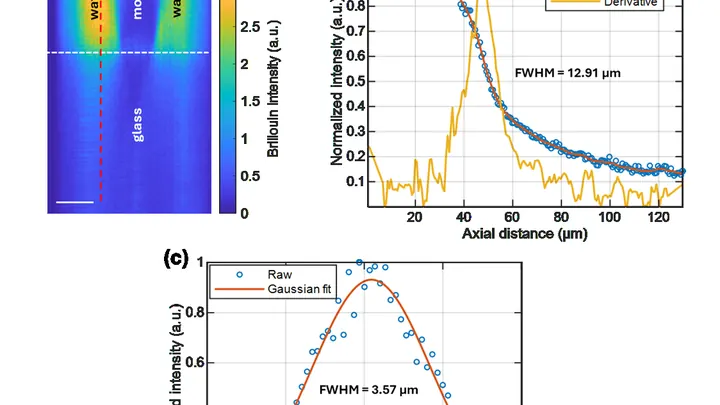
A laser beam passes through a cell, and the cell responds to the touch, like a taut string plucked by a finger. The frequency of this 'ring' reveals how stiff or soft the material is. That's how Brillouin microscopy works, named after the French physicist Leon Brillouin.
A laser beam as faint as a whisper of light has stirred a thorium-229 nucleus into a higher energy state. Most nuclei demand a blast of energy, but thorium-229 has such a tiny energy gap that even this gentle nudge works.
Hunting for a single glowing spot in a dark sample is like trying to find a needle in a haystack: the microscope beam crawls line by line, wasting time and light. Physicists replaced this slow sweep with random light patterns. The sample is illuminated with a broad field, but each time with a new pattern of bright and dark patches, as if random shadows from a grid were projected onto it.
In the operating room, the surgeon illuminates the tumor with a special agent that makes it glow. But how do you know whether it glows brightly because there are many cancer cells or simply because it lies close to the surface?
In a hospital, blood from a finger prick usually goes to the lab, and the result comes back the next day. The new method promises to cut that wait to a few minutes. Instead of catching light reflected off a sample, it reads the electrical voltage that arises at the boundary between two media, like the faint tingle you feel when you touch a battery with wet fingers.
A laser beam strikes a gold-and-silver film for just a few nanoseconds — in that time, light travels less than a meter. At the point of impact, the metal boils, splatters, and freezes into a random pattern of tiny particles. Each pattern is as unique as cracks in ice or tree branches.
Gas is nearly invisible, but it has a temperature, and you can read it from how the gas 'shadows' the thermal background. In the experiment, a camera looks at a warm screen through a jet of carbon dioxide. If the gas is cooler than the background, it appears as a dark spot; if warmer, it appears bright.
A standard laser rangefinder works like a stopwatch on a 100-meter dash: it times how long light takes to run to the target and back. But such a stopwatch has a limit: it ticks in steps of tens of picoseconds (trillionths of a second). In that step, light travels about a centimeter, so finer details are invisible.
Ordinary white light is a jumble of all colors at once, like the noise of a crowd where everyone speaks at their own frequency. But scientists need light where frequencies are aligned with ruler-like precision, like piano keys, where each note sounds distinct and exact.
Gravitational waves are ripples in the fabric of spacetime, spreading from sources like circles on water from a thrown stone. When a wave passes a galaxy, its path bends, like water ripples meeting an underwater boulder.
According to Einstein's theory, massive objects cause spacetime curvature, like a heavy ball warping a rubber sheet. As they accelerate, they create ripples — gravitational waves, akin to the circles from a stone dropped in a pond.
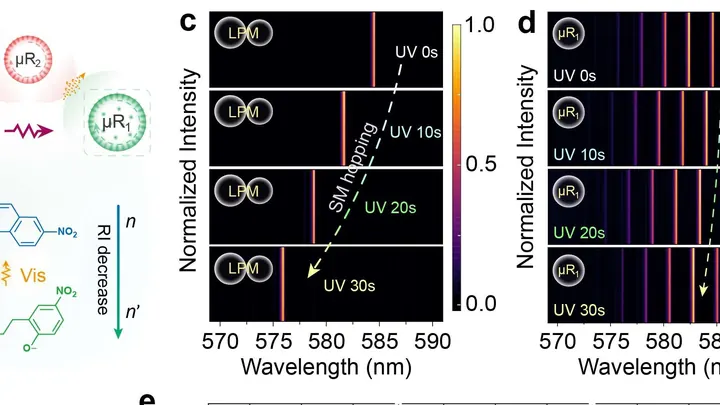
Two liquid droplets hanging side by side begin to sing in unison. One droplet is like a string tuned to a certain pitch, and together they form a laser that shines with a single, pure color. That's how a new type of sensor, a liquid photonic molecule, works.
The secret is that the droplets are slightly different in size.
A camera that captures not light but a stream of electrons reflected off a crystal is a hybrid pixel detector. It can count every electron that hits it, generating almost no noise of its own. In normal mode, when the electron beam flows continuously, the detector works perfectly.
Light in murky water behaves like a person in thick fog: every step is a collision, and the picture blurs. That's why a regular microscope can't see through skin or milk. Engineers found a workaround — look in the infrared range, where light collides less with particles.
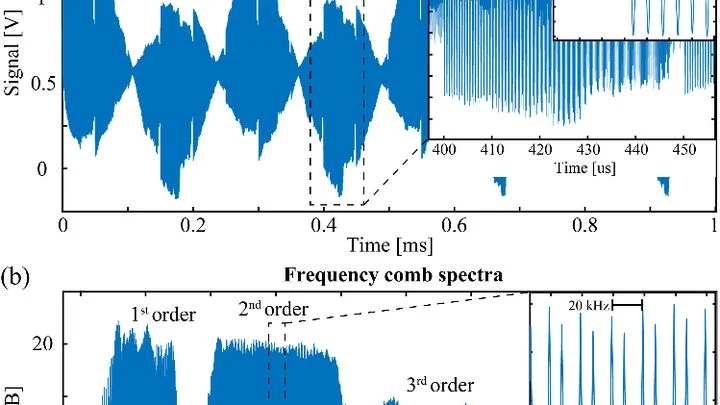
An ordinary comb parts hair into even strands. A laser 'comb' does the same to light: it emits not one color but thousands, spaced at exactly equal frequency steps. Such a tool has already helped measure time to billionths of a second and peer inside atoms.