A Crystal That Conducts Magnetic Waves Differently in Different Directions express
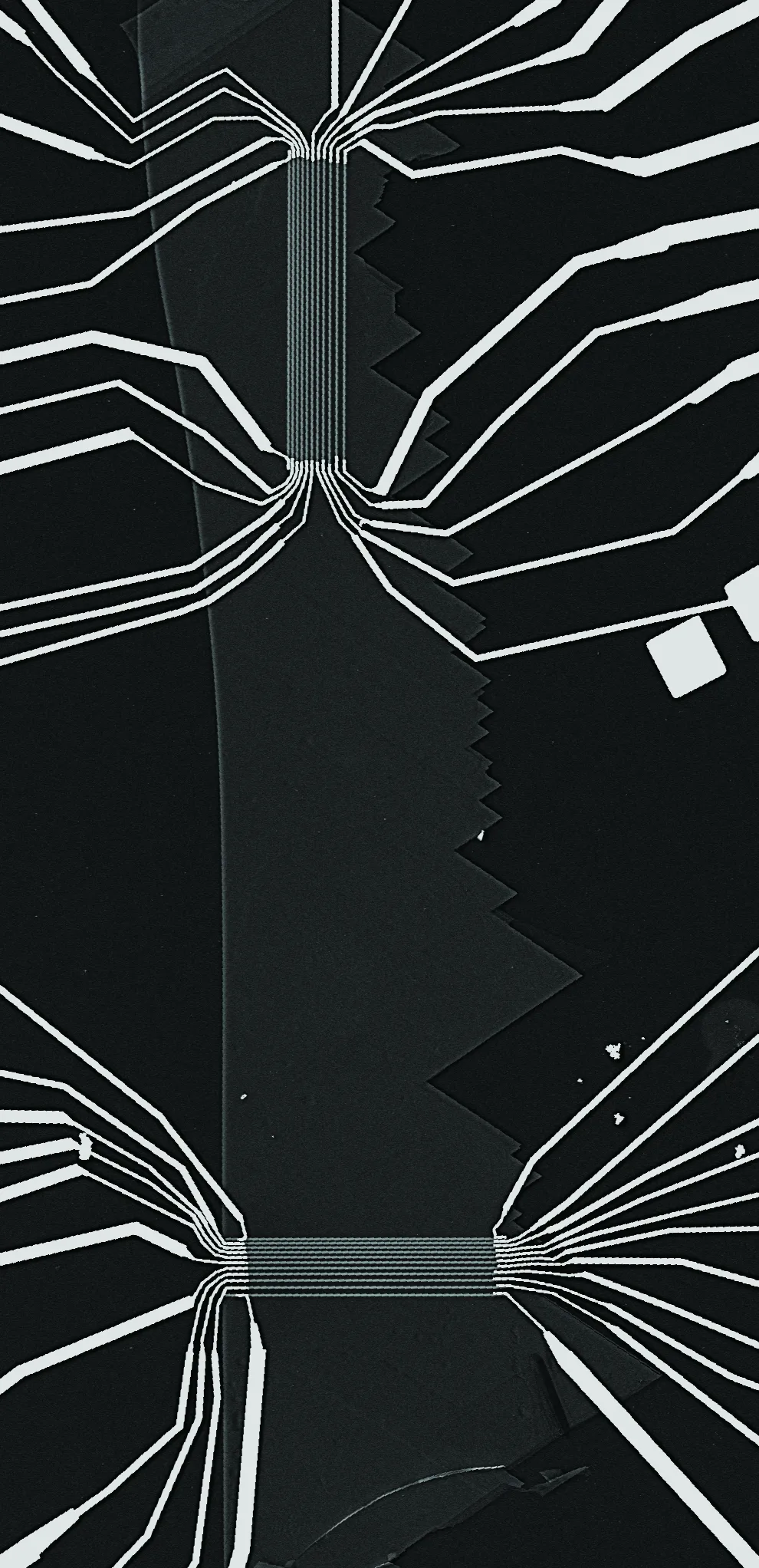
The crystal is like a city with different streets: on some, cars drive fast and far, on others, they crawl and get stuck. In the layered material CrPS₄, magnetic waves that carry spin (a particle's intrinsic angular momentum) behave the same way. Along one crystal axis, they travel 2.2 times faster and cover 2.7 times more distance than along the other.
Researchers excited magnetic waves in two ways: with an electric current and with heat. With electrical excitation, the difference between directions was clear: the wave's propagation length along one axis was 211 nanometers, and along the other, at least 575 nanometers. It's as if a courier on one route delivered packages for 575 meters, but on another, only for 211.
Thermal excitation gave a similar picture, but with nuances: because heat also spreads unevenly in the crystal, it's hard to separate the contribution of magnetic waves from that of thermal conductivity. So the electrical method is more reliable: it allows direct measurement of how anisotropy (the variation of properties with direction) controls spin transport.
This built-in "road network" for magnetic waves could become the foundation for new magnonic devices, where information is carried not by electrons but by spin waves. Just choose the right crystal axis, and the magnetic wave flow goes where you want it.
Original abstract
as written by the authors arXiv:2608.10802v1
Crystal anisotropy provides a powerful route for realizing direction-dependent transport in solid-state systems. While its influence on electronic transport is well established, the role of anisotropy in magnon spin transport in van der Waals magnets is largely unexplored. Here, in a nonlocal geometry, utilizing the monoclinic van der Waals antiferromagnet CrPS$$_4$$, we observe pronounced anisotropy in both electrically and in thermally excited magnon spin transport. Electrically generated magnons exhibit a magnon spin conductivity at least 2.2 times larger and a spin diffusion length at least 2.7 times longer for transport along the crystallographic-b axis compared to the crystallographic-a axis, where $$\lambda_m^{a} \sim$$ 211 nm and $$\lambda_m^{b} \geq$$ 575 nm. In comparison, at 8T, we find the nonlocal second-harmonic resistance associated with thermally excited magnons to be $$\sim$$7 times larger along the crystallographic-b axis at 25K. We further show that a magnon spin diffusion length cannot be reliably extracted from the nonlocal second-harmonic resistance, owing to the extended temperature profile within CrPS$$_4$$. Likewise, we show that the anisotropy in the spin Seebeck coefficients cannot be reliably estimated from the thermally excited magnon spin transport alone, as it is intertwined with the anisotropic heat conductivity of CrPS$$_4$$. Utilizing the electrically generated magnon spin transport, we demonstrate that intrinsic crystalline anisotropy serves as an effective control parameter for tuning magnon spin transport, opening new avenues for magnonic device engineering.
The word "anisotropy" comes from the Greek words "anisos" (unequal) and "tropos" (direction). In everyday life, you can easily see anisotropy in wood: splitting a log along the grain is much easier than across it.
In Stanislaw Lem's novel "Solaris," the planet's ocean had anisotropic memory, responding differently to signals depending on their direction and nature.