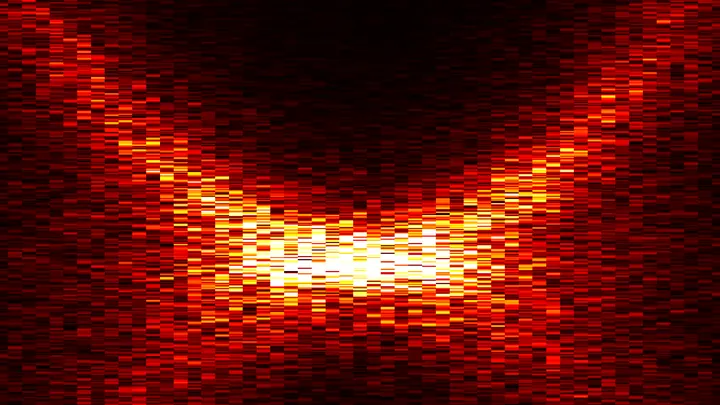
A magnon is a quasiparticle representing a collective excitation of electron spins in a magnetic material — essentially a quantized spin wave. When spins in a crystal precess in a coordinated, wave-like manner, the energy of that motion comes in discrete packets called magnons. They behave like particles with momentum and energy, and their dispersion relation (energy vs. wavelength) is typically quadratic at long wavelengths, meaning energy increases as wavelength shortens.
History
The concept was introduced by Felix Bloch in 1930 to explain the low-temperature behavior of magnetization in ferromagnets, building on earlier spin wave ideas.
How it works
In a ferromagnet, neighboring spins align. A disturbance causes a spin to tilt; this tilt propagates to neighbors, creating a wave. Quantum mechanically, this wave is quantized: each magnon carries a spin of ħ (reduced Planck constant) and can be created or annihilated. Magnons interact with electrons, phonons, and each other, allowing them to carry information and energy without moving charge.
In practice
Used in spintronics for data storage and logic devices, in magnonic circuits for wave-based computing, and in microwave technology for signal processing.
Fun fact
Magnons can be compressed into a macroscopic sphere to reach a quantum limit where their wavelength is comparable to the sphere's size, enabling studies of quantum effects on a visible scale.
A room of funhouse mirrors: you stand in the center, and the echo of your voice comes back from an unexpected direction, amplified and distorted. That is how spin waves in a thin magnetic film, excited by an antenna, reflect off defects and irregularities, creating a tangled pattern of fields.
The crystal is like a city with different streets: on some, cars drive fast and far, on others, they crawl and get stuck. In the layered material CrPS₄, magnetic waves that carry spin (a particle's intrinsic angular momentum) behave the same way.
In the vast clouds of rarefied gas that fill the space between stars, something is always churning. Supernova explosions, colliding streams — all of it shakes the plasma. And in this rippling, as it turns out, hides the mechanism that gives birth to magnetic fields.
Plasma is a gas in which electrons are stripped from atoms.
In a crystal that for centuries was called 'fool's gold,' physicists have spotted genuine treasure. The compound MnTe2 with a pyrite structure has become the stage for a quantum ballet: spin waves here twist into left- and right-handed vortices, with the twist direction firmly tied to momentum.
A pebble falls into a pond, and ripples spread across the water. In the quantum world, the pond is not made of water but of many identical particles, and the pebble is also a particle, just a foreign one. Such a foreign particle is called a Fermi polaron.
Every quantum particle has spin — an intrinsic magnetic property, like a tiny arrow. In an experiment, a beam of such particles passing through a magnet splits in two, like a coin that lands either heads or tails. That’s exactly how particles like a hydrogen atom behave.
The edge of a magnet works like a guitar fret: a string pressed near the edge sounds different, with a richer set of overtones. Magnetic waves in a thin strip of nickel and iron behave in much the same way.
Magnetic moments in a crystal are like compass needles fixed at lattice sites. In the normal state, they line up in neat order, but if an electromagnetic wave strikes the crystal, the needles start to sway, like wheat stalks in the wind. These oscillations are called magnons, and they carry energy without the atoms themselves moving.
If you compress a plate with accordion-like cells, a kink wave runs through it, like a wrinkle in a rug when you push it with your foot. Such waves can switch the material between two stable shapes, and this is the basis of mechanical memory. But if a table leg gets in the way of the wrinkle, it gets stuck. In a new study, researchers showed how to nudge it loose without brute force.
There is always noise in the microworld. Even in absolute emptiness, something trembles, and these quantum fluctuations interfere with precise measurements. But noise can be "squeezed," like a balloon: if you squeeze it from the sides, one part gets thinner while the other bulges.
If you toss a stone into a pond, ripples spread across the water. Tiny magnetic crystals also host waves — except it's not water that oscillates but the direction of magnetization. These are called spin waves. They travel through the crystal like ripples on a surface and can carry information.
A laser flash strikes a copper oxide crystal, and magnetic excitation waves, magnons, ripple outward like ripples on water. For the first time, scientists traced their path from birth to disappearance with femtosecond precision (millionths of a billionth of a second).
A football kicked with spin doesn't fly straight: it bends to the side. A tightly focused beam of light does something similar: it starts pushing an atom not just forward but also sideways. Physicists measured this shift on a single calcium ion trapped in a light trap.
The beam was aimed at the atom like a spotlight on a grain of sand.
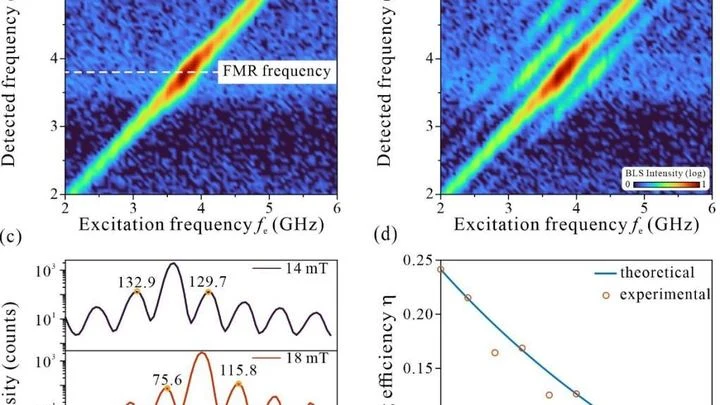
Waves in magnets resemble the vibrations of a string: if you pluck a string, it sounds a single note, but with a strong pluck, overtones appear — sounds at multiple frequencies.
Magnetic materials can store oscillatory energy, like a tuning fork that keeps ringing after being struck. When such a material is placed in a microwave cavity, its oscillations (magnons) start interacting with light (photons).
An ordinary wave in a magnet is like ripples on water: the shorter the wavelength, the higher the energy. Physicists call such waves magnons. But in a thin film of bismuth yttrium iron garnet, they managed to create waves with the opposite behavior: their energy decreases as the wavelength gets shorter. These are antimagnons.