Crystals Got Brighter: How to Catch Dark Matter express
Dark matter doesn't emit or reflect light, but its presence is revealed through gravitational effects. To catch even a single particle, physicists build detectors that are like very quiet rooms: inside lie crystals that flash when a particle hits them. But the flash is faint, and if light is lost along the way, the signal can be missed.
In the COSINE-100U setup, sodium iodide crystals have learned to collect light better. Previously, quartz windows stood between the crystal and the photomultiplier — the device that converts light into an electrical signal. Light passed through several boundaries and was partially reflected. Now the windows are gone, and photomultipliers are pressed directly against the crystal ends through thin silicone pads 2 millimeters thick. The edges of large crystals were beveled so that light, as if along a chute, flows to the sensors. As a result, all eight crystals now produce more light — up to 27.7 photoelectrons per kiloelectronvolt, whereas before it was about 15.
This isn't just a technical whim. The brighter the flash, the easier it is to distinguish a real dark matter signal from random noise. Moreover, the new design reduced background from radioactive contamination on the crystal surfaces. Two crystals that were previously unusable for analysis due to poor light are now back in action. Tests showed that the new packaging withstands prolonged immersion in liquid scintillator at low temperature — the harsh conditions of an underground laboratory.
So the upgraded detector is preparing for the ultimate test. The DAMA/LIBRA group has for years reported mysterious seasonal variations in its signal that could be explained by dark matter. With brighter and cleaner crystals, COSINE-100U will finally be able to confirm or refute that observation.
Original abstract
as written by the authors arXiv:2608.11678v1
The COSINE-100 experiment was designed to test the DAMA/LIBRA annual-modulation claim using low-background NaI(Tl) detectors. For the COSINE-100U upgrade, we developed a new crystal-encapsulation system to increase light-collection efficiency while preserving long-term detector stability, thereby improving sensitivity to low-mass dark matter. The upgraded design eliminates the quartz optical windows used in COSINE-100 and directly couples the photomultiplier tubes (PMTs) to the crystal end faces through 2-mm-thick silicone optical pads, thereby reducing the number of optical interfaces. For the larger crystals, the crystal edges were beveled to guide scintillation light more efficiently onto 3-inch high-quantum-efficiency PMTs. The performance study uses 2462~h (102.6~days) of room-temperature COSINE-100U data and, for direct background comparisons, reference COSINE-100 data acquired near the end of operation. 698~h (29.1~days) of COSINE-100 data acquired near the end of operation in March 2023. All eight crystals showed higher light yields than in COSINE-100, with values ranging from 15.8 to 27.7~p.e./keV; six crystals exceeded 20~p.e./keV. The measured bulk-$$\alpha$$ rates were lower than the COSINE-100 values and consistent with the expected time evolution of internal $$^{210}$$Pb, while the 1--2-MeV surface-$$\alpha$$ rates were substantially reduced. The upgrade also restored two crystals that had previously been excluded from the COSINE-100 physics analysis because of poor optical performance. Independent validation tests demonstrated that the encapsulation remains mechanically robust and optically stable during long-term immersion in liquid scintillator at low temperature. This paper presents the encapsulation design, the room-temperature detector performance, and the reduction in surface-related backgrounds achieved at the Yemilab facility.
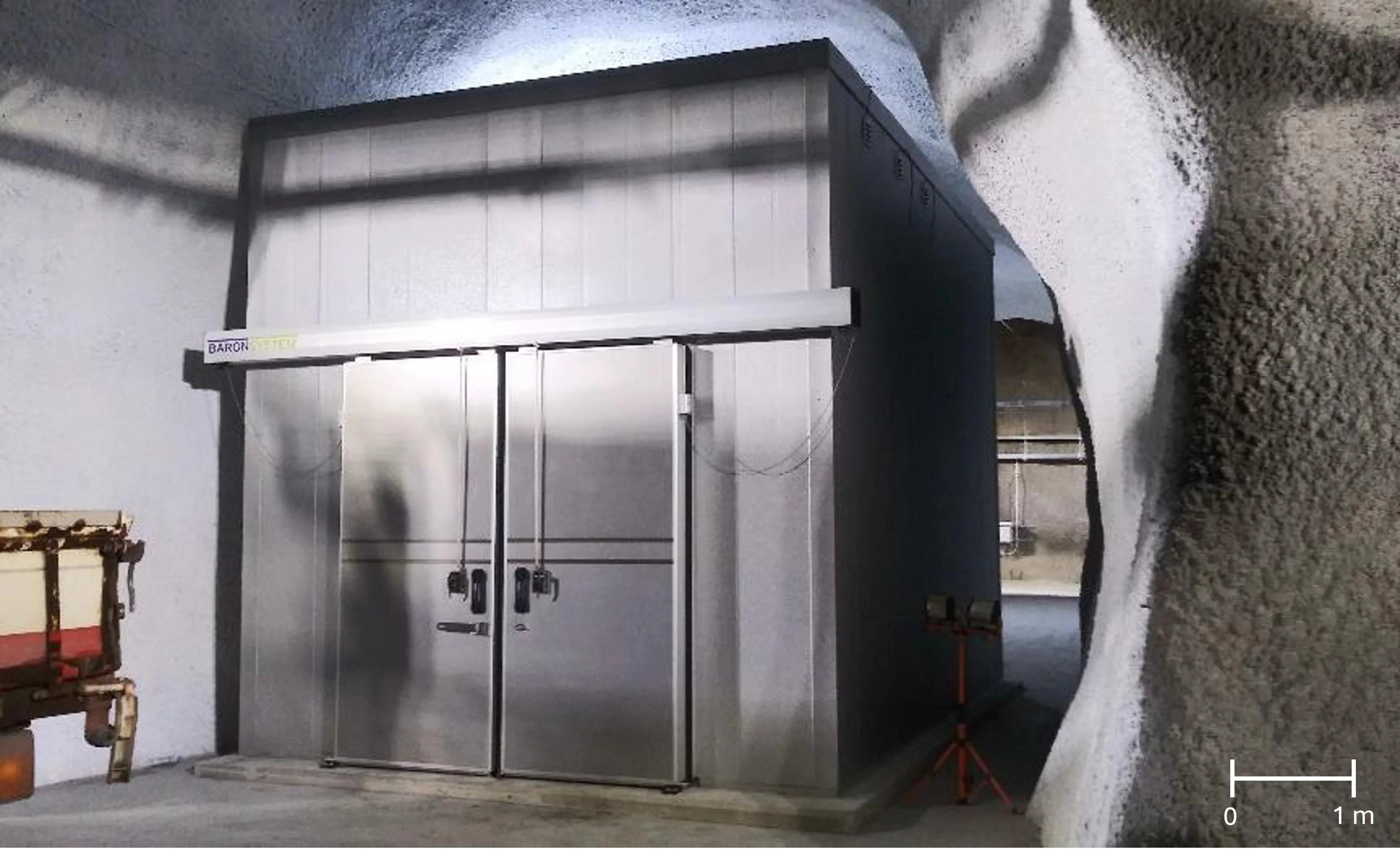
Sodium iodide crystals glow not only from dark matter but also from ordinary radiation, so they are grown in ultra-clean conditions, and the detector is buried deep underground.