unit

kiloelectronvolt

A unit of energy equal to one thousand electronvolts, used in atomic and nuclear physics.
20 related articles

Description

The kiloelectronvolt (keV) is a unit of energy equal to one thousand electronvolts. An electronvolt is the amount of kinetic energy a single electron gains when accelerated through an electric potential difference of one volt. While tiny on a human scale, the keV is a convenient and widely used measure for processes at the atomic and nuclear level, such as the energy of X-rays, the binding energy of electrons in atoms, and the energy released in nuclear reactions.

History

The electronvolt unit was introduced in the early 20th century, and the kiloelectronvolt followed naturally as a multiple. It became standard in atomic physics and later in X-ray and nuclear physics as those fields developed.

How it works

The unit works by providing a scale that matches the energies involved in atomic and nuclear phenomena. For example, the energy needed to remove an inner-shell electron from an atom is typically in the range of a few keV, and X-ray photons used in medical imaging have energies from about 20 to 150 keV. By using keV, physicists avoid unwieldy numbers in joules (1 keV = 1.602 × 10⁻¹⁶ J) and can directly compare energies to the fundamental charge of the electron.

In practice

It is used to describe the energy of X-ray tubes in medical and industrial imaging, the energy of particles in particle accelerators, and the energy of gamma rays emitted in nuclear decay.

Fun fact

The energy of a single visible-light photon is only about 2 to 3 electronvolts, so a kiloelectronvolt is roughly 400 times more energetic than a photon of green light.
Concept graph →

Related articles · 20

Milky Way passes the baton: seamless transition of cosmic rays
The mystery of the main break in the spectrum of galactic cosmic rays, the knee at 3 PeV, has persisted for nearly a century.
HEP Experiment2026-04-142 minarXiv:2604.13320express
Catcher of Smudged Electrons
When two particles fly at almost the same speed in the same direction, their signals in the detector merge, like two voices in unison. Telling a duet from a soloist is an art in itself.
Nuclear Experiment2026-04-031 minarXiv:2604.03410express
Scales for the Invisible: Weighing an Atom's Decay
In the basement of a laboratory in Jyväskylä, a trap holds a single atom aloft, like a magician balancing a ball on a fingertip. The tin-113 atom is unstable: sooner or later it captures one of its own electrons and becomes indium-113, emitting an elusive particle — the neutrino. How much energy is released in the process was previously known only approximately.
HEP Experiment2026-03-241 minarXiv:2603.23256express
Hunting for Sterile Neutrinos
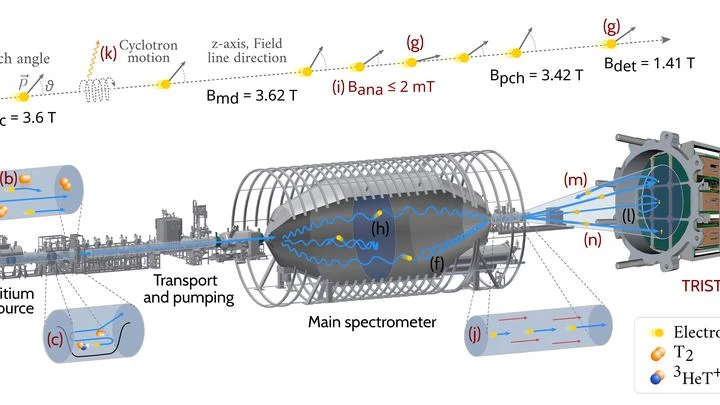
Radioactive tritium decays, emitting an electron. Its energy is almost always the same, but sometimes, just a little less. This shortfall could mean that alongside the ordinary neutrino, another, hidden particle was born. The Standard Model describes three types of neutrinos, but scientists suspect there is a fourth — the sterile one.
HEP Experiment2026-03-212 minarXiv:2603.20960express
Hunting an Invisible Particle in Kaon Decays
The kaon is a long-lived particle by microcosm standards: it lives for billionths of a second before breaking apart into lighter particles. In the KOTO experiment in Japan, physicists catch the rarest variants of such decays. One of them is when a kaon transforms into two neutral pions plus another particle X, which immediately decays into two photons (particles of light).
A Cold Detector and Extra Signals
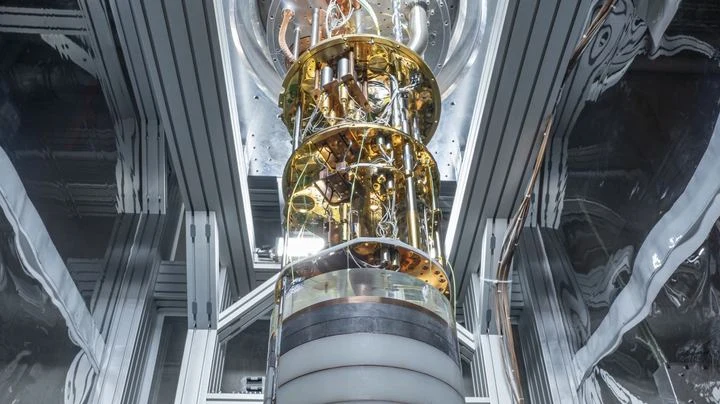
In a dark chamber where the temperature sits just four degrees above absolute zero, a sapphire crystal the size of a grain of rice lies waiting. When a neutrino, a ghostly particle that barely notices matter, flies through it, the crystal shudders and warms by a tiny fraction of a degree.
Quantum Physics2026-03-062 minarXiv:2603.05795express
Quantum Computer Peers into the Heart of a Water Molecule
A water molecule resembles a tiny dumbbell: two hydrogen atoms attach to an oxygen atom at an angle. This dumbbell doesn't stay still: it stretches, compresses, and rotates. Each such motion has its own energy, like steps on a ladder.
physics.acc-ph2026-02-131 minarXiv:2602.12765express
An Electron Beam as Fine as a Pencil
An electron beam can be compared to the light from a laser pointer: if it diverges, the spot on the wall quickly spreads out. In the lab, physicists created such a narrow beam that it remained thin over a long distance, like the beam of a good pointer.
Gamma Rays Weighed to One Part per Million
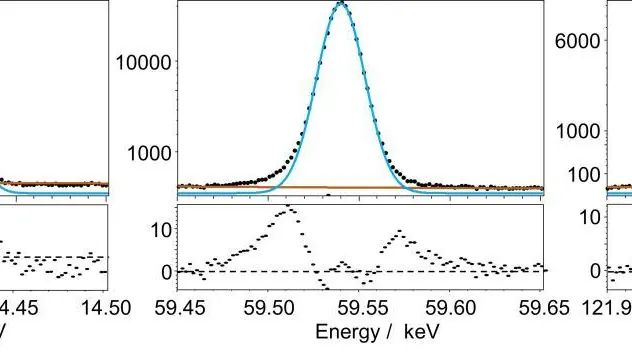
Gamma rays are the most energetic flashes of light born deep within atoms. Their energies are like fingerprints: each radioactive element has its own pattern. But measuring that pattern with high precision is like weighing a grain of sand on a scale sitting on a vibrating truck. The new setup works like an ultra-sensitive thermometer.
Quantum Physics2026-02-101 minarXiv:2602.09596express
Quantum Internet: From Theory to Reality
Ordinary messages can be intercepted without anyone noticing. Physicists have come up with a way to create a shared secret that instantly breaks if someone so much as glances at it. Instead of paper, they use single particles of light. This quantum communication exploits a rule: any measurement changes a quantum object.
Mesoscale2026-01-301 minarXiv:2601.22719express
Light Vortices Stir Up Turbulence
In a container the size of a coin, light behaves like water: it gathers into a single quantum fluid. When energy is added, whirlpools, quantum vortices, spin up on their own. Each vortex is like a tiny whirlpool that cannot simply disappear. Physicists illuminated this fluid with a laser and took snapshots.
HEP Experiment2026-01-271 minarXiv:2601.19185express
Neutron in the Light
The neutron is a particle with no charge but with internal structure. Like a ball that looks smooth on the outside but has a complex filling inside. Scientists have long wanted to understand how electric and magnetic forces are distributed inside the neutron. To do this, you need to "feel" it — collide it with its antiparticle and see what happens.
A Scale That Weighs a Kilogram by Quantum Rules
In a quiet lab, a device the size of a microwave oven sits on a table. Inside, a coil glides smoothly up and down while a computer reads electrical signals. This is the tabletop Kibble balance — a machine that links mass to quantum constants. Previously, such balances occupied a whole room and required a team of engineers.
High Energy2026-01-252 minarXiv:2601.17792express
How Iron Reveals the Secrets of Cold Gas
A flashlight shines through fog, and its light changes color slightly. From that change, you can tell what the fog is made of. That's how astronomers study cold gas around X-ray sources: iron atoms in the gas absorb and re-emit X-rays at a very specific energy, like a fingerprint. But there's a catch: if you strip a few electrons from the atom, the line shifts.
A Detector That Can Hear a Single Electron
Light hits a silicon wafer, and a single electron is born inside it. An ordinary instrument wouldn't notice — the signal is too faint. The new detector not only hears it but also determines its energy with an accuracy of 589 millielectronvolts. That's like distinguishing the footsteps of an ant at arm's length. Inside the detector, a particle knocks an electron out of a silicon atom. This takes 0.
Nuclear Experiment2025-10-161 minarXiv:2510.21768express
Tantalum Nucleus Reveals Electric Asymmetry
Measured dipole moment of tantalum-181: 3.39 × 10⁻³² e·cm — like spotting a one-atom shift across the entire Solar System. An ordinary atomic nucleus is perfectly balanced, like a spinning top. In tantalum, that balance is broken: the positive and negative charges are slightly offset from each other.
Electron on Helium Catches a Microwave Photon for the First Time
Above the mirror-like surface of superfluid helium cooled to 7 millikelvin, a single electron dances in perfect waltz with a microwave photon.
A Wide-Angle Lens for the Subatomic World
At Jefferson Lab, electrons are accelerated to 12 GeV and smash into protons to pry out their secrets. But existing detectors are like cameras with a narrow field of view: you either see a lot but dimly, or brightly but only a tiny patch. Electron scattering is the main tool, but statistics are insufficient for subtle effects.
Echo of an Explosion in a Quiet Harbor
In the quiet harbor of the Local Bubble, a rarefied cavity of hot gas around the Sun, an explosion recently thundered. A supernova went off tens of parsecs away, and its echo still lingers in the neighborhood, reshaping the cosmic-ray landscape.
High Energy2011-04-181 minarXiv:1104.3452express
Extra Electrons in Cosmic Rays
High above Antarctica, a balloon carried an instrument that caught electrons from space. These particles come from distant stellar explosions and other powerful events. The instrument measured their energy, like the force of an impact. And in one energy range, there were more impacts than calculations predicted.