A photoelectron is an electronejected from a material when it absorbs a photon. This phenomenon, known as the photoelectric effect, was explained by Einstein in 1905 and provided crucial evidence for the quantum nature of light. Photoelectrons carry information about the energy levels of electrons in the material, making them a powerful probe of electronic structure.
History
Heinrich Hertz observed the effect in 1887, but Albert Einstein explained it in 1905 using the concept of light quanta, for which he received the Nobel Prize in 1921.
How it works
When a photon strikes an atom or solid, its energy can be transferred to an electron. If the photon's energy exceeds the material's work function (the minimum energy needed to free an electron), the electron escapes with kinetic energy equal to the photon energy minus the binding energy. By measuring the kinetic energy and angle of emitted photoelectrons, scientists can map out the electronicband structure of materials.
In practice
Photoelectronspectroscopy is a standard technique in materials science and surface chemistry, used to analyze the composition and electronicstates of surfaces, including in semiconductor development and catalysis research.
A laser hits an atom, and tears out an electron. The brighter the light, the stronger the kick, and the faster the electron flies away. That's how the familiar picture works, where light is a smooth wave. But what if the light isn't smooth but 'squeezed,' with quantum fluctuations, like the trembling of a string?
The lifetime of the entangled triplet pair in the protein is about 60 picoseconds, which is eight times longer than in solution.
Sunlight is like a continuous stream of balls flying at a wall.
In 1976, physicists predicted that an electron could do more than just fly past a nucleus: it could slam into it, transferring energy and making the nucleus 'shudder.' They called this effect NEEC — nuclear excitation by electron capture. But for nearly fifty years, no one has managed to observe it in an experiment.
In a tight row of atoms, spaced closer than the wavelength of light, a remarkable state hides. The excitation is distributed among all particles so that their radiation cancels itself out. This quantum 'silence' is an ideal vault for a photon: it can be stored there hundreds of times longer than usual.
Each positron annihilation is like the birth of a pair of dancers, connected by an invisible thread of polarization. Two gamma quanta fly apart, but their states remain entangled: measuring one instantly determines the other — as if one partner senses every movement of the other, no matter the distance.
An electron and its antiparticle — the positron, predicted by Дираком, — upon meeting, momentarily form позитроний: a tiny pair circling each other, like in an atom but without a nucleus. Almost instantly it decays, emitting two photons that turn out to be mysteriously linked.
The solar wind rushes from the Sun to Earth, but the magnetosphere bends the flow and sculpts it into plasma tails. The same motif plays out at the heart of galaxies: jets from accretion disks around black holes are twisted by the invisible hand of a magnetic field.
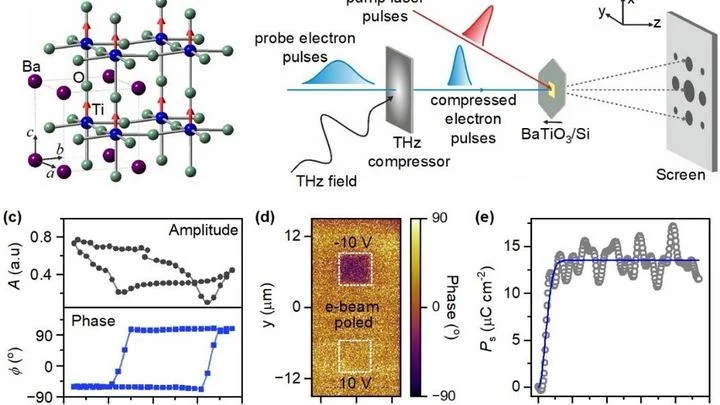
The thinner the ferroelectric film, the stronger the depolarizing field — a dictate of classical physics. Imagine a pencil balancing on a fingertip: the shorter it is, the harder to keep it upright. Nanoscale polarization likewise strives to vanish.
A surfer glides across the ocean surface until a big wave comes, and then they're flying forward. Similarly, a free electron interacts with light: usually the energy exchange is barely noticeable, but if the surrounding medium begins to oscillate rhythmically, each wave crest pushes the particle harder and harder.
In very dim light, photons arrive one by one, like drops from a leaky faucet — never in pairs. This effect, predicted by Roy Glauber and confirmed by Leonard Mandel, directly proves that light is made of particles.
Understanding the photoelectric effect — where light knocks electrons out of a material — is like learning to cook without a recipe. That’s where digital tools help: games provide intuition, and simulations provide precision.
A black hole is a cosmic pocket into which everything, even light, falls. But the pioneering work of John Wheeler, Stephen Hawking, and Roger Penrose showed: sometimes, due to the colossal spacetime curvature, the pocket turns inside out.
A detector filled with superfluid helium-4 is like a perfectly still lake. The liquid doesn't slosh or bubble: it's frozen in a single quantum state. An invisible guest, a dark matter particle, flies through it. It doesn't shine or leave a track. But sometimes it nudges a helium nucleus.
A light carousel spins not people but electrons. Instead of wooden horses, there are invisible blades of light. This is exactly the kind of 'carousel' physicists built to give electrons a spin.
Usually, to twist an electron beam into a vortex, you need a tiny mask — a stencil with slits carved on the atomic scale. Fabricating it is extremely challenging.
A swing only gets going if you push it in rhythm. Miss the beat, and your effort is wasted. Light interacts with an atomic nucleus in much the same way: a photon is usually absorbed only when its energy exactly matches the gap between nuclear levels. But what if the photon's energy doesn't fit? The authors of a new study have found a workaround.
A drop of water stretches in a strong electric field. The deuterium nucleus, a bound pair of a proton and a neutron, behaves the same way, except here the field comes from a passing gamma ray, and instead of just stretching, the nucleus can simply fall apart.
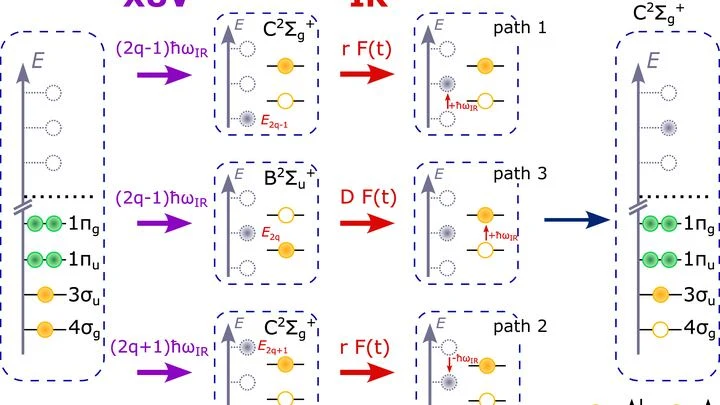
A high-speed camera capable of capturing the motion of electrons is an attosecond interferometer. It sends two laser pulses at a substance with a tiny delay. The first, ultraviolet, acts like a flash, knocking an electron out of the molecule. The second, infrared, like an invisible hand, gently nudges or slows this electron in flight.
A dust grain hangs in the air, held by an invisible beam of light. Around it is ordinary air, but sometimes a tiny spark jumps across the grain. For the first time, scientists have observed such discharges up close and found that they are triggered not by the grain itself, but by invisible visitors from space and from the ground.
A deuterium molecule, two atoms of heavy hydrogen, falls apart under a laser pulse. One electron is ripped away, leaving an ion behind. At that moment, they are still linked: the direction of one immediately tells you which way the other went. This link is called quantum entanglement.
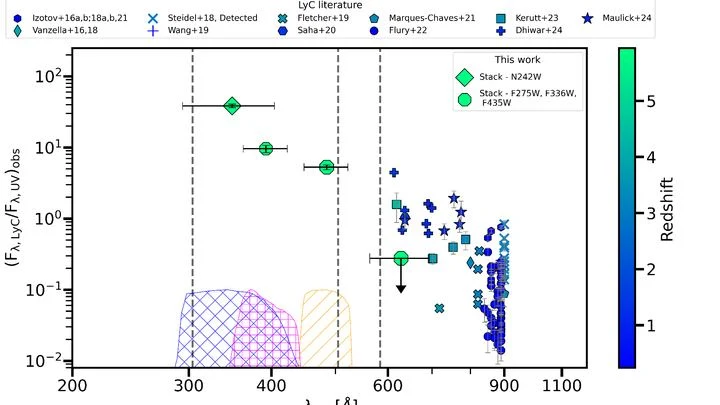
After the Big Bang, the Universe was filled with cold gas — mostly neutral hydrogen and helium. It enveloped the cosmos like a morning fog, impenetrable to light. The Dark Ages began.
When the first galaxies ignited, their radiation, like a searchlight beam, started knocking electrons out of atoms.
When two particles fly at almost the same speed in the same direction, their signals in the detector merge, like two voices in unison. Telling a duet from a soloist is an art in itself.
At night in a dark room, the human body emits a barely perceptible glow. This light is so faint that only highly sensitive detectors can catch it. Some researchers thought this glow from the head could tell us about brain activity — no scanners or wires needed.
But when put to the test, the story changed.
Light in an optical fiber is a stream of photons, and quantum communication requires single photons that can be sent one at a time. But making them emerge quickly while remaining indistinguishable from one another is a tough challenge.
Inside a barium titanate crystal, there's a built-in electric field, like a permanent magnet, but for charges. When a flash of light hits it, electrons are knocked loose and start darting around, colliding with atoms. But the crystal isn't the same in all directions: it has an axis along which the field is strongest.
When light knocks an electron out of an atom, it flies off like a ball thrown into a crowd. Scientists have long wanted to know the exact moment each electron leaves the atom, but direct measurement disturbed the very process. Now physicists have proposed a method that uses a second light pulse to 'photograph' the moment of the electron's birth.
In quantum communication, a secret key is transmitted using single photons. Eavesdropping on such a channel is supposedly impossible: any interception attempt disturbs the particle and leaves a trace. But the idea has a weak spot — the real hardware, which sometimes behaves differently than theory dictates.
A semiconductor diode normally conducts current in only one direction, like a spring-loaded door: it opens easily one way but pushes back the other. But if you dope the crystal heavily, the door starts behaving strangely: under reverse bias, the current doesn't just flow: it shoots up.
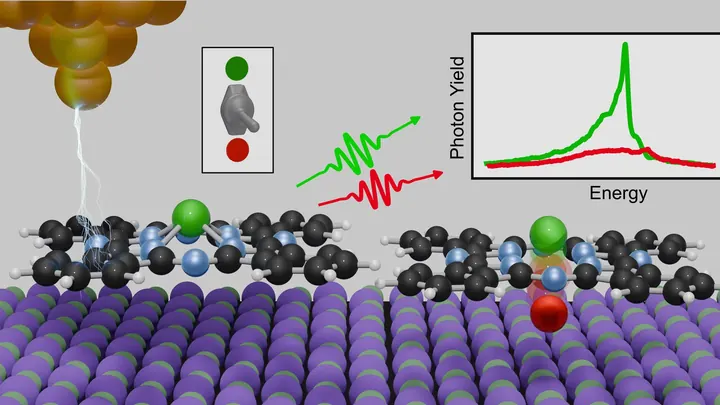
A glowing dot the size of a molecule. Run a current through it, and it flashes like a tiny lightbulb. That's what the experiment with dye molecules on a thin salt film looks like.
When current enters a molecule, one electron hands it energy. The molecule immediately gives that energy back, as light. It's like a swing: give it one push, and it rocks and then stills.
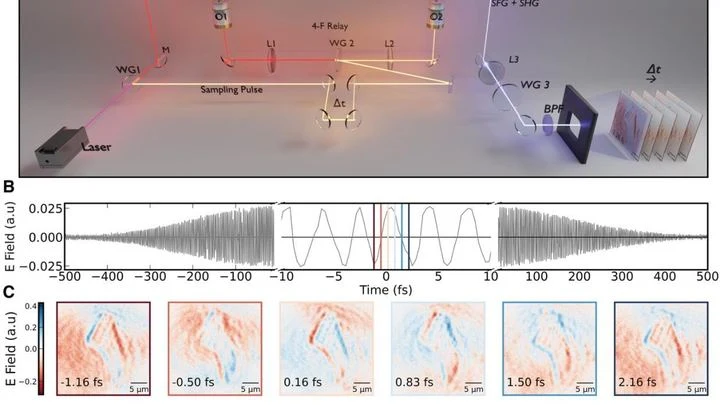
Light is not just a beam but a wave with an electric field that changes at a speed unimaginable to ordinary clocks. Until now, this field could only be measured at a single point, like taking temperature with a single thermometer. Now researchers have created a method that shows the entire field at once, like a thermal imager showing a heat map.
The tip of a scanning tunneling microscope approaches a crystal surface so closely that an electric current jumps between them. Electrons from the needle are injected into a layered semiconductor and land in an atomic vacancy — a spot where one atom is missing from the lattice. This void acts as a tiny trap for charge.
When light knocks an electron out of a molecule, the remaining electrons don't just sit still: they rearrange, like passengers in a train car when one gets off at a stop. In ordinary molecules, this rearrangement is barely noticeable, but in chiral molecules, mirror images like left and right hands, it can make the orbitals rotate.
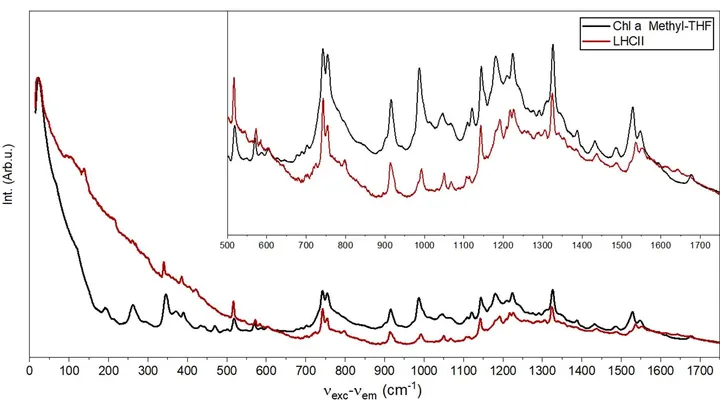
When a sunbeam hits a leaf, a relay race begins inside it. The energy of light passes from one chlorophyll molecule to the next until it reaches the reaction center — the place where the chemistry of life kicks off. This relay runs with astonishing accuracy: nearly every quantum of light finds its way.
Imagine a vast field of fireflies, each flashing alone rather than in a swarm: that's what the new automated setup is hunting for. It sweeps a laser across the sample like a flashlight and records the color and brightness of the glow at every spot.
The proton is not a smooth ball but a tangle of smaller particles in constant motion. To peek inside, physicists fire electrons at protons and watch how they bounce off. The new machine, the Electron-Ion Collider, will do this with unprecedented accuracy.
Scientists have run simulations to see what would happen if data were collected at different energies.
Light, regardless of its source, consists of photons — elementary particles, quanta of the electromagnetic field. The simplest light detector, such as a photometric illuminance meter, operates in a binary mode: it merely registers whether photons hit it or not, giving a 'yes/no' answer.
A muon is like an electron, but about 200 times heavier. When it stops in a piece of silicon, it gets pulled into the atomic nucleus like a nail to a magnet. The nucleus gains extra energy and starts to "boil": various particles fly out — protons, deuterons, tritons, and alpha particles.
In a dark room, you might notice a faint blue glow around some radiation sources. This is Cherenkov light: it appears when a charged particle travels through a medium faster than light can propagate in it. The result is a light shock wave, similar to the sonic boom from a supersonic jet, but made of photons.
A crystal without a center of symmetry is like a staircase where all the steps are tilted in the same direction: electrons, given a kick by light, roll predominantly in one direction. This is how a direct current is born — the photogalvanic effect.
A rubidium atom is like a lock that opens only with one key: a particle of light of a strictly defined color. Even under the fiery rain of the sun, where myriads of colorful 'keys' fall, the lock remains silent. But when the right one strikes, the atom gets excited for an instant, and the detector registers a click.
Quantum computers demand reliable memory. In a diamond crystal — carbon — information is stored as the orientation of microscopic magnetic needles (spins) at special defects. Reading these arrows with light was inconvenient: optics are bulky for chips. The new method works like developing photographic film.