The Giant That Didn't Kick Out Its Neighbor ✛
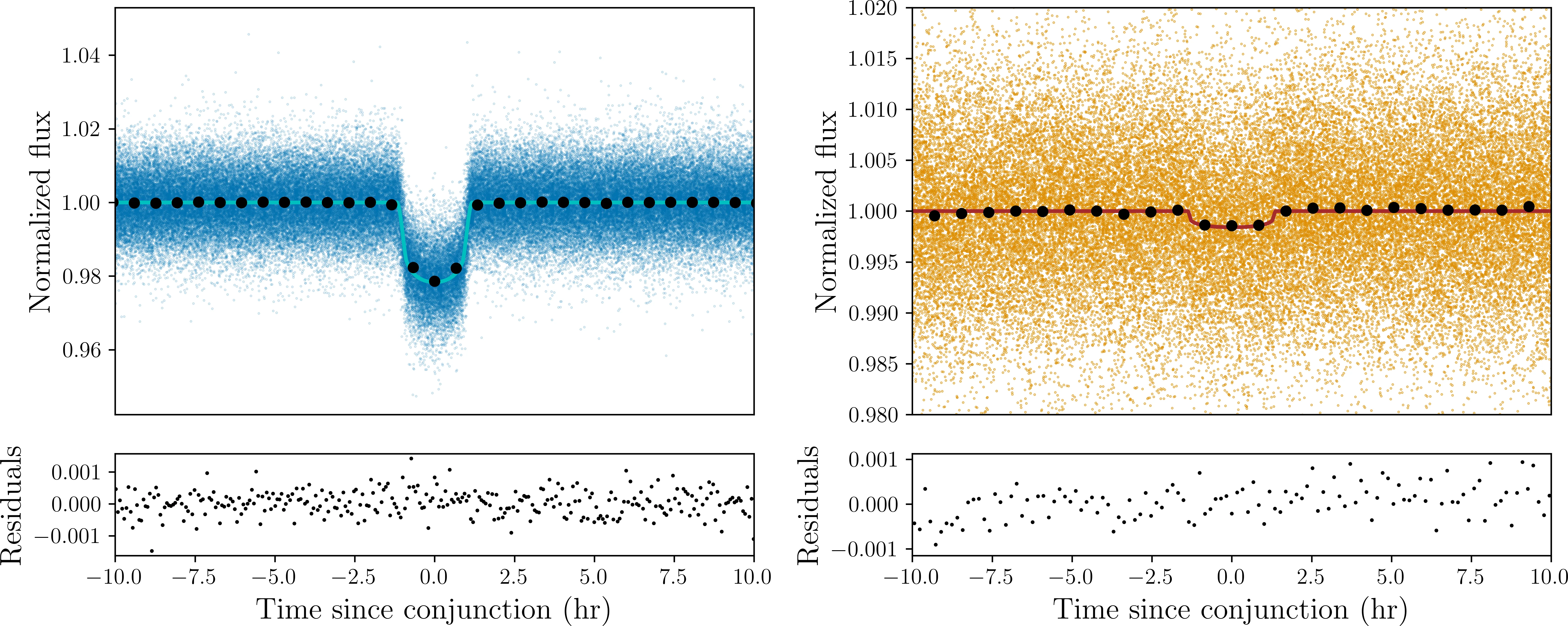
Picture a family where the big brother moves closer to the parents but doesn't kick his little sibling out: he just leaves them playing in the yard. That's the setup in TOI-4468: a hot Jupiter (a gas giant hugging its star) zips around in 2.77 days, while an outer sub-Neptune (a planet smaller than Neptune) takes 7.01 days. There are no inner planets at all.
Systems like this hadn't been found before. The thinking was that when a hot Jupiter migrates inward, it flings away or swallows any close neighbors. So other hot Jupiters either have inner companions or none at all. But here, there's an outer companion, and only that.
The astronomers measured the hot Jupiter's mass and radius by combining transits (passages across the star's disk) with the star's wobble induced by the planet. The NEID spectrograph gathered 13 data points over two years with an error of 8.1 m/s: that's like noticing someone stepping a millimeter. The outer planet was confirmed statistically: the presence of one planet boosts confidence in the second.
Most likely, the system dodged a secular resonance — a slow rocking of orbital tilts that usually 'pushes' outer companions out of the transit plane. Either the star wasn't oblate enough, or a possible outer giant locked the inner orbits together. The big brother didn't just stay: he's watching the little one play in the yard.
The star TOI-4468 is 378 light-years away, and its age is estimated at 7.4 billion years — almost twice as old as the Sun. The hot Jupiter completes an orbit in 2.77 days, meaning a year on this planet lasts less than three Earth days.