A Lonely Neighbor for a Hot Jupiter ✛
Context
Hot Jupiters—gas giants on orbits shorter than a few days—are rare but easy to detect, so they set the tone in exoplanet censuses. Among their formation channels, high-eccentricity migration stands out, which is thought to destroy close neighbors. Therefore, systems with a hot Jupiter and a close companion are rare: until now, only inner companions have been found, and the only case with an outer companion, WASP-47, also had an inner planet. This work fits into the search for such unusual architectures: nearby in the archive are studies of hot Jupiters with inner companions (TOI-1130, TOI-2000, TOI-1408) and works on the birth and migration of giants.
Methods
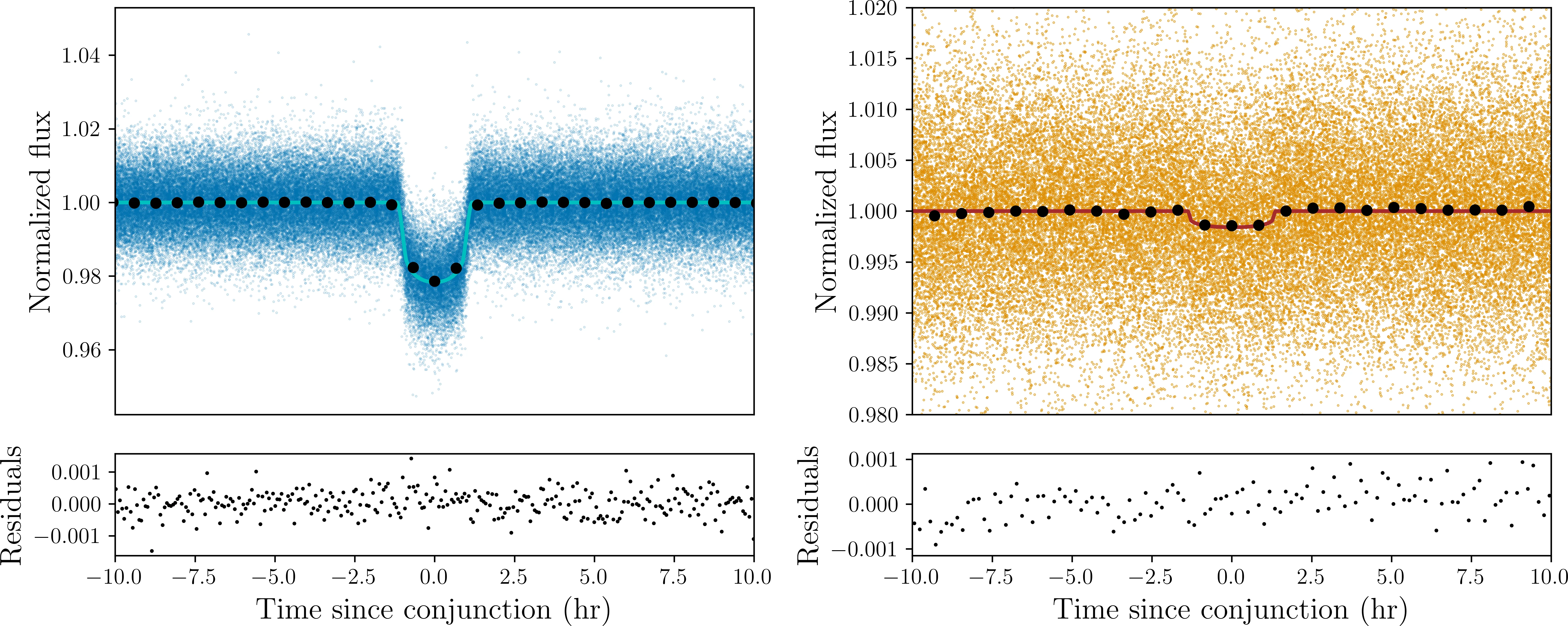
The planets were detected via transits in TESS data: the star was observed in 39 sectors, first in full-frame images with a 30-minute cadence, then with a 2-minute one. Ground-based telescopes (LCOGT 1 m, RFAC 0.3 m, SUTO 0.3 m, and others) confirmed that the signals originate from TOI-4468 itself, not from neighboring stars. Radial velocities were measured with the NEID spectrograph on the 3.5-meter WIYN telescope: 13 points over two years with a median error of 8.1 m/s. The joint fit of transits and radial velocities was performed with the exofastv2 code, and statistical validation of the outer planet with the triceratops code, accounting for the 'multiplicity factor' for systems with multiple candidates.
Results
The hot Jupiter TOI-4468 b has a mass of 0.54 Jupiter masses and a radius of 1.01 Jupiter radii, an orbital period of 2.77 days, and an equilibrium temperature of about 1150 K. The outer planet TOI-4468 c is a sub-Neptune with a radius of 0.28 Jupiter radii (3.1 Earth radii) and a period of 7.01 days; its mass is not measured, but from the mass–radius relation it is estimated at 11 Earth masses. The period ratio of 2.53 is slightly beyond the 5:2 resonance, and transit timing variations do not exceed 6.8 minutes for b and 48.6 minutes for c. A third signal with a period of about 624 days and a semi-amplitude of 25.8 m/s is seen in the data; if it is a planet, its minimum mass is 0.98 Jupiter masses, but stellar activity cannot be ruled out.
Implications
This system is the first example of a hot Jupiter with a single outer companion, setting it apart from its archive neighbors, where companions are inner or absent altogether. The lack of an inner planet and the small mutual orbital inclination indicate that the system likely never underwent the early secular resonance that typically 'pushes' outer companions out of the transit plane. This offers a rare opportunity to test hot Jupiter formation theories: either the star was not sufficiently oblate, or a possible outer giant dynamically coupled the orbits of the inner planets.
Future development
Further radial velocity observations will confirm or refute the third signal and refine the outer planet's mass. If the outer giant is real, the system becomes an analog of WASP-47 and paves the way for testing the two-stage formation scenario. Searching for other systems with the same architecture will reveal how rare this evolutionary path is.
Impact
The results will affect the statistics of hot Jupiter architectures and models of their migration, as well as the understanding of the role of secular resonances in planetary system evolution.
Next steps
Obtain more radial velocities to test the third signal and attempt to measure the mass of TOI-4468 c, as well as conduct detailed modeling of the system's dynamical history.
Key open problems
This work directly addresses the unresolved problem of hot Jupiter formation: which migration channels actually operate and why close companions are so rare. The absence of an inner planet raises the question of the survival of small bodies during giant migration, while the possible outer giant raises the role of distant bodies in the dynamics of inner systems.
The knowledge machine's view
This section is addressed to the author of the paper and their colleagues. Neighbouring works were found by meaning-based search across our archive, not by word overlap. We do not review: we show the field around the work.
What the work does
The TOI-4468 system hosts a hot Jupiter with a 2.77-day orbit and an outer sub-Neptune with a 7.01-day orbit, with no inner companions. A joint fit of TESS transits and NEID radial velocities yielded the hot Jupiter's mass and radius, and the outer planet is statistically confirmed. The architecture indicates the absence of an early secular resonance.
Where its strength is
This is the first example of a hot Jupiter with a single outer companion, allowing direct tests of migration and dynamical evolution scenarios.
Where it could go next
- It might be interesting to compare TOI-4468 with systems where a hot Jupiter has an inner companion, to identify which mechanisms preserve or destroy close-in planets.based on: Neighbors of Hot Jupiters: A Rare Stroke of Luck arXiv:2601.13302
- A related study examines the birth of inflated Neptunes from Jupiters; perhaps the evolution of the outer sub-Neptune in this system is linked to mass loss or tidal heating.based on: Cosmic Carving: Birth of a Bloated Neptune from a Jupiter arXiv:2607.01315v1
- The archive contains work on how a distant companion can create hot Jupiters through secular perturbations; it is worth checking whether such a mechanism explains the current architecture of TOI-4468.based on: The Gravitational Conductor: How a Distant Companion Creates Hot Jupiters arXiv:2607.10177
Worth trying
- Test whether a hypothetical outer giant (with a 624-day signal) could dynamically link the orbits of the inner planets and suppress the secular resonance.
- Compare the orbital inclination of the outer sub-Neptune with predictions from high-eccentricity migration models.
- Assess the probability of preserving the outer companion under various tidal migration scenarios for the hot Jupiter.
Why this may matter
Such systems are rare natural laboratories for testing theories of hot Jupiter formation and the dynamical evolution of planetary systems.
Nearby works in our archive
- Neighbors of Hot Jupiters: A Rare Stroke of Lucksimilarity 0.60
- Cosmic Carving: Birth of a Bloated Neptune from a Jupitersimilarity 0.57
- The Gravitational Conductor: How a Distant Companion Creates Hot Jupiterssimilarity 0.54
- Cold Jupiters: Invisible Giants on the Outskirtssimilarity 0.53
- The Stumbling Dance of Two Planets Around TOI-4495similarity 0.52
The archive is sparse around this work: the closest review is only 0.60, against a usual 0.64. It looks like few have drilled nearby.
The star TOI-4468 is 378 light-years away, and its age is estimated at 7.4 billion years — almost twice as old as the Sun. The hot Jupiter completes an orbit in 2.77 days, meaning a year on this planet lasts less than three Earth days.
Key numbers
- hot Jupiter period: 2.77 days
- outer companion period: 7.01 days
- hot Jupiter mass: 0.54 Jupiter masses
- outer planet radius: 0.28 Jupiter radii
- possible third signal period: 624 days