The Neighbor Who Wasn't Kicked Out ✛
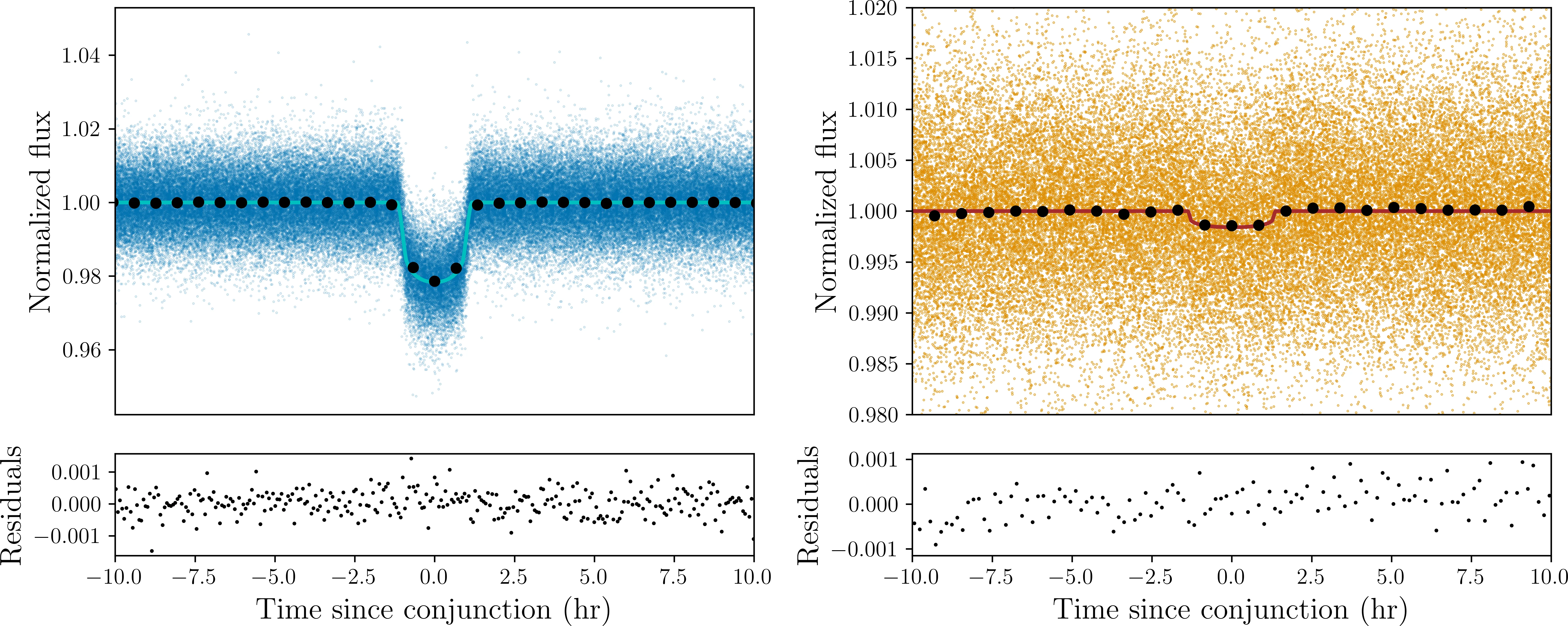
On a sunny street, there's a house with a big family: a giant father who always sits by the window and a small child running around the yard. That's the TOI-4468 system: a gas giant hot Jupiter hugs the star, while a bit farther out circles a sub-Neptune — a planet smaller than Neptune but larger than Earth.
Usually, in such families, the giant kicks out all the neighbors. When a hot Jupiter migrates inward, it scatters or swallows nearby planets. That's why until now we've only found inner companions: those hiding between the giant and the star. But here we have an outer companion and no inner ones at all. It's as if the older brother stayed in the house, didn't kick out the younger one, and just moved closer to the parents himself.
To measure the hot Jupiter's mass and radius, astronomers combined transits (the planet passing in front of the star) with the star's wobble caused by the planet. The NEID spectrograph on the 3.5-meter WIYN telescope gathered 13 data points over two years with an error of 8.1 m/s: that's like noticing a 70-kg person take a step sideways by a millimeter.
The outer planet is confirmed statistically: the triceratops code accounted for the fact that the system already has one confirmed planet, which boosts confidence in the second. The sub-Neptune's mass wasn't measured directly, but from the mass–radius relation it's estimated at 11 Earth masses.
Why did the system survive? Most likely, it avoided the early secular resonance — a slow rocking of orbital inclinations that usually pushes outer companions out of the transit plane. Either the star wasn't oblate enough, or a possible outer giant dynamically coupled the inner planets' orbits.
Back to the house: the older brother didn't just stay; he sits by the window watching the younger one play in the yard. And this is the first such case on our street, a street that's 378 light-years long.
The star TOI-4468 is 378 light-years away, and its age is estimated at 7.4 billion years — almost twice as old as the Sun. The hot Jupiter completes an orbit in 2.77 days, meaning a year on this planet lasts less than three Earth days.