Keivan G. Stassun

6 articles · 30 co-authors · latest: 2026-08-25
38,669 citations · h-index 82 · 1,081 papersData: Semantic Scholar

We have retold 6 papers by this author. 4 of them with a full read. most often about: red dwarf, brown dwarf, Sun. 30 co-authors across our retellings.

Links in the knowledge graph
Exoplanets2026-01-092 minarXiv:2601.05799express
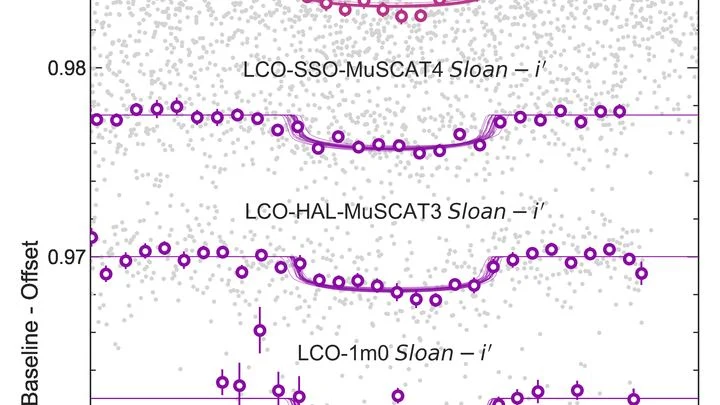
A Warm Belt Around Red Dwarfs
Two new planets are circling dim red stars. One is nearly the size of Earth, the other is three and a half times larger. Both lie in what astronomers call the warm zone: a region where starlight doesn't scorch the surface but also doesn't leave it in perpetual cold. The host stars are red dwarfs, the most common stars in the galaxy.

Stellar2026-03-172 minarXiv:2603.17001express
Cosmic Carving: Birth of a Bloated Neptune from a Jupiter
A ball, almost weightless for its size, circles its star every four days. Planet TOI-2195 A b is a real riddle: by mass it's slightly heavier than Neptune, yet bloated to Jovian volumes. If there were an ocean big enough, this exoplanet would float on its surface like a giant inflatable ball.
Cosmic Kick: Warm Orphans Born from Stellar Death
Like an exquisite clockwork mechanism, a multi-planet system responds sensitively to the slightest nudge. And when the star at the heart of this mechanism dies, shedding its envelope and turning into a white dwarf, even a modest kick at a speed of 0.75 km/s can trigger a cascade of events, flinging entire worlds into interstellar emptiness.
The Neighbor Who Wasn't Kicked Out
On a sunny street, there's a house with a big family: a giant father who always sits by the window and a small child running around the yard. That's the TOI-4468 system: a gas giant hot Jupiter hugs the star, while a bit farther out circles a sub-Neptune — a planet smaller than Neptune but larger than Earth.


