Scales Where Overly Heavy Planets Tip the System ✛
Astronomers catch distant planets by the trembling of their stars: an invisible companion tugs the star toward us and away, and its light subtly shifts in color. But that trembling tells only half the truth. If the planet's orbit is tilted to our line of sight, only part of its weight rocks the star, so telescopes reveal not the true mass but its shadow.
An interpreter distracted by every rustle in the hall stretches a one-hour meeting into two. Same here: to learn the true mass, you need the orbital inclination, and it's almost never visible. For a single planet, that's a dead end. But when several planets huddle close together, a weighmaster steps in: too heavy weights will tip the pan. Too small an inclination would mean too large masses, and the system would fall apart over its lifetime.
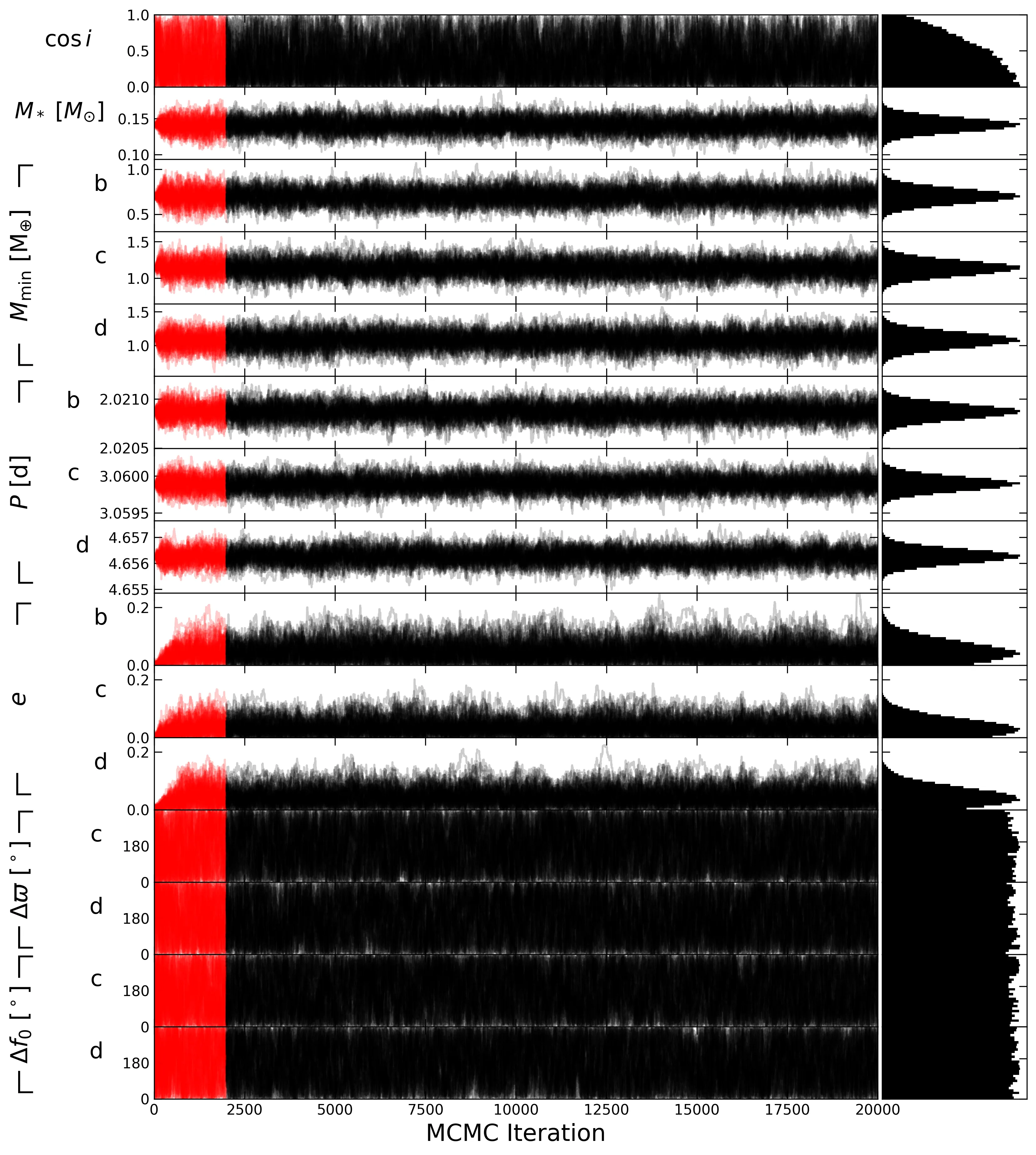
The new study puts not one planet but the whole family on the scales. For each configuration, the machine classifier spock assesses whether the system would survive, and the Bayesian inference cycles through possible inclinations, favoring those where the dance doesn't break apart. On five known systems, this approach worked: upper mass limits shrank by 20–45%. Around Barnard's star, all planets turned out lighter than 0.6 Earth masses, not giants but rocky crumbs. And the three gas balls around HD 184010 fit between Saturn and Jupiter.
The method requires no new telescopes, only old data and a bit of patience. It will prove useful for thousands of non-transiting planets expected from the fourth Gaia release. But even today it patches the main gap in the radial velocity method: now, from the star's trembling, we can judge not only the lower bound of weight but also that the scale pan hasn't flipped.
If the orbital inclination were very small, some 'planets' would turn out to be brown dwarfs, objects above the deuterium-burning limit. For instance, for the star HD 215152, Gaia astrometry excludes inclinations below 0.2 degrees, which corresponds to masses greater than several Jupiters.