True masses of exoplanets: how stability reveals orbital inclination ✛
Context
This work sits in the study of non-transiting exoplanets, where neighboring research concerns the dynamics of compact systems, atmospheric loss, and mass–radius relations. Nearby studies already use stability to constrain orbits and masses, but they either assume a known inclination or scan it manually. This paper fills the gap: it systematically includes inclination as a free parameter in a Bayesian inference, relying on a probabilistic stability classifier.
Methods
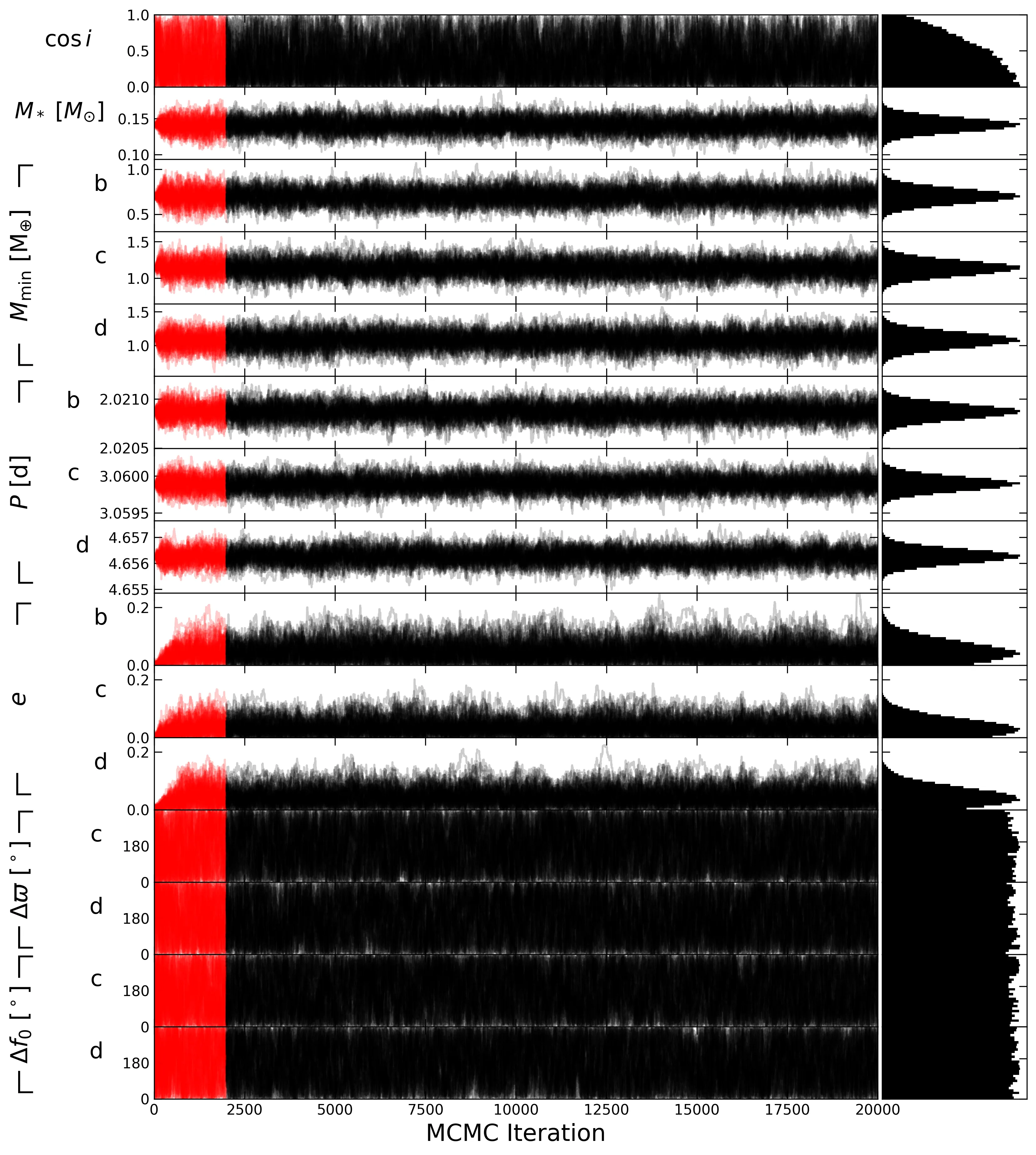
The cinemas framework builds a posterior distribution for inclination via Bayes' theorem: the stability likelihood is computed by the spock classifier for each configuration, and the prior on inclination is isotropic (sin i). System parameters, such as minimum masses, periods, eccentricities, and stellar mass, are taken from published radial velocity data as normal distributions, while arguments of periastron and mean anomalies are taken as uniform. The inference is performed with Markov chain Monte Carlo using the emcee package.
Results
For all five compact systems, the posterior inclination distribution shifts toward larger angles, corresponding to smaller masses. The upper 95% mass limits shrink by 20–45%. For example, all of Barnard's planets have masses bounded above by 0.6 Earth masses with at least 95% confidence, and the three gas giants of HD 184010 have masses between Saturn and Jupiter. For a hypothetical fifth planet in the HD 215152 system, stability weakly constrains the mass but noticeably narrows the allowed periods.
Implications
Unlike neighboring works that either fix the inclination or check individual values, here inclination becomes a full parameter of Bayesian inference with a probabilistic stability assessment. This allows uniform treatment of different systems and yields not only point constraints but also full posterior mass distributions. The work follows the trend of using dynamics to refine exoplanet properties but takes a step toward a more rigorous treatment of uncertainties.
Future development
The framework can be extended to systems with mutual inclinations, though this would require more computational resources. It is also promising to use nested sampling for model comparison with different numbers of planets and to include stability directly in radial velocity analysis. With the fourth Gaia data release, thousands of non-transiting planets will appear, for which such a method will be especially valuable.
Impact
The results will affect the interpretation of planet nature in nearby systems and the statistics of exoplanet populations, especially in the low-mass regime.
Next steps
The plan is to apply the method to a larger number of systems and integrate it into standard radial velocity analysis pipelines.
Key open problems
The work directly addresses the long-standing mass–inclination degeneracy in the radial velocity method, which hinders the determination of densities and internal structures of planets. It also touches on the prevalence of super-Earths and sub-Neptunes near stars.
The knowledge machine's view
This section is addressed to the author of the paper and their colleagues. Neighbouring works were found by meaning-based search across our archive, not by word overlap. We do not review: we show the field around the work.
What the work does
The paper presents a Bayesian framework called cinemas, which uses the spock stability classifier to constrain the inclinations and masses of exoplanets in compact systems. The authors applied it to five systems and reduced the upper mass limits by 20–45%, finding, for example, that Barnard's planets are lighter than 0.6 Earth masses, while the giants in HD 184010 fall between Saturn and Jupiter.
Where its strength is
The strong point is the systematic inclusion of inclination as a free parameter in the Bayesian inference, combined with a probabilistic stability assessment, which yields full posterior mass distributions without additional observations.
Where it could go next
- It might be interesting to compare this approach with methods that use transits to independently determine inclinations, thereby checking the consistency of constraints from dynamics and geometry.based on: How to Weigh a Planet by Its Shadow arXiv:2607.10175
- Related work on atmospheric loss, where planet masses are important for estimating escape rates, could benefit from applying cinemas to systems with hot Neptunes to refine their masses and thus their atmospheric fate.based on: Planetary Collisions and Their Hydrogen Coat arXiv:2607.19632
Worth trying
- Test how mass constraints from stability affect atmospheric loss predictions for planets with measured radii.
- Compare the posterior inclinations from cinemas with those derived from transit observations for the same systems, if available.
- Use the spock classifier for rapid screening of large samples of compact systems to identify those where stability provides strong constraints.
Why this may matter
Refining exoplanet masses is crucial for understanding their composition and evolution, and the method can be extended to larger samples of systems discovered via radial velocity.
Nearby works in our archive
- How to Weigh a Planet by Its Shadowsimilarity 0.57
- Dark Matter Sways Distant Planetssimilarity 0.55
- How to Spot a Pale Planet in a Star's Blinding Lightsimilarity 0.54
- Disk Vortices Keep Planets from Falling Insimilarity 0.54
- Neural Network Cleans Stellar Noise from the Search for Distant Worldssimilarity 0.53
- Weighing the Dust Around Young Starssimilarity 0.53
- Planetary Collisions and Their Hydrogen Coatsimilarity 0.52
The archive is sparse around this work: the closest review is only 0.57, against a usual 0.64. It looks like few have drilled nearby.
If the orbital inclination were very small, some 'planets' would turn out to be brown dwarfs, objects above the deuterium-burning limit. For instance, for the star HD 215152, Gaia astrometry excludes inclinations below 0.2 degrees, which corresponds to masses greater than several Jupiters.
Key numbers
- reduction in upper mass limits: 20–45%
- upper mass limit for Barnard's planets: 0.6 M⊕
- mass of HD 184010 giants: between Saturn and Jupiter
- number of systems studied: 5
- speedup of spock compared to N-body: ≈105