Direct imaging is an observational technique in astronomy used to capture actual images of exoplanets by blocking out the overwhelming light of their host star. Unlike indirect methods like the transit or radial velocity techniques, which infer a planet's presence from its effects on the star, direct imaging detects the planet's own thermal or reflected light. This method is particularly effective for young, massive planets that are far from their star and still glowing from the heat of their formation.
History
The first direct image of an exoplanet was taken in 2004 by the Very Large Telescope, imaging a planet around the brown dwarf 2M1207. This was followed by the first image of a multi-planet system around HR 8799 in 2008.
How it works
The main challenge is the extreme brightness contrast between a star and its planet—often a billion times or more. To overcome this, astronomers use a coronagraph, a device that blocks the star's light, or a starshade, a spacecraft that physically blocks the star's light before it enters the telescope. The remaining light is then analyzed to reveal the faint planet. Adaptive optics correct for atmospheric distortion, and infrared wavelengths are often used because planets emit more light there.
In practice
Direct imaging is used to study the atmospheres of young giant planets, their orbital dynamics, and to search for potentially habitable rocky planets in future missions like the Roman Space Telescope.
Fun fact
The first directly imaged exoplanet, 2M1207b, is about five times the mass of Jupiter and orbits a brown dwarf at a distance similar to that of Neptune from the Sun.
Astronomers catch distant planets by the trembling of their stars: an invisible companion tugs the star toward us and away, and its light subtly shifts in color. But that trembling tells only half the truth. If the planet's orbit is tilted to our line of sight, only part of its weight rocks the star, so telescopes reveal not the true mass but its shadow.
In the dark outskirts of our Galaxy, far from bright star clusters, millions of black holes lurk. They are invisible: they don't shine and don't noticeably accrete matter. Conventional search methods, designed for dense stellar fields, are useless here. A different approach is needed.
Astronomers have proposed using the very fabric of space as a detector.
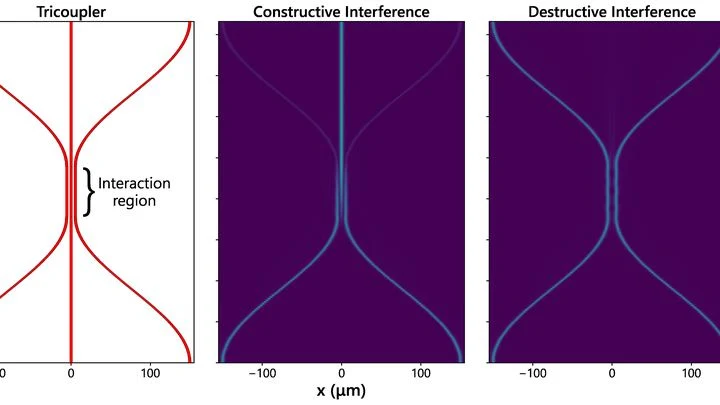
Every night, hundreds of observatories scan the sky, yet planets around other stars remain ghosts. Their light is billions of times fainter than the glare of their parent star — the task seems hopeless. But optics found a way: rather than block the star’s light, cancel it with a counter-wave of the same amplitude, shifted by half a period.
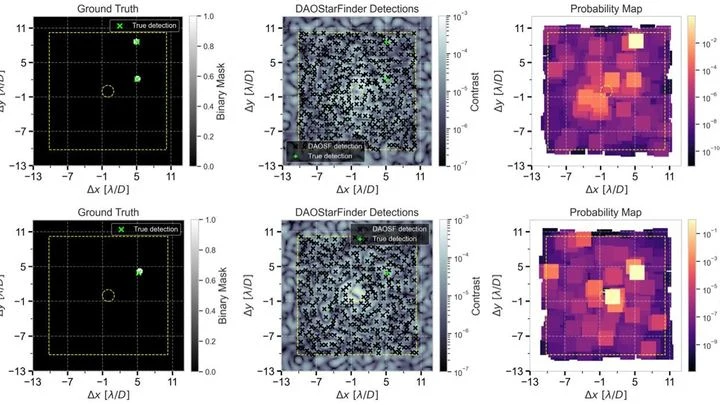
A pebble on a streambed lies still as sunlight sparkles dance on the water's surface. In astronomy, the contrast is similar: a real exoplanet is the stone, while myriad speckles (patches of scattered starlight) are the ripples trembling in instruments.
When a distant planet passes in front of its star, it briefly blocks part of the light. Astronomers call this a transit and judge the planet's size by the depth of the dip. But light has a property: a massive body acts like a lens. Even a giant planet can slightly bend the star's rays, and the dip becomes a bit shallower than you might expect.
A spotlight blazes straight into your eyes, and a few steps away a tiny firefly flickers. That's roughly what it's like hunting for an Earth-like planet around a neighboring star: the planet is a hundred million to ten billion times fainter than its star, and in the sky they almost merge into a single point.
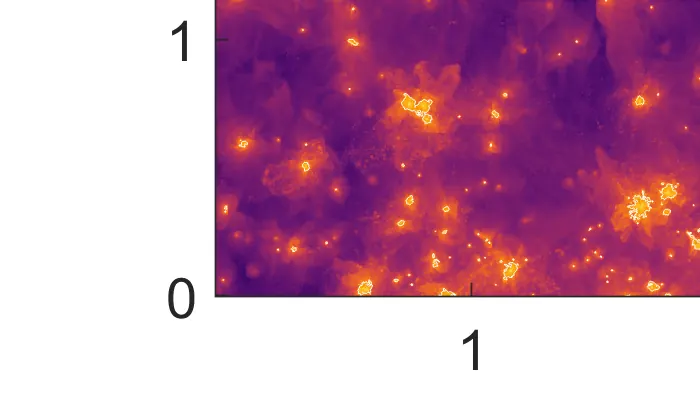
In the young Universe, about ten billion years ago, galaxies resembled endless fields after a thunderstorm: everywhere, giant — thousands of light-years across — clumps of star formation were boiling up, where young stars were born with unbridled energy. Today, these patches are an almost vanished species: in nearby galaxies, raucous hotbeds are rare.
The birth of planets resembles the workings of a cosmic forge. Rocky blocks collide and fuse together. A powerful impact strikes a spark — material heats to white-hot and glows like cooling metal. Computer simulations show: the flash is visible from days to years, peaking at a tenth of the sun's light.
When a planet slips behind the edge of its star, the star backlights the planet's atmosphere, just as a setting sun illuminates clouds on the horizon. This brief moment, lasting only minutes, carries the imprint of the gases through which the starlight has passed.
A stellar river winds around the center of a distant galaxy like a glowing ribbon on an invisible frame. That frame is the dark halo: a vast cloud of invisible dark matter whose gravity holds stars and gas in place. If the halo is squashed like a pumpkin or stretched like a melon, the stellar stream will bend differently.
Astronomers pointed JWST at a planet near the star Epsilon Indi — a giant gas ball resembling Jupiter, just 12 light-years away. In thermal images, the planet shone like a lantern. But nearby they noticed a faint dot — like a firefly. Calculations showed that two objects describe the picture better than one. However, it's most likely a lens flare — like a ghost of a lamp.
A neutron star is the dead core of a massive star, crushed to the size of a city. A teaspoon of its material weighs as much as a mountain. Dark matter particles fly through such a dense medium almost unimpeded, but occasionally they do hit neutrons and get stuck, like bullets bogging down in deep sand.
Every galaxy floats in an invisible cloud of gas, like fruit in syrup. This gas is the leftover building material from which stars were assembled, and it is constantly replenished by fresh supplies from intergalactic space. Seeing it directly is nearly impossible: it is too tenuous and too cold.
Every galaxy is wrapped in an invisible shell of hot gas, like steam rising from a pot of boiling water. This gas barely glows in X-rays, making it notoriously difficult to measure. Yet it holds the memory of stellar explosions and the galaxy's growth.
The new method uses light from a galaxy's bright center.
Gas is nearly invisible, but it has a temperature, and you can read it from how the gas 'shadows' the thermal background. In the experiment, a camera looks at a warm screen through a jet of carbon dioxide. If the gas is cooler than the background, it appears as a dark spot; if warmer, it appears bright.
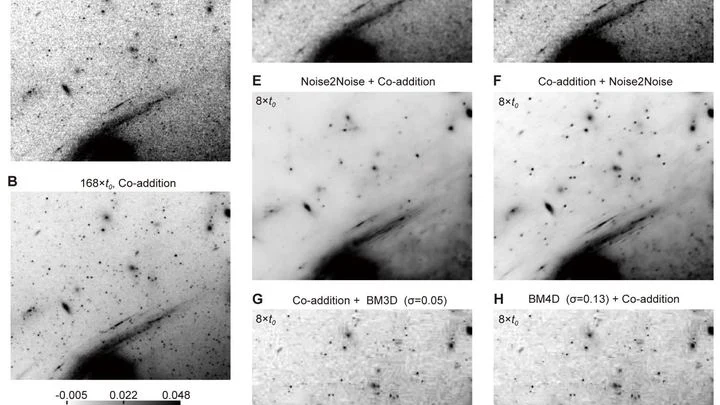
The night sky in a telescope image looks like a photo taken through a fogged-up window: bright stars are visible, but everything faint drowns in a murky haze. That haze is noise — random interference from electronics, heat, and the atmosphere itself.
Entangled photons are like twins: what affects one instantly affects the other, even if they are separated by kilometers. Until recently, observing such a connection required detectors that counted each photon individually in pitch darkness. Physicists simplified the task by swapping them out for a regular scientific camera.