Star Polymers Embrace Their Prey ✛
An octopus waits with tentacles spread wide. No central controller directs its arms, but the moment prey touches one, all eight wrap around it. Physicists have recreated a similar trick in the lab with a body that has neither neurons nor muscles: a star polymer with self-propelled arms.
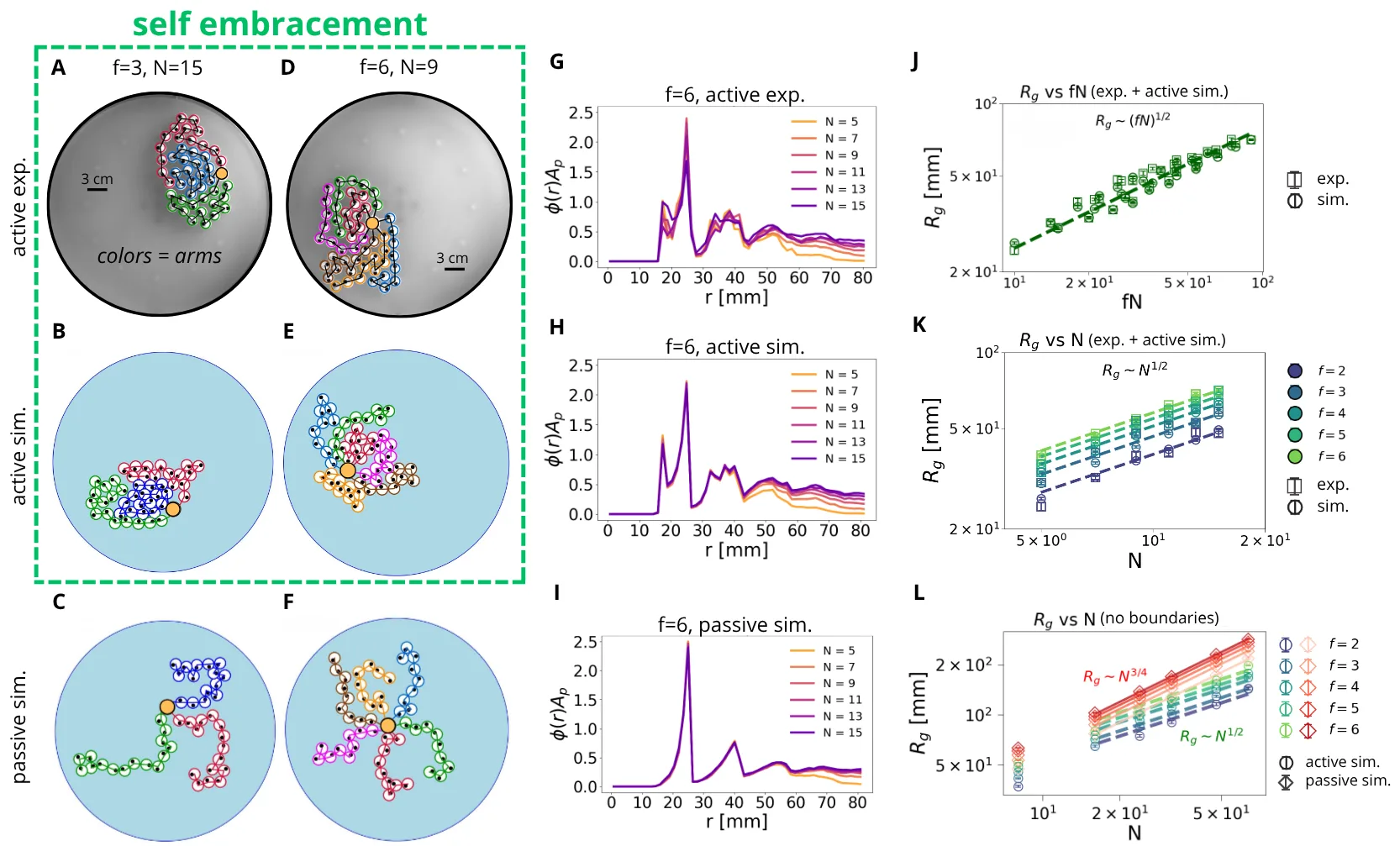
The polymer was assembled from small cylindrical vibrobots on a vibrating plate. Active monomers have tilted legs, so each one crawls on its own; passive cores have vertical legs and stay in place. The monomers were connected by rigid rods into a star with several arms. Individual arms pull in different directions, but together, colliding and catching on each other, they fold the whole structure into a tight ball. This was dubbed an active embrace.
Friction plays a key role. When active arms collide, contact friction prevents them from simply sliding past each other and makes them catch. In simulations where friction was removed, self-capture disappeared. Thus, self-propulsion of individual parts turns into coordinated wrapping around the core, and also around any objects nearby.
In a bath of passive particles, an active star captures them by wrapping its arms around them. At low particle density, it holds nearly 10 times more than a passive star; at high density, about 4 times more. Several active stars can embrace each other, forming stable clusters: their contact area is noticeably larger than that of passive stars.
Previously, it was unclear whether a star architecture with active arms could be made to deliberately grab objects. Now it is clear: yes, if self-propulsion is combined with friction. Already today, this principle is suitable for soft gripper robots at the macroscale, and in the future, for microscopic delivery systems. The octopus made of vibrobots does not think, but it embraces its prey as if it knows why it has arms.
Active star polymers capture passive particles like a spider wrapping its prey in its legs, even though they have neither a nervous system nor sensors.
The behavior of active star polymers resembles soft robotic manipulators from science fiction, such as Doctor Octopus's tentacles in the Spider-Man universe, which autonomously grasp objects.