Stellar collapse is the dramatic final act of a star's life, when its core can no longer support itself against gravity. While the basic story — core collapse, bounce, and either a neutron star, black hole, or supernova — is well known, the details are shaped by two often-overlooked players: rotation and magnetic fields. These forces can deform the collapsing core, launch jets, and even determine whether the star explodes or quietly settles into a compact remnant. The process is not a simple implosion but a complex, dynamic interplay of gravity, pressure, and electromagnetic forces.
History
The role of rotation and magnetic fields in stellar collapse was recognized in the mid-20th century, with key contributions from theorists like Chandrasekhar and later through numerical simulations in the 1990s and 2000s. The specific mechanism of magnetorotational supernovae was proposed in the 1970s by Bisnovatyi-Kogan and later developed by others.
How it works
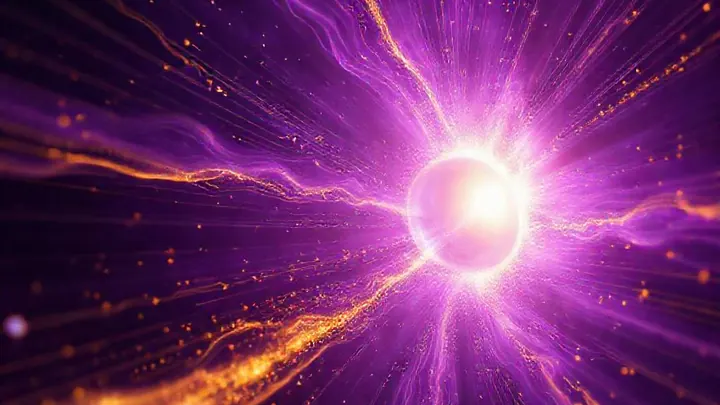
As a massive star exhausts its nuclear fuel, the core's pressure support fails and it begins to collapse inward. If the core is rotating, it spins faster as it shrinks (like an ice skater pulling in their arms), which can flatten the core into a disk-like shape and slow the collapse. Magnetic fields, frozen into the stellar plasma, get wound up and amplified by this differential rotation, creating powerful magnetic pressure and launching relativistic jets along the rotation axis. These jets can punch through the outer layers of the star, carrying away energy and angular momentum, and in some cases, they are the very mechanism that triggers the supernova explosion. The interplay between rotation and magnetic fields can also lead to a 'magnetically arrested' collapse, where the magnetic field acts as a brake, preventing the core from collapsing directly into a black hole and instead producing a highly magnetized neutron star (a magnetar).
In practice
Understanding this mechanism is crucial for interpreting observations of supernovae, gamma-ray bursts, and gravitational wave signals from collapsing stars, and for predicting the properties of the neutron stars and black holes they leave behind.
Fun fact
The magnetic field inside a collapsing stellar core can become so strong that it would strip the electrons off atoms from a distance of a thousand kilometers.
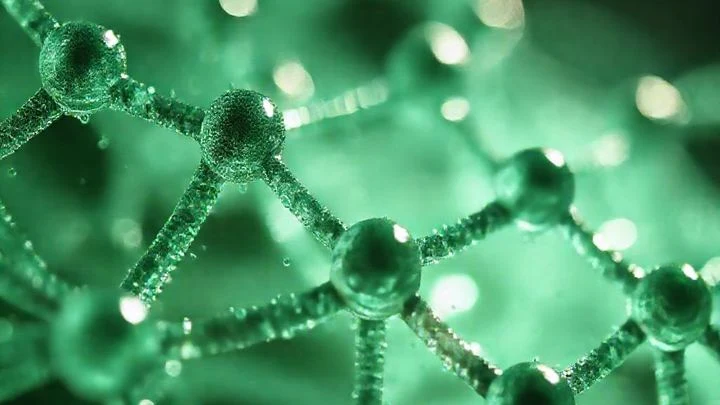
An octopus waits with tentacles spread wide. No central controller directs its arms, but the moment prey touches one, all eight wrap around it. Physicists have recreated a similar trick in the lab with a body that has neither neurons nor muscles: a star polymer with self-propelled arms.
The polymer was assembled from small cylindrical vibrobots on a vibrating plate.
The James Webb Space Telescope JWST has peered into the heart of supernova remnant SNR 0540-69.3 — what remains after a massive star died in a neighboring galaxy. Inside, amid the flying debris, astronomers saw a clear pattern: glowing clumps and voids arranged in a symmetric design.
At the heart of a warp drive lies Einstein's idea that massive bodies curve spacetime — the very stage on which all cosmic events unfold. Picture a bubble of such curved spacetime. Inside it, the ship floats without any G-forces, like a passenger in an airplane cabin who doesn't feel the headwind.
A massive star ends its life in a spectacular collapse: the core compresses into a neutron star or a black hole, while the outer layers fly off in a dazzling supernova.
Immediately after the Big Bang, in the seething cauldron of the cooling Universe, much like in unevenly hardening glass, stresses appeared — hairline cracks in reality, cosmic strings. Picture a tightrope walker balancing on an invisible cable stretched across the abyss of warped spacetime.
A figure skater pulls their arms in, and their spin suddenly accelerates. When a massive star exhausts its fuel and its core collapses, something similar happens, but on a cosmic scale. The core shrinks to a city-sized sphere, and if it is spinning rapidly, a peculiar instability can arise.
A pot of boiling porridge, where instead of grains there are layers of oxygen and silicon, and the fire beneath is about to go out, and the star will collapse in on itself. Until now, astrophysicist cooks have used a simplified recipe: they assumed that bubbles and eddies in the porridge obey one and the same average temperature throughout the depth.
Imagine a soap bubble with electricity trapped inside and walls made of an invisible field: that's roughly what a black hole with 'resonant hair' looks like. This isn't real hair, but a cloud of scalar field held around the hole by its own interactions.
The fate of a civilization isn't just a matter of luck or disasters. Scientists simulated a thousand years of history under ten different scenarios, accounting for resource consumption, governance, and random shocks. The key metric turned out to be the 'activity coefficient' – the fraction of time when a civilization is technologically alive. At best, this fraction nears 100%; at worst, it drops to 38%.
A massive star, 40 times heavier than the Sun, dies in a fraction of a second. Its core compresses like a spring squeezed too hard, then snaps back: that's a supernova explosion. But what if the star is also spinning, like a figure skater pulling in their arms, and threaded with a magnetic field, like invisible strings?
A solar flare is like a tightly coiled spring suddenly uncoiling. In the Sun's corona, energy accumulates in the twisted magnetic field, and then it is abruptly released, accelerating particles and heating plasma.
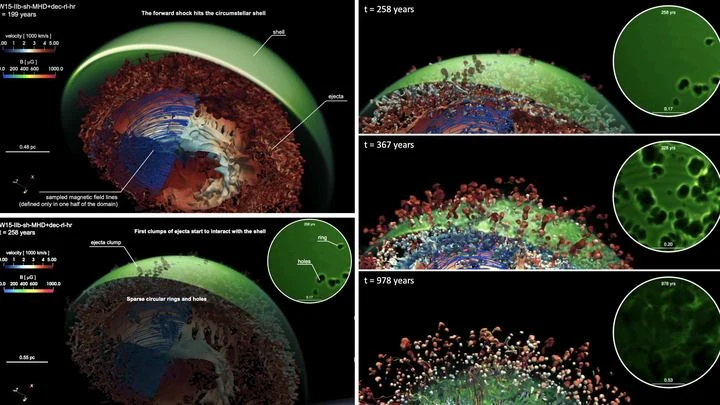
The James Webb Space Telescope peered into the remnant of the supernova Cassiopeia A — a cloud of gas left behind after a massive star exploded. There, it spotted an intricate web of glowing filaments and a mysterious structure dubbed the 'Green Monster,' featuring nearly circular holes and rings.
A neutron star is the ultra-dense remnant of a supernova explosion, whose existence was predicted by Fritz Zwicky back in the 1930s. Later, Jocelyn Bell Burnell detected them as pulsars — rotating sources of strictly periodic radio signals.
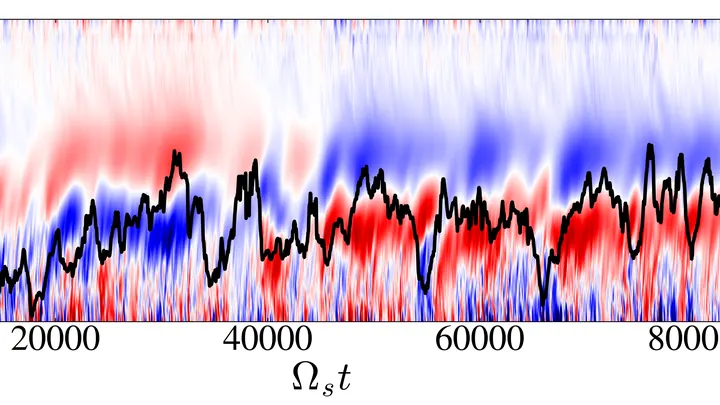
A young star is like a layered spinning top: its outer layers rotate slower, its inner ones faster. The magnetic field here acts like sturdy threads binding these layers together. When the speeds differ, the threads begin to twist and stretch more and more.
The universe exists in a state of false vacuum, like water behind a dam. Behind it lies the true vacuum — an abyss with different laws. Normally, water can only seep through the pores in a thin trickle (a quantum effect), barely changing the level.