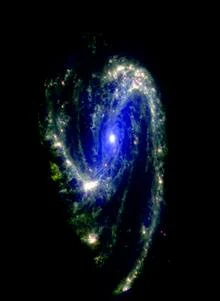
Spiral arms are the bright, curving regions of enhanced star formation that extend from the center of a spiral galaxy, giving it its characteristic pinwheel appearance. They are not solid structures but rather density waves that move through the galactic disk, compressing gas and dust as they travel. This compression triggers the collapse of molecular clouds, leading to the birth of new, massive stars that illuminate the arms with their intense radiation.
History
The density wave theory was developed in the 1960s by Chia-Chiao Lin and Frank Shu, building on earlier ideas by Bertil Lindblad.
How it works
The leading theory, the density wave theory, posits that gravitational instabilities create a rotating pattern of higher density in the galactic disk. As interstellar gas and dustorbit the galaxy at slightly different speeds than the pattern, they pass through these density peaks, get compressed, and form stars. The newly formed stars, especially the bright, short-lived blue ones, mark the location of the wave before they die out, leaving the pattern visible.
The Sun is currently located in a small spur between two major spiral arms, the Perseus and Sagittarius arms, and it takes about 230 million years to complete one orbit around the galactic center.
An octopus waits with tentacles spread wide. No central controller directs its arms, but the moment prey touches one, all eight wrap around it. Physicists have recreated a similar trick in the lab with a body that has neither neurons nor muscles: a star polymer with self-propelled arms.
The polymer was assembled from small cylindrical vibrobots on a vibrating plate.
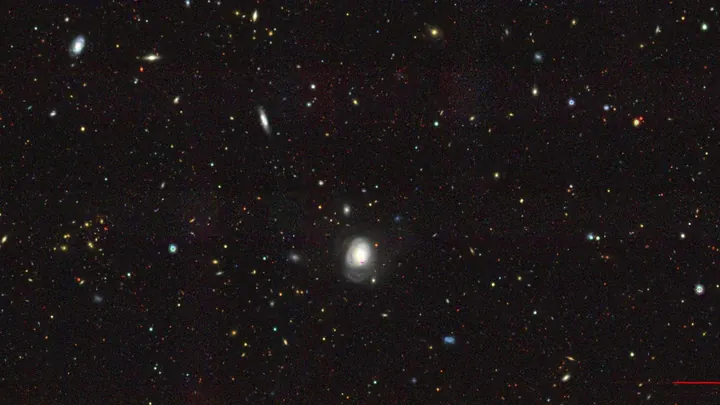
An old city gains new suburbs. In the center, narrow streets where life has nearly stopped, while on the outskirts construction is booming. That is what a spiral galaxy looks like when its core stars have long aged and new stars are still being born in the outer disk.
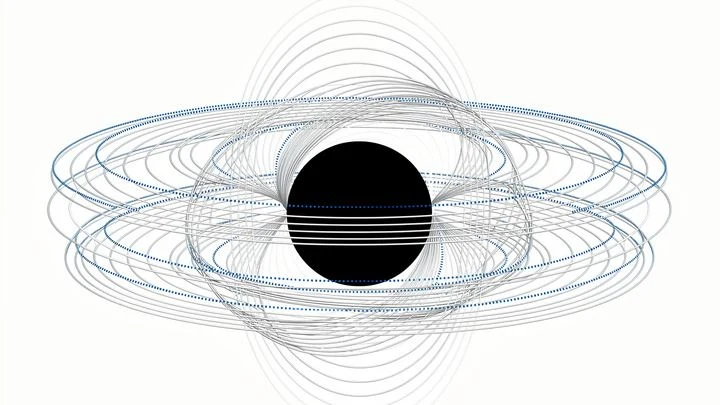
At the hearts of many galaxies, cosmic tops of incredible power spin — supermassive black holes. Their nature was first described by Schwarzschild right after Einstein gifted the world with general relativity.
At the center of a tiny galaxy lies a dense clump of stars and dark matter. This clump, called a soliton, is not frozen in place: it quivers and oscillates like jelly on a plate.
The early Universe is often imagined as a nursery: most galaxies there are amorphous blobs, rowdy and irregular, choking on gas and bursts of star formation.
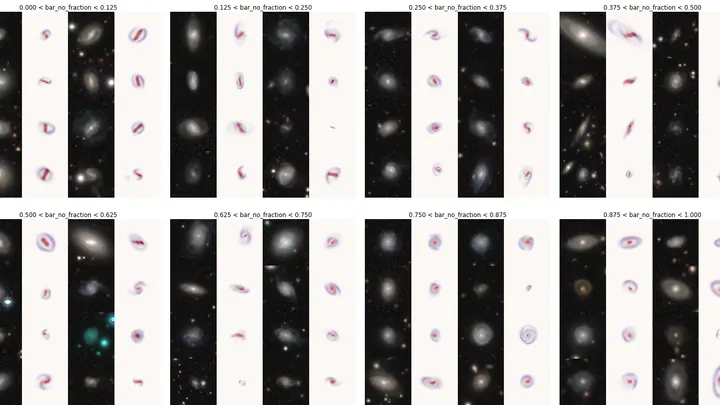
An ordinary photo editor highlights objects in an image. The ZooBot:3D neural network works with distant galaxies like a cartographer drawing a map of an unexplored land.
Imagine a dark room with dust floating in the air. A bright flashlight goes off, and the dust particles light up, revealing their positions. Astronomers have applied a similar trick to our Galaxy. The flashlights were gamma-ray bursts, the most powerful explosions in distant galaxies, and the dust particles were interstellar clouds.
In the distant universe, when it was just a couple of billion years old, many galaxies resembled boiling cauldrons: gas clumped so quickly that stars ignited one after another, and dust heated up and shone brightly in the submillimeter range.
Like a river that suddenly disappears underground, the Perseus Arm in the Milky Way breaks off in a region astronomers call the Giraffe Bay. Where the bright band of stars should continue, a dark 'void' is visible.
For a long time, astrophysics was dominated by the belief that giant jets of radio emission, radio outbursts blasting from central regions, were the exclusive privilege of elliptical galaxies. It was thought that only their calm, featureless internal environment could allow such colossal fountains of energy, powered by supermassive black holes, to form.
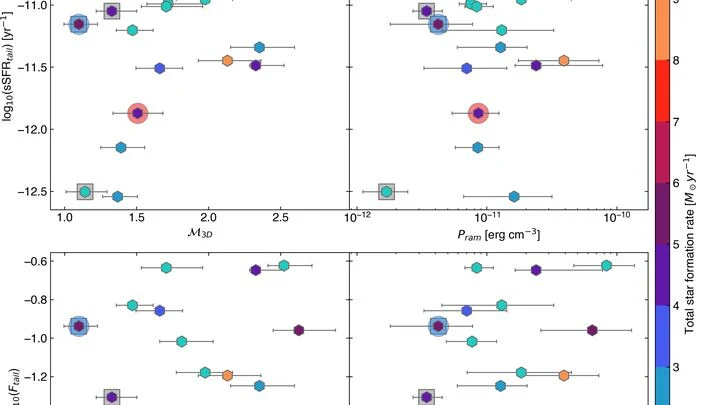
A galaxy plunges into a dense cluster like a runner into a crowd. The oncoming gas, known as the intracluster medium, strips away its own gas, stretching it into a long, glowing tail. Astronomers call these galaxies jellyfish: they have a body and flowing tentacles of stripped material. But only in a few do new stars ignite within those tentacles.
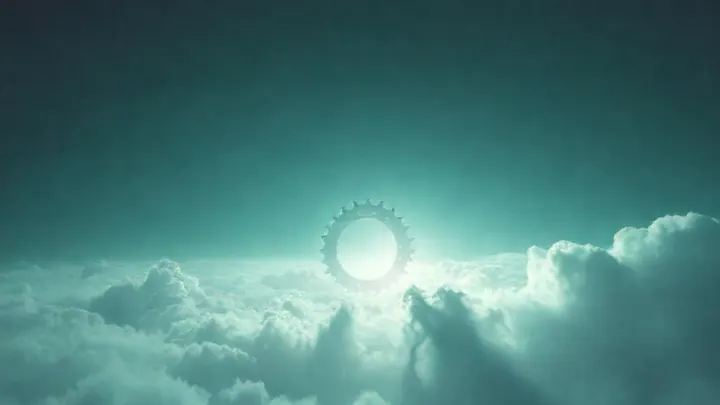
A wormhole is a tunnel through space, connecting distant regions of the Universe. Its shadow against a bright gas background was long thought to be as round as that of a black hole. But for a rotating wormhole (one you could actually traverse), the shape of the shadow might be surprising: the edge becomes jagged, like a gear.
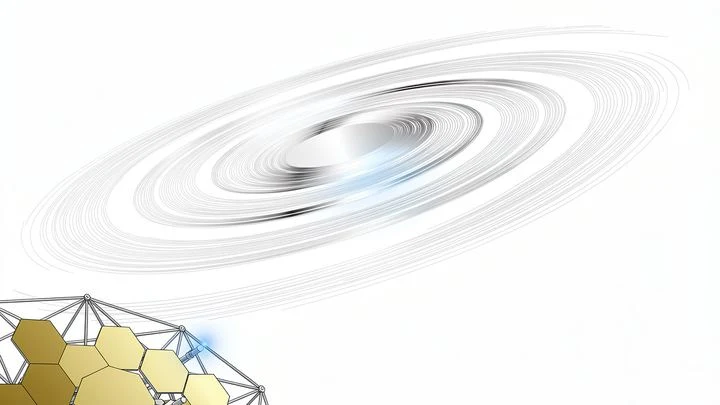
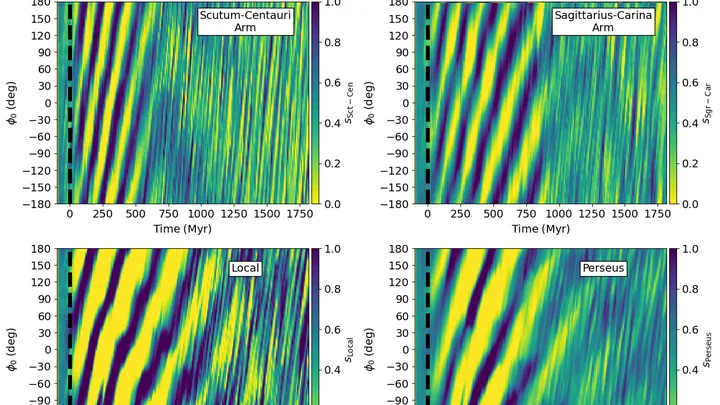
The Sagittarius galaxy plunged into the disk of the Milky Way and passed through again and again, like a stone thrown into a still pond. Each strike left ripples: waves and warps in the star field.
A galaxy cluster is like a busy intersection where galaxy-cars race through a headwind of hot gas. This wind, called ram pressure, strips galaxies of their cold gas — the fuel for star formation. Astronomers from the SAMI survey traced how this happens in hundreds of galaxies across eight nearby clusters.
In the dense, star-forming gas cloud W44, the ALMA telescope has spotted eight tiny clumps racing at enormous speeds. In position–velocity maps, each one looks like the letter V, just like the previously discovered 'Bullet'. This resemblance hints at a common origin.
Light from a distant galaxy travels toward us for billions of years, but along the way it can run into a massive galaxy cluster. Its gravity acts like curved glass: it bends the path of rays, so instead of one image, we see several — sometimes arcs, sometimes points.
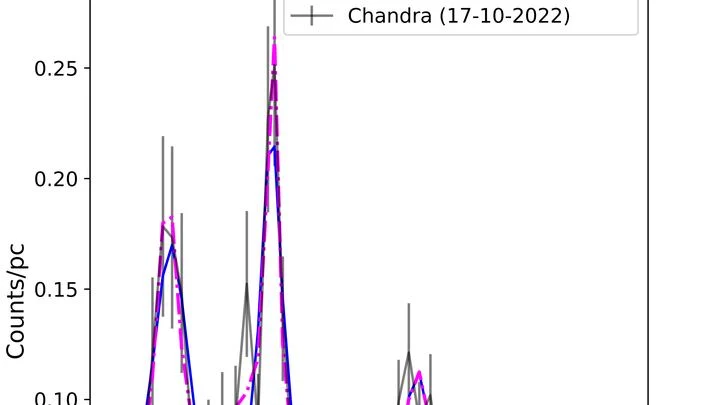
NGC 3627, a spiral beauty in the constellation Leo, harbors a trail that fits no standard scenario. A narrow band of cold gas, a molecular trail, stretches more than 8 kiloparsecs (thousands of parsecs, each about 3260 light-years) with a width of about 200 parsecs. That is like a thread as long as a football field and as thick as a pencil.