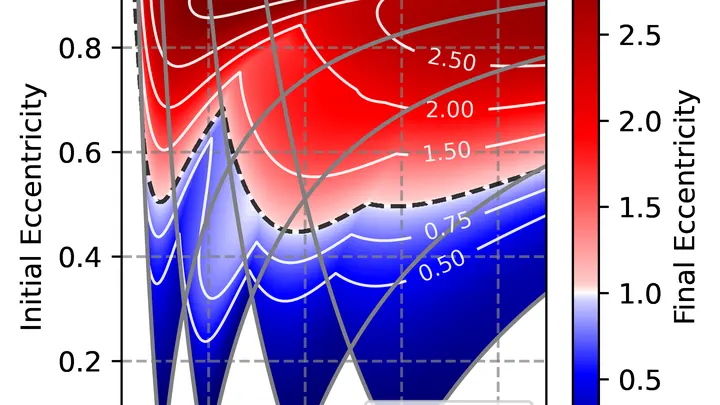
Ejection is the dynamical process in which a body in a multi-body system gains enough kinetic energy to escape the gravitational pull of the entire system. This is a fundamental process in stellar dynamics, planetary formation, and even atomic physics. In a cluster of stars, for example, close encounters can transfer energy to a lighter star, giving it a velocity exceeding the escape velocity, thus ejecting it from the cluster.
History
The concept has been understood since the early studies of celestial mechanics, but its importance in stellar dynamics was highlighted by the work of Subrahmanyan Chandrasekhar and others in the mid-20th century, particularly in the context of star clusterevolution.
How it works
In a multi-body system, gravitational interactions between bodies can exchange energy. Through a series of close encounters, a particular body may receive a net positive energy relative to the system's potential well. When its total energy (kinetic plus potential) becomes positive, it is no longer bound and will fly away. This is often described as a 'slingshot' effect, where a heavier body transfers energy to a lighter one.
In practice
Ejection is used to explain the loss of stars from globular clusters, the formation of hypervelocity stars ejected from the galactic center, and in planetary science, the ejection of planetesimals from the solar system. It also plays a role in the design of spacecraft trajectories using gravity assists.
Fun fact
The article 'Квантовый побег с орбиты' suggests that quantum effects can influence ejection processes, where particles may tunnel out of a potential well, a purely quantum mechanical analog of classical ejection.
An octopus waits with tentacles spread wide. No central controller directs its arms, but the moment prey touches one, all eight wrap around it. Physicists have recreated a similar trick in the lab with a body that has neither neurons nor muscles: a star polymer with self-propelled arms.
The polymer was assembled from small cylindrical vibrobots on a vibrating plate.
A balloon that lets out air in bursts zips around the room — the jet blasts first one way, then another. A dying star behaves the same way as it sheds its bloated shell. Only instead of air, it's superheated gas, and instead of a balloon, it's a future white dwarf (the dense stellar remnant about the size of Earth).
At a concert, moving through a dense crowd is tough — the tighter the pack, the less you want to move. That's how active matter usually behaves: swarms of bacteria or robot flocks freeze in tight quarters. But one research group found the opposite effect.
Toss a handful of coins on a table: each one lands heads or tails on its own. Now imagine the coins start flipping over, nudging each other. That's roughly how neutrinos behave in a very dense environment.
A handful of rice thrown into a glass of water scatters — the grains spread apart. Now imagine each grain propels itself forward with stubborn persistence and bounces off softly upon collision. Such particles are called active: they spend their own energy to move, like bacteria or microscopic robots.
A stream of scorching gas races away from a star, and suddenly stalls, as if it hit an invisible wall. That's exactly what researchers saw when they tried to reproduce a stellar eruption on a laboratory scale. They used a laser to create a plasma jet and shot it through a magnetic field — first weak, then strong, like that of many stars.
Interstellar wanderers are rocks and icy chunks that have broken free from their home planetary systems and now drift through the Galaxy. The first such visitor, 'Oumuamua, zipped past the Sun in 2017, followed by Comet Borisov and the ATLAS object. Where do they come from?