A star is a massive, luminous sphere of plasma held together by its own gravity. The immense pressure and temperature in its core trigger nuclear fusion, converting hydrogen into helium and releasing energy that counteracts the inward pull of gravity. Stars are the fundamental building blocks of galaxies, and their life cycles — from birth in nebulae to death as white dwarfs, neutron stars, or black holes — drive the chemical evolution of the universe, producing heavy elements that later form planets and life.
History
The understanding of stars as fusion-powered objects developed in the early 20th century. Arthur Eddington proposed in the 1920s that stars are powered by nuclear reactions, and Hans Bethe worked out the specific fusion chains in 1938-39, for which he later received the Nobel Prize.
How it works
Stars form from the gravitational collapse of dense regions in molecular clouds. As the core heats up, fusion ignites, creating an outward pressure that balances gravity in a state of hydrostatic equilibrium. The energy generated by fusion slowly works its way to the surface and is radiated into space. The star's mass determines its temperature, luminosity, and lifetime: more massive stars burn hotter and die faster, while smaller stars like our Sun can shine for billions of years.
In practice
Stars serve as natural laboratories for studying plasma physics, nuclear reactions, and extreme states of matter. They also act as 'cosmic furnaces' that produce the elements necessary for life, and their light is used to measure distances and the expansion of the universe.
Fun fact
The Sun alone converts about 600 million tons of hydrogen into helium every second, yet it has enough fuel to continue shining for another 5 billion years.
An octopus waits with tentacles spread wide. No central controller directs its arms, but the moment prey touches one, all eight wrap around it. Physicists have recreated a similar trick in the lab with a body that has neither neurons nor muscles: a star polymer with self-propelled arms.
The polymer was assembled from small cylindrical vibrobots on a vibrating plate.
Boiling water in a pot is a good place to start. Bubbles of steam rise, pop, and the surface settles down. Something similar might have happened in the first moments of the universe's life with a special field filling space: bubbles of a new phase inflated and collided, like islands of steam in liquid.
The Orion Nebula is a showcase of astrophysics, a laboratory for studying star formation right in our backyard. For over a century, its light has been split into spectra, and each forbidden line whispers its own version of how many electrons per cubic centimeter.
Blazars are long-lasting beams from black holes at the centers of galaxies. Gamma-ray bursts are the briefest flashes from supernova explosions or neutron star mergers. The former act like eternal spotlights, the latter like camera flashes.
A lump of dark matter drifts through the void — invisible, almost intangible. No one knows what it's made of, but a new study suggests viewing it as a drop of quantum liquid. Two kinds of fermion particles — call them "heavy" (ψ) and "light" (χ)—exchange signals via a third mediator particle (φ), like floats tied to a single line.
In the scorching solar corona, where temperatures soar past a million degrees, float cold, dense clouds — solar prominences. They hang for weeks, neither falling nor dissolving, like icebergs in a boiling ocean. How they got there is a question that has puzzled astronomers for decades.
A river flows toward a whirlpool, but a dam with a notch blocks the way. Most water piles up before the dam, but some, gaining height, leaps over it and falls straight into the funnel. So it is with gas in a galaxy: it streams toward the center but hits a ring of stars and gas, like a dam. Usually, everything stops there, swirling into a dense vortex.
Dough rises faster when it already contains yeast. Similarly, galaxies may have assembled faster if they already had black holes inside. Astrophysicists considered a scenario where the universe contained primordial black holes from the very beginning — objects that could have formed in the first instants after the Big Bang.
Light from the galaxy PAN-z14-1 began its journey when the universe was 400 million years old — a cosmic infancy. The expansion of space made it travel to us for nearly 13.5 billion years.
At the center of galaxy VV 340a lies a supermassive black hole — an object with gravity so strong that even light cannot escape it. It emits a relativistic jet: a narrow stream of matter accelerated to near-light speeds.
A few hundred million years after the Big Bang, the universe resembled an endless dark ocean, shrouded in a thick fog of neutral (non-ionized) hydrogen. Then something dispersed the gloom: ultraviolet radiation knocked electrons out of atoms, making the gas as transparent as pure water.
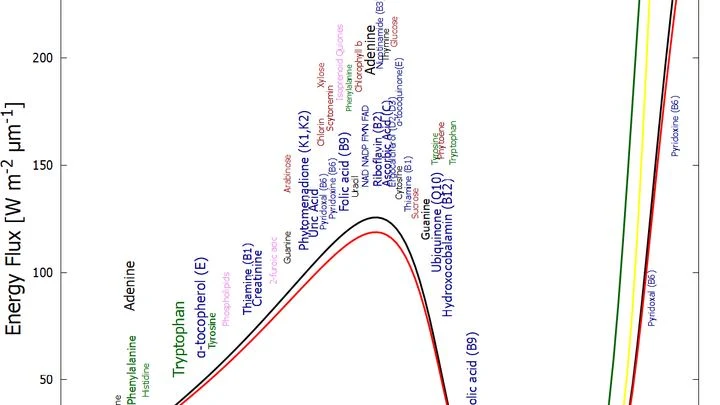
Life began with molecules akin to natural sunscreen — based on carbon, they soaked up the mild ultraviolet of the young Sun and turned it into heat. This way of dissipating energy wasn’t just heating: it made molecules self-organize, like chefs kneading structured dough out of a chaos of ingredients. But ultraviolet is a finicky tool.