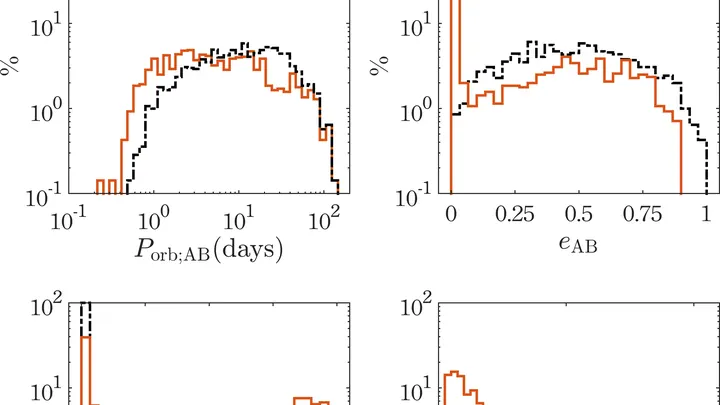
Magnetic braking in binary star systems is a process where the orbital motion of the two stars is slowed down due to electromagnetic interactions. In a close binary system, if one star has a strong magnetic field and a stellar wind, the wind particles are forced to co-rotate with the star out to a large distance, carrying away angular momentum. This loss of angular momentum from the star's rotation also affects the orbital motion of the binary, causing the stars to spiral closer together over time. This mechanism is particularly important for the evolution of cataclysmic variable stars and other compact binaries, as it drives them toward mass transfer and eventual merger.
History
The concept of magnetic braking was proposed in 1966 by Ludwig Biermann and Rolf Kippenhahn, who suggested that stellar winds in magnetic stars could remove angular momentum. The application to binary star evolution was developed in the 1970s and 1980s, notably by Bohdan Paczyński and others, to explain the period gap in cataclysmic variables.
How it works
The magnetic field of a star, such as a low-mass main-sequence star, extends into space and interacts with the ionized stellar wind. The wind is forced to rotate with the magnetic field lines out to the Alfvén radius, where the magnetic energy density equals the kinetic energy density of the wind. Beyond this radius, the wind escapes, carrying with it angular momentum that is extracted from the star's rotation. In a binary system, the star's rotation is tidally locked to the orbital period, so the loss of rotational angular momentum is transferred to the orbit, reducing its separation and period. This process is most effective for stars with strong magnetic fields and high mass-loss rates.
In practice
Magnetic braking is used in models of binary star evolution to predict the orbital periods of systems like cataclysmic variables and to understand the formation of compact binaries that eventually merge, producing gravitational waves detectable by observatories like LIGO.
Fun fact
Magnetic braking is so effective that it can shrink the orbit of a binary system by a factor of two over a few billion years, dramatically altering its future evolution.
An octopus waits with tentacles spread wide. No central controller directs its arms, but the moment prey touches one, all eight wrap around it. Physicists have recreated a similar trick in the lab with a body that has neither neurons nor muscles: a star polymer with self-propelled arms.
The polymer was assembled from small cylindrical vibrobots on a vibrating plate.
A stellarator fusion reactor resembles an intricately twisted magnetic cocoon. Its job is to confine superheated plasma so that hydrogen nuclei fuse and release energy. But the cocoon's three-dimensional shape creates gaps: some particles escape, especially the fastest ones, which carry most of the heat.
Two stars circle each other, gradually drawing closer. Their dance loses energy, and that energy escapes into space — in the form of gravitational waves, and sometimes other fields.
Light from the very beginning of the cosmos has been traveling toward us for 13.8 billion years. During that time, its polarization, the direction of its oscillations, might have been twisted, like a compass needle that someone quietly nudged. Physicists call this phenomenon cosmic birefringence.
Quantum entanglement — a phenomenon where the states of two or more particles become interconnected regardless of the distance between them — usually links intrinsic properties such as spin or polarization. However, a new experiment has for the first time realized entanglement of the positions of two atoms in space.
Inside a neutron star, matter is compressed so intensely that atomic nuclei fuse into long strands and flat sheets. Astrophysicists call these structures nuclear pasta. At their surface, the density of matter plummets to nearly zero, like diving out of thick jelly into thin air.
It's this sharp transition that creates the unusual effect.
A streetlamp flickers as someone walks past. That's roughly how our nearest star, Proxima Centauri, behaves: it flares in response to the motion of its planets.
Astronomers observed the star with a highly sensitive instrument, the ESPRESSO spectrograph. It captures light and splits it into colors, much like a prism.
Holding a phone number in your head while you dial it: that's working memory. In the brain, a group of cells is responsible for this, sending signals to each other like people passing a bucket along a chain. But every transfer has a cost: it requires messenger substances that get used up.
Two stars orbit a common center, accreting gas from a surrounding cloud. Rotating disks of gas form around each star and around the pair as a whole. From these disks, jets shoot out like hoses. Inside the disks, gas is constantly churned — that's the magnetorotational instability at work.
When two heavy bodies collide, they don't always stay put. Merging black holes get a powerful kick, like the recoil of a gun, but instead of gunpowder, it's the curvature of spacetime doing the work. This kick can send the new hole flying out of a galaxy's center or even beyond its outskirts.
31 Aquilae is an aging star that has puffed up into a subgiant. It once resembled the Sun, but has since cooled and grown larger. It rotates very slowly — one full turn takes many days.
Double stars lose speed like a figure skater who slows their spin by extending their arms. In a close pair, one star transfers mass onto a white dwarf. The magnetic field of the donor star, consisting mostly of hydrogen, entangles the outflowing gas and flings it away, as if the skater's arms were pulling the spin outward.
A spinning top whirls slower and slower until it stops. Neutron stars, the ultra-dense remnants of exploded stars, have their own 'stalling period.' In a new study, astronomers noticed that the rotation periods of two types of such stars, magnetars (with very strong magnetic fields) and dim X-ray neutron stars, cluster…
Ordinary tiles form a repeating pattern. But atoms can do more: under certain conditions, they themselves lay out a complex mosaic where the pattern never repeats, like on antique tile panels.
Two sheets stacked together behave differently than they do separately. The same is true in the world of two-dimensional crystals: if you take two layers of a material one atom thick and place them on top of each other with a slight shift, their magnetic properties can change completely.
The young star RY Tau is like a finicky spinning top. Around it whirls a flat disk of gas and dust — the leftovers of the cloud from which the star was born. The star pulls some of the disk's matter toward itself like a vacuum cleaner, and flings some back out in a narrow wind cone like a fountain.
For thirteen straight years, the Swift space observatory recorded the X-ray "breathing" of the pulsar GX 301-2. Every few minutes, the BAT instrument measured how much hard radiation came from this pair — a neutron star and its massive companion.
Space works like a billiard table. Massive outer planets, like heavy balls, transfer their energy to light inner worlds. Such a gravitational kick can fling a small planet out of the stellar system. It turns into a free-floating wanderer — a rogue exoplanet without a star.
Detecting these invisible bodies is hard: they neither emit nor reflect light.
A young star is like a layered spinning top: its outer layers rotate slower, its inner ones faster. The magnetic field here acts like sturdy threads binding these layers together. When the speeds differ, the threads begin to twist and stretch more and more.
Two stars, drawing together in a cosmic dance, experience an extra wobble — a consequence of spacetime curvature (an effect predicted by Einstein). A planet orbiting them also wobbles. Sometimes the rhythms align: the gravitational tugs from the stars fall in step with the planet’s orbit, like hands pushing a swing.
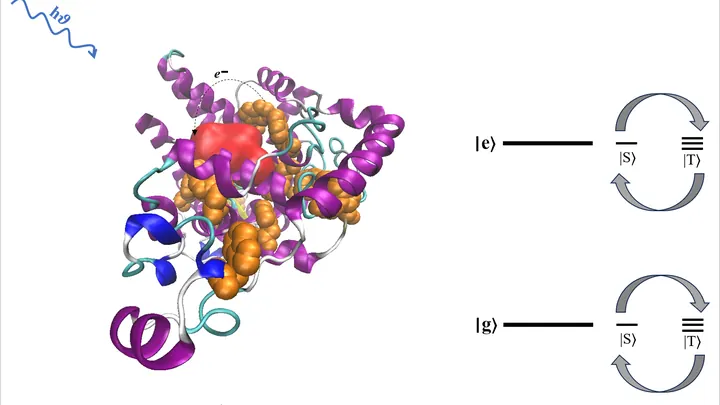
Birds migrate using the magnetic field. In their eyes, there's a protein called cryptochrome. It captures sunlight, especially blue light, and triggers a reaction. Absorption of light leads to the formation of a particle pair that is acutely sensitive to magnetic fields.