Laser trapping is a technique that uses the momentum and electric field of laser light to confine, manipulate, and cool microscopic and even macroscopic particles—from individual atoms and molecules to dust grains and living cells. It encompasses optical tweezers, which trap transparent objects in a focused beam, and magneto-optical traps, which cool and confine neutral atoms. The method is fundamental to modern physics, enabling experiments from quantum computing to dark matter detection, and it has become a versatile tool in biology and materials science.
History
The foundational ideas were developed in the 1970s and 1980s. Arthur Ashkin pioneered optical tweezers in the 1970s, while Steven Chu, Claude Cohen-Tannoudji, and William Phillips developed laser cooling and trapping of atoms in the 1980s, earning the 1997 Nobel Prize in Physics.
How it works
The mechanism relies on the transfer of momentum from photons to the trapped object. In optical tweezers, a tightly focusedlaser beam creates a gradient force that pulls a dielectric particle toward the region of highest intensity, while scattering forces push it along the beam direction; by balancing these, a stable trap forms. For atoms, laser cooling uses the Doppler effect: atoms moving toward a red-detuned laser beam absorb photons and slow down, while the trap's magnetic field creates a position-dependent force, confining the cooled atoms at a specific point.
In practice
Laser trapping is used to hold single molecules for biophysical studies, to isolate and study individual atoms for quantum computing, and to levitate microspheres as ultra-sensitive detectors of forces, including potential dark matter interactions.
Fun fact
Laser trapping can hold a living bacterium without killing it, allowing scientists to study its behavior in a controlled optical 'cage'.
In a dark room, you can hold a glowing sphere without touching it: walls of light push it away but do not burn it. That is roughly how the trap built in Rio de Janeiro for yeast cells works. A conventional optical tweezer, that is, a focused laser beam, acts like tweezers made of light, but the light itself pierces the cell from side to side.
An octopus waits with tentacles spread wide. No central controller directs its arms, but the moment prey touches one, all eight wrap around it. Physicists have recreated a similar trick in the lab with a body that has neither neurons nor muscles: a star polymer with self-propelled arms.
The polymer was assembled from small cylindrical vibrobots on a vibrating plate.
A laser beam focused to the size of a dust speck can hold a single molecule, much like tweezers hold a tiny bead. But filling a hundred such tweezers with exactly one molecule each is like trying to put a single drop of water into every compartment of an egg carton without spilling a drop.
The laser beam in an optical tweezer is not just a spot of light but a force bag. A particle caught in it usually rolls toward the brightest point, like a ball into a dimple.
A laser beam strikes a thin target hidden inside layers of another material. Within billionths of a second, the material is compressed to a density of 25 grams per cubic centimeter, as if a piece of lead became more than twice as heavy without moving an inch.
In a thin perovskite film, a material for cheap solar cells, light creates pairs of charges: an electron and a "hole." They need to reach the electrodes and produce current, but many vanish along the way. Where exactly they go is the question that determines how efficient the cell will be.
A stack of playing cards lies still. You can slide the top card with your finger: that's crude intervention. Or you can blow so that the whole stack momentarily changes shape, but the cards don't scatter. That's roughly how light, in a new experiment, rearranges a crystal of tin selenide (SnSe).
Usually, to change the structure of a solid, you heat it or pass a current through it.
Catching a single molecule in a beam of light and nearly stopping its motion is like trying to hold a dandelion fluff in a gust of wind. A particle that's too hot slips out of the trap, so physicists first tame its thermal jitters with laser cooling.
The authors applied a technique called Sisyphus cooling to strontium hydroxide (SrOH) molecules.
Dark matter — the invisible architect of the universe, holding galaxies from flying apart. Thanks to the pioneering work of Fritz Zwicky and Vera Rubin we know: ordinary matter in the cosmos is just a negligible impurity. But what lies behind this dark matter?
A magnetic field holds a tiny particle in mid-air, like an invisible dance partner. A special tuning of the field creates a trap with two "positions." In the ordinary world, a dancer occupies only one, but in the quantum world — both at once. Physicists have learned to achieve this for dust grains weighing trillionths of a gram.
Light flows like an invisible river. If you place an obstacle in the stream, the water whirls into eddies. Likewise, specially designed surfaces create light 'whirlpools' that catch nanoparticles like wood chips.
Any measuring device is spoiled by quantum noise — the chaotic jitters of elementary particles. To tame it, physicists used a trick on calcium fluoride molecules, much like squeezing a balloon: press in one spot, and it bulges in another.
An invisible trap made of laser light held 11,000 atoms — a record for quantum engineering. Previously, physicists wrestled with a few dozen of these particles; now the count runs into the thousands. Each atom becomes a qubit — a quantum bit that is both zero and one at once, like a spinning coin balanced on its edge.
Light in an optical fiber runs along the core, barely escaping outside. But if you get very close, you can feel a faint trembling of the field at the surface — the evanescent wave. It is in this 'light fog' above the surface of a tiny silicon ring that physicists have caught a single rubidium atom.
A flashlight beam in a dark room can hold a dust mote almost still: that's how optical tweezers work. But light doesn't just push the particle; it also jostles it with random kicks. Each absorbed photon strikes it like an invisible hammer. The authors of the new study have devised a light trap of a special shape.
A typical atom trap works like a funnel: laser light and a magnetic field slow atoms down and gather them at the center. But the funnel has a limit: it only catches atoms moving within a certain speed range.
A flat crystal of charged atoms suspended in an electromagnetic trap behaves like a perfectly calm pond. The slightest breeze, and ripples spread across its surface. This 'pond' catches the splashes from dark matter particles and the ripples of spacetime — high-frequency gravitational waves.
An optical tweezer is a laser beam that holds an atom in place, much like fingers holding a pea. Arrays of these tweezers form the basis of future quantum computers. But there's a catch: not every tweezer catches an atom. Typically, only half of the traps get filled, and for molecules, even fewer. Empty spots break the whole setup.
Imagine trying to examine a snowflake without letting it melt or get damaged. That's roughly the challenge facing scientists who want to study individual proteins — the tiny molecular machines of life. In solution, a protein constantly jiggles and clumps with its neighbors, and in an electron microscope, the beam destroys it.
Two tiny dust grains hover at the crossing of laser beams. Each is held by its own 'tweezer'—a focused beam that keeps the particle from falling. Inside a mirrored cavity, light bounces between the walls, and its oscillations are coupled to the trembling of the grains.
Biologists often tag cells with glowing molecules — it's like searching for a dim light in the smoke. The light quickly fades, and the smoke creates interference.
Snapping an atom is like photographing a startled butterfly without scaring it off. Scientists use two alternating beams: one holds, the other cools like a gentle breeze. This reduces entropy (the atom's jitter) and chills them to millionths of a degree above absolute zero — colder than deep space.
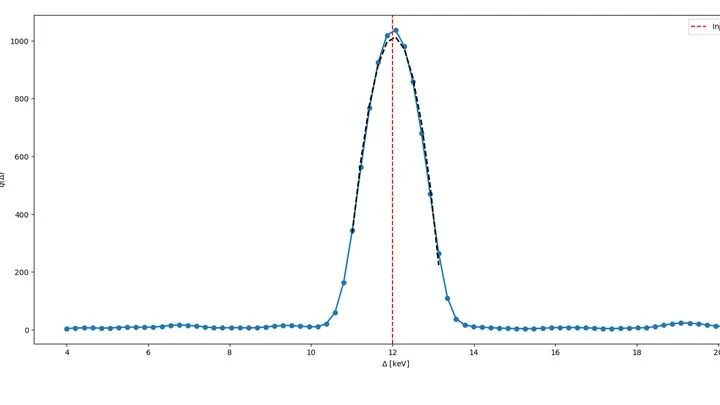
A gamma-ray spectrum looks like a picket fence: each line is the precise energy a nucleus released as a photon. But sometimes ghosts appear in that fence — faint lines shifted by the same amount from the main ones. Such a shift could mean that part of the energy went into creating a light particle we cannot yet see directly.
Dark matter is an invisible mass holding galaxies together. Its nature remains unknown, but one likely candidate is the axion — an ultra-light particle that barely interacts with matter. To catch it, physicists built a hybrid trap.
To align particle spins in one direction, physicists usually cool a substance to near absolute zero and place it in a strong magnetic field. That is expensive and bulky.
A new method resembles tuning many spinning tops with a gentle touch: mediator molecules temporarily bind to target atoms and pass on their order.
A particle wanders through a medium scattered with obstacles. Sometimes it pushes them aside like a snowplow, and it was thought that this pushing is what eventually stops the motion. But in three-dimensional space, that mechanism doesn't work.
It turns out that stopping arises from rare events: every so often, a particle randomly finds itself in a trap, and all exits close, as if doors slam shut.
Ultracold molecules are a promising material for quantum computing, but assembling them into a neat array, like eggs in a carton, is no easy feat. A method has been proposed to load molecules one by one into optical tweezers or lattices directly from a gas. The molecules immediately end up in the calmest state of motion.
A tiny cloud of 300,000 ytterbium atoms, cooled to near absolute zero, was shuttled along a light track 34 centimeters long, like transporting a fragile cargo over a bumpy road without shaking it apart.
A calcium ion in a magnetic trap resembles a tiny ball that constantly trembles from heat. To make it freeze, physicists usually hit it with lasers from several sides. But in the new experiment, a single beam aimed along the trap's axis sufficed.
First, the ion is cooled the usual way — the laser slightly slows its motion, like a headwind slowing a runner.
An ordinary laser amplifies light into a bright beam. Run the process in reverse, and you get an anti-laser — a device that sucks in light without a trace. But such a machine is finicky: even a slight disorder can ruin the absorption.
Physicists have found a way to make the anti-laser invulnerable.
Five charged calcium atoms hover in a trap, held by electric fields. Laser cooling saps their excess energy, and they line up into a tiny pyramid with a square base. But this pyramid doesn't stay put: every now and then it flips over, as if someone tosses it into the air and catches it upside down.
A laser beam usually looks like a straight column of light. But if you pass it through a wafer with a pattern thinner than a hair, the beam scatters into thousands of tiny pockets of light. In each pocket, you can suspend a single atom, like a pea in a dimple.
The space between two closely spaced surfaces is far from empty: it's a seething "quantum glue." Within it, quantum fluctuations continuously pop in and out of existence: microscopic bursts of energy in electromagnetic fields that, according to quantum theory, give the vacuum a dynamic structure.
Four cesium atoms hang in vacuum, held by laser tweezers like beads on an invisible thread. Around them is a ring resonator, a closed loop of mirrors where light circulates without obstacles. When a probe beam strikes this tiny chain, something strange happens: the atoms scatter light not uniformly in all directions, but predominantly in one direction.
Think of a reliable container instead of a fragile test tube: that's the shift from trapping chemically reactive radicals to holding stable molecules. Until now, magneto-optical traps have only worked with particles that are eager to react at the first collision.