A Magnetic Knob for a Superconducting Orchestra ✛
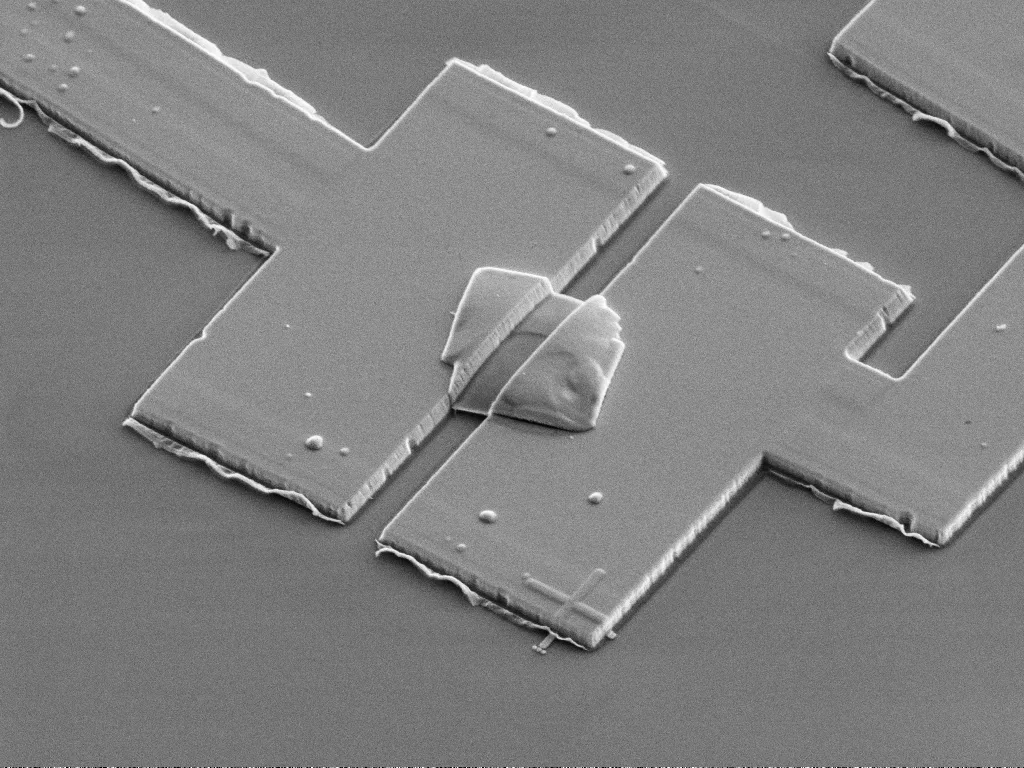
A superconductor is like an orchestra that plays without a single wrong note, until the conductor turns the tuning knob. In this new work, that knob turned out to be the magnetic history of nickel contacts. The researchers created tiny plates from two oxides, at whose interface a thin layer of free electrons emerges. They brought magnetized nickel contacts to this layer through the side wall, and superconductivity did not vanish.
All devices entered the superconducting state at temperatures around 100–200 millikelvin, just above absolute zero. Current flows through such a conductor without resistance, like water through a perfectly smooth pipe. But the magnetic field from the nickel contacts hinders electrons from moving in pairs. It turned out that an external field can precisely compensate for this influence: resistance dropped to zero not at zero field, but at a shift of about 45 millitesla in either direction.
Previously, it was unclear whether magnetized contacts could be joined to a superconducting layer at a buried interface without destroying superconductivity. Now it has been shown that it can be done. Moreover, the magnetic state of the contacts works as a tuning knob: by turning it, we change the field that the superconductor feels and control the current. This is the first time a superconductor and a ferromagnet coexist in a single oxide micro-membrane with a side contact.
The orchestra from the first sentence now sounds different. We are not just listening to its performance; we can turn the tuning knob, knowing that each note depends on how the knob was turned before. The next step is to learn to control two contacts independently, to see whether new types of electron pairs are born there. Then superconducting memory and logic will become a reality.
The compensation field of ±45 mT corresponds to a nickel magnetization of about 2.5×10⁵ A/m, which is close to saturation of thin nickel films. This means that at such a field the contacts are still fully magnetized, and their stray field can be precisely compensated by an external field.