Magneticsuperconductivity refers to the interplay between superconductivity and magnetism, where magnetic fields or magnetic ordering influence the superconducting state. In conventional superconductors, magnetism is destructive: even a modest magnetic field destroys superconductivity by breaking Cooper pairs. However, in certain exotic superconductors, magnetism and superconductivity can coexist, and magnetic fluctuations can even mediate the pairing mechanism. This is particularly relevant in high-temperature superconductors, iron-based superconductors, and heavy-fermion systems, where magnetic correlations are believed to play a key role in enabling superconductivity at relatively high temperatures.
History
The coexistence of superconductivity and magnetism was first observed in the 1970s in ternary rare-earth compounds like ErRh₄B₄. The theoretical framework for magnetic-mediated pairing was developed in the 1980s, particularly for heavy-fermion superconductors, and gained prominence with the discovery of iron-based superconductors in 2008.
How it works
In conventional superconductors, electrons form Cooper pairs via phonon exchange, and magnetic fields align electron spins, breaking these pairs. In unconventional superconductors, the pairing may be mediated by spin fluctuations — magnetic excitations that can glue electrons together in a spin-singlet or spin-triplet state. Magnetic ordering can also create a spatially modulated superconducting state, such as the Fulde-Ferrell-Larkin-Ovchinnikov (FFLO) phase, where Cooper pairs carry nonzero momentum. Additionally, in heterostructures, magnetic layers can induce superconductivity in adjacent non-superconducting materials via the proximity effect, or control the superconducting phase through spin-orbit coupling.
In practice
Understanding magneticsuperconductivity is key to designing materials with higher critical temperatures, which could enable lossless power transmission, more efficient MRI machines, and quantum computing components that operate at less extreme cooling requirements.
Fun fact
In some iron-based superconductors, the superconducting transition temperature actually increases when a magnetic field is applied, a phenomenon opposite to conventional behavior and a direct signature of magnetic pairing mechanisms.
Two dancers on one stage: one pulls the partner in one direction, the other in the opposite. In the crystal Cu2(OH)3Br, known as botallackite, copper atoms form chains where the spins (magnetic moments) of neighboring ions align either parallel, as in a ferromagnet, or antiparallel, as in an antiferromagnet.
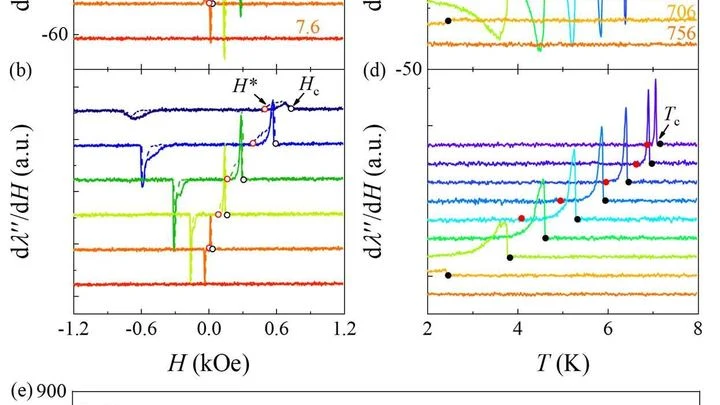
A superconductor is like an orchestra that plays without a single wrong note, until the conductor turns a tuning knob. In this new work, that knob turned out to be the magnetic history of nickel contacts.
A superconductor pushes out a magnetic field like a sponge squeezing out water. This Meissner effect has been known for nearly a century, but it's usually calculated in a flat world — without gravity. In the strong field of a black hole or at enormous speeds, the picture changes.
A thin film of a special crystal (for instance, molybdenum disulfide) sits on a microscope stage. The temperature is just above the point where the material becomes a superconductor.
A swarm of fireflies rarely collides, yet they synchronously change color by exchanging signals. This is how neutrinos behave in dense streams from collapsing stars: they collectively transform from one type to another, even though individually they interact extremely weakly.
A superconductor is like a perfect electron dance: electrons move in pairs without losing energy, like dancers who never miss a beat. But add a few magnetic impurities, and strangers crash into the dance, disrupting the synchronized motion. The temperature at which this dance begins drops.
The dance floor is full of couples waltzing. Usually, partners move in opposite directions: one steps forward, the other backward, to keep the overall rhythm.
Ordinary magnetic measurements only see the surface of a superconductor, where barriers and viscous flows of magnetic field get in the way. Inside, in the so-called intermediate state, superconducting and normal domains coexist, separated by thin walls. These walls can oscillate, but hearing them directly has been difficult.
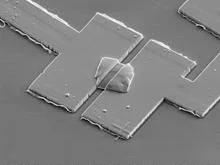
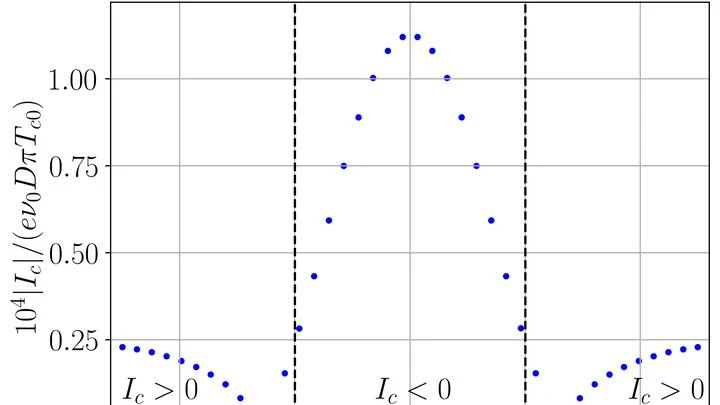
Two superconducting banks are connected by a bridge of magnetic material. Inside the bridge lies a domain wall: a narrow boundary where the magnetization rotates, like a column of soldiers changing their marching direction.
In a tiny magnetic dot, smaller than a micron, lives a vortex — magnetization swirls like water in a drain. At the center of this swirl is a core that itself orbits in a small circle, like a spinning top that's been given a nudge.
A single electron in a magnetic field is like a tiny top that spins and weakly "squeaks" at its own frequency. Hearing that squeak directly is nearly impossible: it gets lost in the noise. Scientists have devised a resonator: a superconducting microwave strip that works like a tuning fork tuned to the same note.
A tiny superconductor, levitating above a magnet, is like a cork on the surface of an invisible ocean. The slightest breath of dark matter makes it shudder. Scientists examined two kinds of such 'wind'. The first – gravitational waves, which stretch and squeeze space itself, like ripples on the fabric of the cosmos.
In a crystal made of europium, zinc, and phosphorus, electric current behaves like a car on a bumpy road. Electrons don't run freely but drag magnetic clouds, polarons, behind them.
An ordinary superconductor expels magnetic fields, but this ring does the opposite: it creates a magnetic field inside itself. The ring is made of Fe(Te,Se) — a compound of iron, tellurium, and selenium that loses its electrical resistance at very low temperatures.
A semiconductor film one atom thick is like a tightly stretched membrane. Light makes it flash: luminous points (excitons) are born, which quickly fade. Where the membrane is torn or crumpled, the glow flickers and stutters, like a string with a knot sounding off-key.
An ordinary superconductor loses resistance when cooled, and current flows through it without loss. But in ultrathin films, things are different: the material fluctuates between normal and superconducting states, and in this transition zone, strange resistance waves emerge. Resistance rises and falls as if someone were turning a volume knob.
The crystal CeRh₂As₂ behaves like a switch: cool it down and it becomes a superconductor, then bring a magnet close and it abruptly jumps to another superconducting state. Such behavior is rare: most superconductors have only one state, but here there are two, separated by a sharp boundary.
A thin superconducting wire, cooled to near absolute zero, can sense a single particle of light. Such detectors are indispensable for quantum computing and secure communication, but their temperament is spoiled by disorder — random irregularities and impurities that cannot be completely removed.
Instead of fighting disorder, physicists decided to tame it.
A nanowire is like a tiny cable: inside is a magnetic core, outside is an aluminum shell that can conduct current without resistance. But they don't get along easily: a strong magnetic field destroys superconductivity, like noise drowns out a quiet melody.
The classic BCS theory of superconductivity, developed by John Bardeen, Leon Cooper, and Robert Schrieffer, describes the mechanism by which electrons pair up into Cooper pairs and move without resistance.
The crystal of RbMn6Bi5 resembles a five-story building of manganese atoms, where the residents on each floor form a pentagon. At room temperature, the magnetic moments of the atoms fluctuate chaotically, like compass needles during a magnetic storm.
In a conventional superconductor, electrons team up into pairs that stay put: their total momentum is zero. But sometimes it's different: pairs gain a shared momentum and start moving, like a school of fish swimming against the current. This state is called a pair density wave, and it's very finicky: it needs special conditions.
In the crystal La₂₋ₓSrₓCuO₄, at a certain composition, two states coexist: superconductivity, where electrons move without loss, and a charge-density wave — a periodic bunching of electron density. These states compete for the same electron clouds, which resemble cross-shaped petals.
Run a current through a contact between a superconductor and a ferromagnet, and you will hear the whisper of the quantum world. In the lab at 0.3 K, that whisper turned into a roar: the shot noise—electrical noise due to the discreteness of charge—was a hundred times louder than theory allows for ordinary contacts.
A magnetic field of 8 tesla is 200 times stronger than Earth's field. Under such a field, superconductivity in a thin film of palladium ditelluride not only survives but persists down to 20 millikelvin, which is a hundred times colder than outer space. For comparison, a thick film of the same material has a critical field 80 times smaller.