A millikelvin is a unit of temperature equal to one thousandth of a kelvin (0.001 K). It is used to describe environments that are extremely cold, just fractions of a degree above absolute zero (−273.15°C). At these temperatures, thermal motion nearly ceases, allowing quantum effects to dominate and enabling experiments that would be impossible at room temperature.
History
The kelvin scale was defined in the 19th century, and the prefix 'milli-' was standardized with the metric system. The practical ability to reach millikelvin temperatures emerged in the 20th century with the development of dilution refrigerators in the 1960s.
How it works
Temperature is a measure of the average kinetic energy of particles. At millikelvin temperatures, particles move extremely slowly, and their quantum wave-like nature becomes prominent. To reach such low temperatures, scientists use techniques like dilution refrigerators or adiabatic demagnetization, which remove energy from the system step by step.
In practice
Millikelvin temperatures are essential for operating superconducting quantum computers, studying superfluidity, and cooling detectors in astrophysics to reduce thermal noise.
Fun fact
At millikelvin temperatures, some metals become superconductors, allowing electricity to flow with zero resistance.
Systems:SIOne millikelvin is equal to 10^-3 kelvin, where the kelvin is defined by the fixed numerical value of the Boltzmann constant k = 1.380649 × 10^-23 J/K.
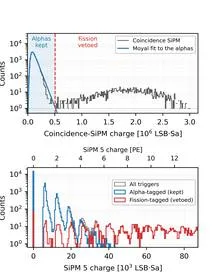
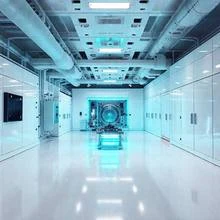
The stage is bathed in icy light, and on it stand silicon spectators. Each is an array of tiny avalanche diodes capable of spotting a single photon, but only if the surrounding temperature drops to 165 K.
A tiny diamond, invisible to the naked eye, sits on a chip and senses heat like no ordinary thermometer can. Hidden inside it are two defects: places where a carbon atom is replaced by a nitrogen atom, with a vacancy nearby.
A quantum lab is like a kitchen where the chef waits a day for the stove to cool down. Superconducting qubits only work at temperatures of a few hundredths of a kelvin, and each 'cool, measure, warm up' cycle eats a whole day. A team of engineers built a fridge the size of a melon, weighing 3 kg, that does the job in just two hours.
Drop a pebble into a pond, and ripples spread across the water. In much the same way, any body, even the tiniest, perturbs the gravitational field around it. In empty, cold space, these perturbations, like ripples on a calm surface, make two nearby objects always repel each other.
In a room, air touches the skin, and we feel its temperature. But if your body suddenly accelerated at a colossal rate, heat would come even from absolute emptiness. This is not fiction but a strict consequence of quantum field theory: for an accelerating observer, the vacuum becomes a warm bath.
Two tiny weights, each about the mass of a grain of sand, hang in the dark at a temperature colder than deep space. They don't touch, but an invisible thread connects them — gravity. The experiment physicists are now building aims to catch the moment when that thread tugs one weight due to the motion of the other.
Quantum technology urgently needs a universal 'translator' between the languages of microwaves and light. Superconducting qubits communicate on centimeter wavelengths, while photons in optical fiber talk at optical frequencies.
Usually, superconductivity is a story about cold. The lower the temperature, the easier it is for electrons to pair up and flow without resistance. But in a new study, physicists grew thin films of nickelates doped with europium and saw the opposite picture.
The Sun is a giant nuclear reactor that continuously sends us light and heat. But it also has another, almost silent postal service: every second, tens of billions of neutrinos, ghostly particles born in the thermonuclear furnace, fly through a square centimeter of your palm. Most of them leave no trace.
A magnet the size of a grain of rice floats in a vacuum without touching the walls. It is held by the magnetic field of a superconducting trap — a ring cooled to a state where current flows without resistance.
In the first moments after the Big Bang, the universe was a boiling soup of elementary particles. Even the light neutrinos were actively colliding with everything around. But the rapid expansion cooled this soup, and the neutrinos broke free, becoming almost indifferent to the surrounding world.
A tiny ball weighing a fraction of a milligram, suspended in a magnetic field and cooled to near absolute zero, oscillates for 110 hours without stopping: this is record isolation. The energy loss is so small that the system's entropy barely increases, making any external influence noticeable.
The rows of wires stretching from the warm room into the fridge holding the quantum chip look like a tangled telephone exchange from the last century. Each qubit needed its own analog channel for precise tuning, and the cables carried extra heat and got underfoot.
Now researchers have placed a digital-to-analog converter right in the cold zone, next to the qubits.
An aluminum pot on the stove melts at 660 degrees Celsius — everyone knows that. But what happens if you heat aluminum a hundred times hotter? The liquid starts to boil, and here's the puzzle: at what exact temperature does that happen?
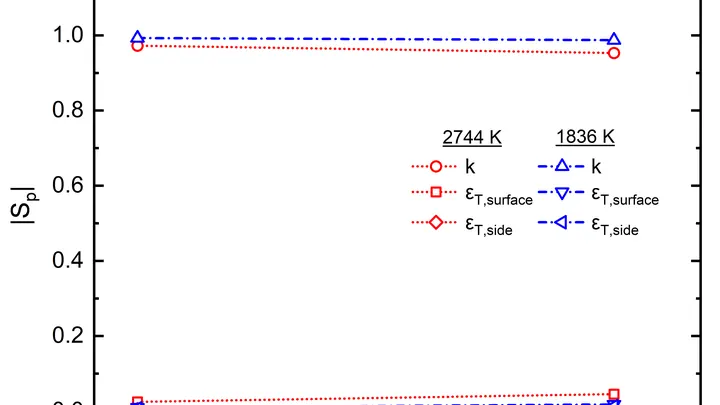
A red-hot piece of metal in a furnace is like a frying pan on the stove: the hotter it gets, the faster heat travels to your hand if you touch it. But at temperatures where the metal is close to melting, measuring that speed is very tricky: sensors don't make good contact, heat escapes into the air, and the glowing sample confuses the instruments.
This new method sidesteps those obstacles.
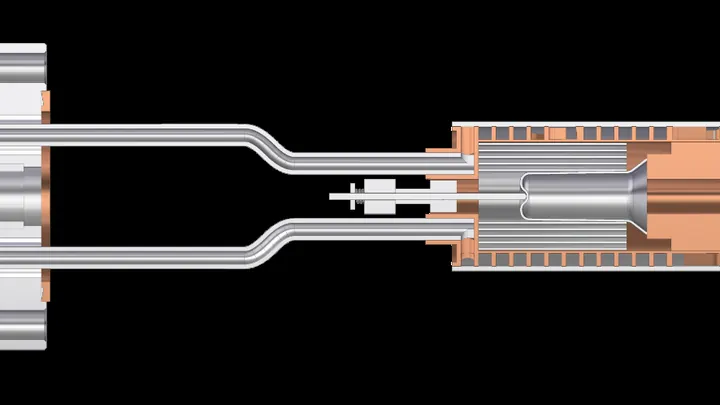
An ordinary aluminum pot on a stove doesn't emit molecules you can catch with light. But if you take aluminum and an aluminum salt, heat them together in a small oven, you get a stream of aluminum fluoride molecules, like steam from a kettle's spout, except instead of water droplets, tiny particles fly out.
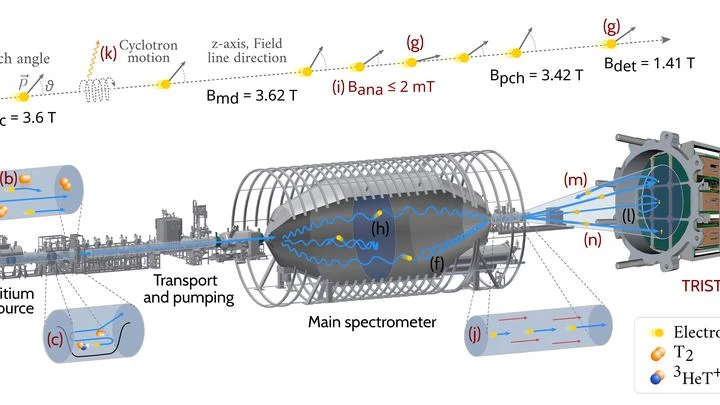
Radioactive tritium decays, emitting an electron. Its energy is almost always the same, but sometimes, just a little less. This shortfall could mean that alongside the ordinary neutrino, another, hidden particle was born.
The Standard Model describes three types of neutrinos, but scientists suspect there is a fourth — the sterile one.
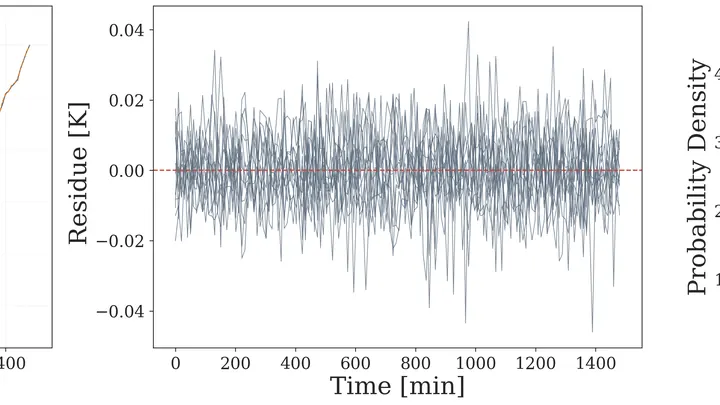
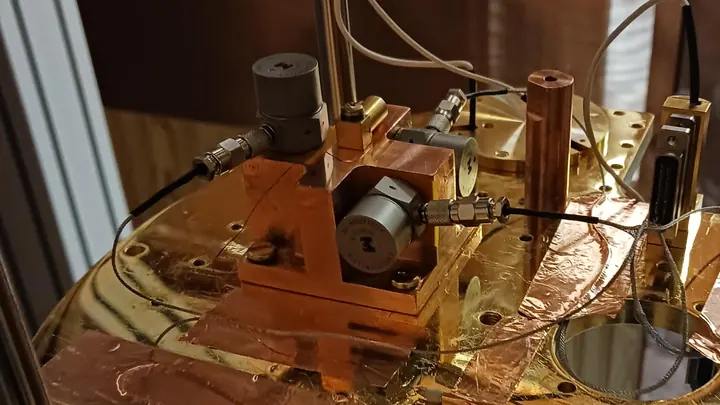
A seismometer is the planet's ear. It picks up the faintest tremors in the ground and turns them into an electrical signal. But this ear isn't perfect: its sensitivity depends on temperature. In the cold and in the heat, the instrument hears slightly differently, and that introduces error into measurements.
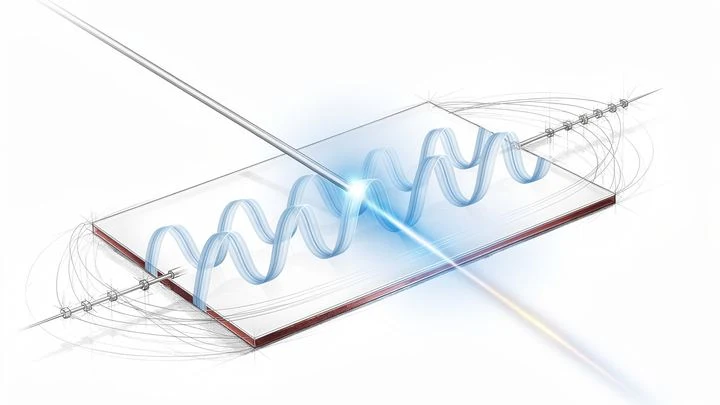
At 0.1 K, just three-tenths of a degree above absolute zero, matter stops following the usual rules. Helium becomes superfluid: it flows without friction, seeps through cracks, and behaves like one giant quantum liquid. Seeing what happens inside such cold is a challenge at the edge of possibility.
The universe is held together by an invisible scaffolding of dark matter. Part of it could be dark photons, ghostly copies of light that pass right through matter. The Dandelion experiment turned a spherical mirror into a super-sensitive ear: it gathers dark photons and translates them into the language of radio waves.
A quantum computer is like an orchestra that has to tune its instruments before every piece. Tuning takes time and requires quiet — in our case, deep cold. For silicon chips with boron atoms, this tuning is usually done with microwaves, slowly and only at temperatures below 2 kelvin (minus 271 degrees Celsius).
The electron is a tiny particle, but inside a crystal it behaves as if it had a different mass. Physicists call this the effective mass. To measure it, they make electrons run in circles in a magnetic field, like a speed skater on an ice rink who is kept from leaving the orbit.
Inside a refrigerator that cools matter to near absolute zero beats a mechanical heart — the pulse tube. It pumps gas and extracts heat, but along with the cold it brings tremors. Each beat of this heart shakes the instruments sitting next to the sample and ruins delicate measurements.
Water in a kettle heats to 100 degrees, and stops being water, turning into steam. Something similar happens to atomic nuclei when they are smashed together at enormous speeds in the Large Hadron Collider.
The James Webb Space Telescope is watching TRAPPIST-1—a tiny red dwarf with seven Earth-sized planets in orbit. And it sees something unusual: bright flares on this star barely reach 3500–4000 degrees. For comparison, a typical solar flare heats up to 9000–10000 degrees.
A qubit, the heart of a quantum computer, is like a soap bubble: the slightest puff and it bursts. On Earth, gravity pulls bubbles down, creating vibrations, and the thermal hustle of atoms adds jitter. Entropy, the measure of this chaos, destroys quantum information.
A tiny seesaw weighing 1.5 nanograms oscillates not from the wind, but from the heat of its surroundings. Physicists nearly stopped it by cooling it to 0.006 degrees above absolute zero.
In a laboratory at Purdue University, a laser beam strikes a crystal of hexagonal boron nitride, and in response, a single point of light flashes. This is not just luminescence; it is a signal from a spin defect, a pair of electron spins, one of which is coupled to a carbon-13 nuclear spin.
In a dilution refrigerator cooled to 170 millikelvin, a coherent state of the microwave field is born. This is laser light with minimal uncertainty: its amplitude and phase are defined as precisely as quantum mechanics allows.
The temperature in a room drops by a few degrees while the refrigerator runs without a single moving compressor. Inside, there is no Freon, but a piece of metal that is alternately magnetized and demagnetized.