Magnetic contacts on free-standing superconducting LaAlO3/SrTiO3 micromembranes ✛
Context
This work sits at the intersection of superconductivity and magnetism, where there are already studies of the superconducting dome under pressure, the mysteries of two gaps, the influence of oxygen, and magnetic dances in crystals. Unlike neighboring works, where ferromagnetic contacts were mostly embedded in planar heterostructures, here for the first time they were connected to the buried two-dimensional electron gas of a superconducting oxide interface through a side geometry on a free-standing micromembrane. This solves a long-standing problem of accessing the hidden interface and opens the possibility of studying spin injection into the superconducting state.
Methods
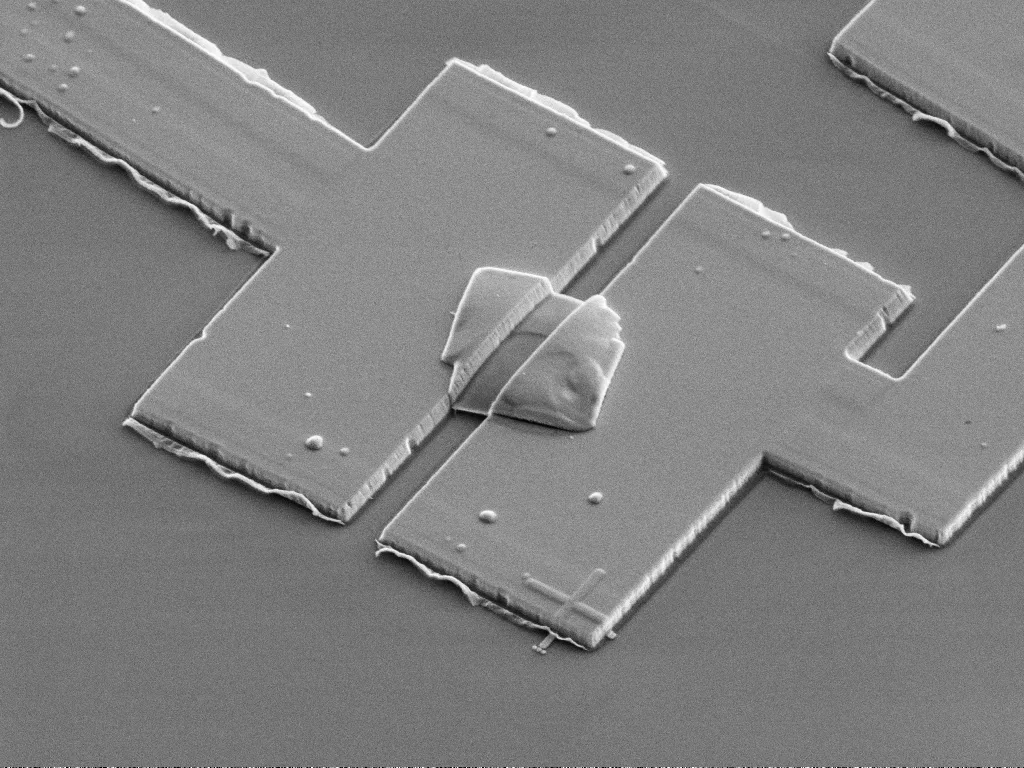
LaAlO3/SrTiO3 micromembranes were obtained by stress-induced exfoliation and transferred onto a silicon substrate with oxide. Nickel contacts were deposited at an angle through a resist with an undercut to ensure electrical contact with the two-dimensional gas on the sidewall of the membrane. Measurements were performed in a dilution refrigerator at 30 mK, recording differential resistance while sweeping the external magnetic field in different directions. Finite-element modeling in COMSOL allowed calculation of the average stray field from the contacts and linking it to the magnetization.
Results
All three devices showed a superconducting transition between 100 and 200 mK. When sweeping the perpendicular field, the resistance had a minimum not at zero but at ±45 mT, interpreted as compensation of the field from the magnetized contacts. Hysteresis depended on sweep direction, and at the same field one could obtain either superconducting or normal state depending on magnetic history. The critical current under in-plane field turned out to be about five times larger than under perpendicular field, due to the smaller stray field. An effective field model with coefficient α = 1.69×10⁻⁷ H/m allowed reconstructing the magnetization loop of the contacts from transport measurements.
Implications
The main difference from neighboring works is that here superconductivity and ferromagnetism coexist in a single oxide micromembrane with a side contact, rather than in a planar heterostructure. This is the first demonstration that the magnetic state of nickel contacts can be used as a knob to tune the superconducting response in LaAlO3/SrTiO3. The sensitivity of the superconducting state to magnetic history turns the device into an internal magnetometer for the contacts.
Future development
Further development may go toward independent control of the magnetization of two contacts to obtain a ferromagnet-superconductor-ferromagnet junction and test spin-triplet superconductivity. Reducing the length of the superconducting channel below the spin precession length will allow direct study of spin injection. Electrostatic gate control, shown in the supplementary materials, will add the ability to tune Rashba spin-orbit interaction.
Impact
The results will impact the development of superconducting memory and logic devices, where the critical current is controlled by the magnetic state of an adjacent ferromagnet. The platform is also useful for studying fundamental effects at the boundary of superconductivity and magnetism in oxide systems.
Next steps
Fabricate devices with two independently switchable ferromagnetic contacts and a short superconducting channel. Perform measurements under parallel and antiparallel magnetization to isolate the contribution of triplet Cooper pairs.
Key open problems
The work directly addresses the unresolved problem of coexistence of superconductivity and magnetism in oxide interfaces, as well as the question of spin injection mechanisms into a superconductor with strong spin-orbit interaction. It offers an experimental platform for testing theories of triplet superconductivity and spin relaxation in a two-dimensional electron gas.
The knowledge machine's view
This section is addressed to the author of the paper and their colleagues. Neighbouring works were found by meaning-based search across our archive, not by word overlap. We do not review: we show the field around the work.
What the work does
In this work, superconducting LaAlO3/SrTiO3 micromembranes with nickel ferromagnetic contacts were fabricated using a side geometry. Measurements at 30 mK showed that superconductivity is preserved, resistance hysteresis occurs when the magnetic field is swept, and the resistance minimum shifts due to the stray field from the contacts. From the transport data, the magnetization loop of the contacts was reconstructed.
Where its strength is
For the first time, ferromagnetic contacts were successfully attached to the buried two-dimensional electron gas of a superconducting oxide interface on a freestanding micromembrane, solving the problem of accessing the hidden interface. The sensitivity of the superconducting state to magnetic history turns the device into an internal magnetometer.
Where it could go next
- It might be interesting to see how the magnetic texture in a nanowire controls superconducting properties: there, a similar idea of using the magnetic state to tune superconductivity is at play, but in a different geometry.based on: Magnetic Texture Controls Superconductivity in a Nanowire arXiv:2601.22051
- A related avenue is studying how magnetic order affects superconducting pairing: one could try a similar approach to analyze how magnetic contacts modify the superconducting state in your system.based on: Magnetic Order That Makes Pairs Swim arXiv:2601.06735
- It may be useful to compare with work where nickelate superconductivity withstands high pressure: this could hint at how mechanical strain in membranes affects the coexistence of superconductivity and magnetism.based on: Superconductivity Withstood Pressure of 210 Gigapascals arXiv:2608.02042v1
Worth trying
- Try applying the effective field method to analyze data at different orientations of the external field, to separate the contributions from different magnetization components.
- Investigate the possibility of switching the superconducting state with short magnetic field pulses, exploiting the hysteresis of the contacts.
- Compare the sensitivity of transport measurements with direct magnetization measurements of the contacts, to assess the accuracy of the hysteresis loop reconstruction.
Nearby works in our archive
- The Superconductivity Dome: Why Pressure First Helps, Then Hinderssimilarity 0.54
- Magnetic dances in a nickel crystalsimilarity 0.51
- Magnetic Texture Controls Superconductivity in a Nanowiresimilarity 0.50
- Waves of Tilts: How to Rebuild a Crystal and Get Magnetismsimilarity 0.49
- Light Spins Up the Spinssimilarity 0.49
- Superconductivity Withstood Pressure of 210 Gigapascalssimilarity 0.49
- Magnetic Order That Makes Pairs Swimsimilarity 0.48
The archive is sparse around this work: the closest review is only 0.54, against a usual 0.64. It looks like few have drilled nearby.
The compensation field of ±45 mT corresponds to a nickel magnetization of about 2.5×10⁵ A/m, which is close to saturation of thin nickel films. This means that at such a field the contacts are still fully magnetized, and their stray field can be precisely compensated by an external field.
Key numbers
- Superconducting transition temperature: 100–200 mK
- Compensation field: ±45 mT
- Effective field coefficient: 1.69×10⁻⁷ H/m
- Maximum in-plane critical current: ~100 nA
- Nickel contact thickness: 120 nm