Magnetic interaction is the force that acts between magnetic dipoles or moving charges, arising from the electromagnetic field. It is one of the four fundamental forces of nature, responsible for phenomena ranging from the attraction of a refrigerator magnet to the alignment of iron filings around a current-carrying wire. In materials, magnetic interactions govern the behavior of magnetic moments — the tiny atomic magnets that arise from electron spin and orbital motion — and determine whether a substance is ferromagnetic, antiferromagnetic, or paramagnetic.
History
The study of magnetic interactions dates back to ancient observations of lodestone, but the modern understanding began with William Gilbert's 'De Magnete' (1600). The mathematical framework was developed by André-Marie Ampère and Michael Faraday in the 19th century, and unified with electricity by James Clerk Maxwell in 1865.
How it works
Magnetic interaction works through the exchange of virtual photons, which mediate the electromagnetic force. At the microscopic level, magnetic moments align or anti-align depending on the energy balance of their interaction. In a magnetic field, particles with magnetic moments experience a torque that tends to align them with the field, while thermal agitation disrupts this alignment. In systems like magnetic fluids or chains of magnetic particles, these interactions cause particles to arrange into structures such as filaments or chains, minimizing their magnetic energy.
In practice
Magnetic interactions are harnessed in data storage devices like hard drives, in magnetic resonance imaging (MRI) for medical diagnostics, and in magnetic separation techniques used to purify biological samples. They also underpin the behavior of magnetic nanoparticles in targeted drug delivery.
Fun fact
Magnetic interactions are responsible for the auroras — charged particles from the Sun are guided by Earth's magnetic field and collide with atmospheric gases, creating glowing light displays near the poles.
A vortex in a magnetic disk usually behaves like a large spinning top: to keep it from toppling, you need a spacious platform and a strong self-field that returns it to the center. But what if you shrink the platform to the size of a virus? Then the usual support disappears, and the vortex should fall apart.
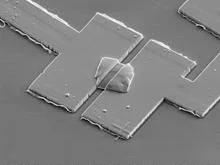
A superconductor is like an orchestra that plays without a single wrong note, until the conductor turns a tuning knob. In this new work, that knob turned out to be the magnetic history of nickel contacts.
Two tiny weights, each about the mass of a grain of sand, hang in the dark at a temperature colder than deep space. They don't touch, but an invisible thread connects them — gravity. The experiment physicists are now building aims to catch the moment when that thread tugs one weight due to the motion of the other.
A tuning fork struck once rings pure and long. But if you shake the fork itself while it sounds, the tone wavers and dies out quickly. Something similar happens to electrons in any piece of matter. Atoms in a lattice never stay put: thermal vibrations keep them jittering.
According to Einstein's general theory of relativity Albert Einstein, a massive rotating body drags the fabric of spacetime along with it, much like a spoon twirled in a jar sets thick honey flowing.
In some crystals, the magnetic moments of atoms oscillate in sync, like a wave in a stadium. It carries spin without charge current, without heating the material. This flow resembles an invisible river — silent and cold. Two-dimensional altermagnets are special materials: spin waves in them run differently along different axes.
Run a current through a spring of organic molecules, and the electrons that come out are almost all spinning the same way. This trick is called chiral spin selectivity, and it has long puzzled physicists. In light atoms, spin (the particle's intrinsic rotation) is too weakly coupled to charge motion to achieve nearly perfect sorting.
In the orchestra of atoms, each instrument has its own score. But sometimes two musicians start playing in unison, and the sound amplifies many times over. In the quantum world, this 'harmony' is called a Feshbach resonance. It allows you to control atomic interactions with jeweler-like precision.
A juggler tosses clubs while sitting on a spinning chair. If he starts spinning the clubs all in one direction, the chair will rotate the opposite way — otherwise, the conservation of angular momentum would be violated.
A handful of rice thrown into a glass of water scatters — the grains spread apart. Now imagine each grain propels itself forward with stubborn persistence and bounces off softly upon collision. Such particles are called active: they spend their own energy to move, like bacteria or microscopic robots.
Physicists are trying to hear a whisper in a noisy room. They build a soundproof booth, but even inside, their own breathing and heartbeat create interference. That's roughly how the search for quantum gravity goes: they want to see gravity bind two particles into a single whole — entangle them.
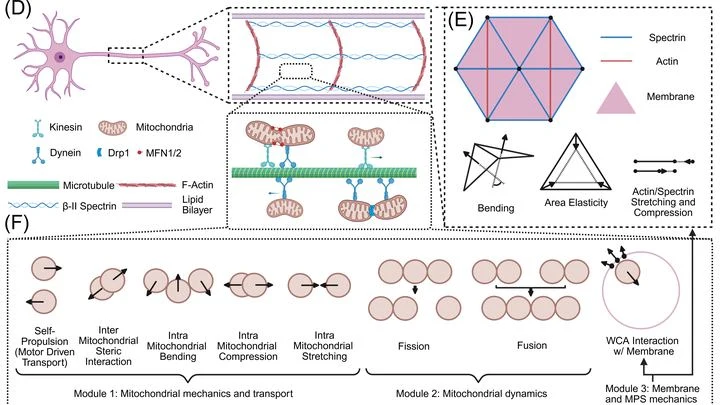
Inside every neuron, there's a long, thin channel, the axon, through which signals travel from the cell body to other cells. To keep this channel working, mitochondria constantly shuttle along it. These tiny organelles produce energy and move in both directions, like cars on a narrow road.
The crystal resembles a layered pie: alternating layers of europium, gallium, and aluminum atoms stack in a strict order. Usually, such materials shouldn't surprise us with magnetism: they are too symmetric. But inside this crystal, magnetic vortices were found, resembling tiny whirlpools that arrange into neat lattices.
An iron crystal is like a mosaic of tightly packed grains. Where one grain meets another, a boundary forms — a narrow seam with disrupted order. It is in these seams that surprises for magnetism hide.
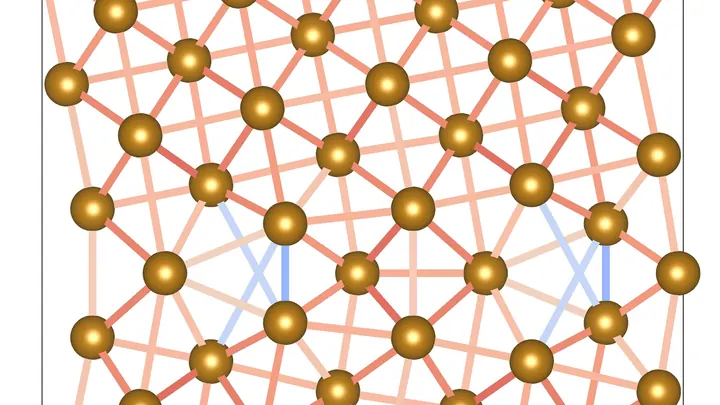
Scientists calculated how iron atoms interact with each other at three types of such boundaries.
A fridge magnet stays put because the tiny atomic arrows inside it all point in the same direction. But when those arrows start to argue (some pulling left, others right, and some spinning like tops) you get magnetic frustration. That disorder gives rise to whimsical patterns: stripes, spirals, vortices.
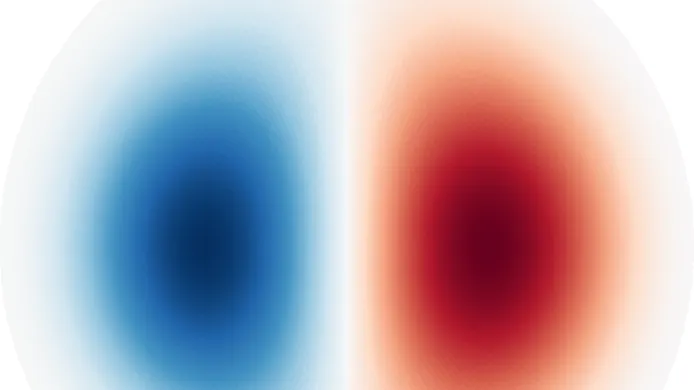
In a thin magnetic film, like in an overcrowded hall, each 'person' is a spin arrow that wants to align with its neighbors. But in the corners of the hall, jams occur — vortices where the arrows twist and cannot straighten out. These vortices live in pairs: one spins left, the other right, and together they prevent the hall from fully settling down.
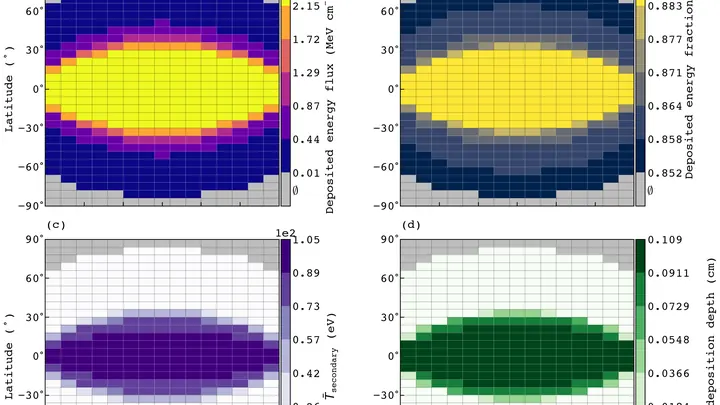
Europa's surface is an icy armor continuously bombarded by charged particles from Jupiter's magnetosphere. Electrons slam into the ice's crystal lattice, lose energy, and kick off chemical reactions. Until now, there was no tool to show how deep such bombardment pierces the ice.
Water boils at 100 degrees Celsius, but if you squeeze it hard enough, it behaves differently. Similarly, quarks and gluons, the building blocks of protons and neutrons, change their properties in a strong magnetic field.
Magnetic moments in a crystal are like compass needles fixed at lattice sites. In the normal state, they line up in neat order, but if an electromagnetic wave strikes the crystal, the needles start to sway, like wheat stalks in the wind. These oscillations are called magnons, and they carry energy without the atoms themselves moving.
Muscle contraction is driven by two types of protein filaments: thin carbon actin filaments and thick myosin filaments that act as molecular motors. At rest, a special protein safety catch, tropomyosin, blocks the myosin-binding sites on actin.
A pigeon flies home from hundreds of kilometers away. Inside its head, in the inner ear, fluid sloshes around, like water in a bottle you shake. When the bird moves, the fluid moves too, helping it maintain balance. Recently, scientists proposed that this same fluid might act as a tiny generator.
Inside every cell, there is a scaffold of filaments, like construction scaffolding that gives the cell its shape and allows it to move. These filaments are connected by crosslinking proteins: some simply hold them together like ropes, while others act as tiny motors that crawl along the filaments and pull them toward each other.
Drop a stone into a pond, and ripples spread across the water. Magnets have waves too — only instead of water molecules, it's the directions of atomic magnetic arrows that oscillate. These waves are called magnons, and their behavior reveals a lot about the invisible forces between atoms.
The crystal Ca2RuO4 resembles a stack of thin sheets. Inside each sheet, the electron spins are arranged in strict order, like rows of soldiers on a parade ground. The bonds between the sheets are weak, and their sign can be flipped by slightly pulling the crystal apart.
A beam of circularly polarized light hits a MAPbI3 perovskite crystal. The electrons inside start behaving like tiny spinning tops, their axes aligning along the beam. This phenomenon is known as optical spin orientation.
In a jar of oily liquid float millions of tiny magnetic grains: each about the size of a bacterium. Switch on a magnet, and the grains, like obedient little soldiers, line up into long threads. But why do they form threads rather than clumps? It turns out it's not just about magnetism.
A football kicked with spin doesn't fly straight: it bends to the side. A tightly focused beam of light does something similar: it starts pushing an atom not just forward but also sideways. Physicists measured this shift on a single calcium ion trapped in a light trap.
The beam was aimed at the atom like a spotlight on a grain of sand.
Two taut strings plucked at the same time sound different if they are connected by a rubber band. Energy starts to flow from one to the other, and the pitch of the combined sound shifts slightly. Two nanomechanical bridges, microscopic beams etched into a crystal, behave much the same way.
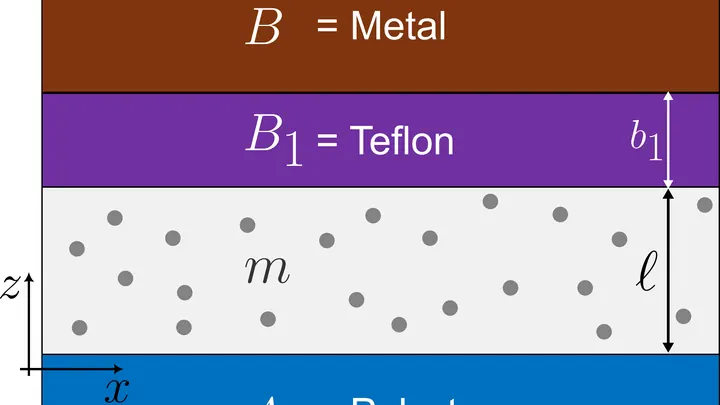
The space between two closely spaced surfaces is far from empty: it's a seething "quantum glue." Within it, quantum fluctuations continuously pop in and out of existence: microscopic bursts of energy in electromagnetic fields that, according to quantum theory, give the vacuum a dynamic structure.
At 78 K, a crystal of Mn₃Si₂Te₆ turns into an inductor that needs neither copper wire nor a superconductor. The electrons inside it spontaneously organize into closed vortices with a definite sense of rotation: chiral orbital currents.
In 2022, physicists observed gravity shifting the phase of a single atom's wave, the gravitational analog of the Aharonov–Bohm effect. This experiment became part of a long-standing debate: whether gravity must be quantized or remains a classical background in the quantum world.
Hidden within the bulk of a diamond are tiny flaws — places where a carbon atom is replaced by nitrogen, with a vacancy gaping nearby. These defects, like beacons, can store and transmit quantum information. But around them rages a magnetic storm: the nuclei of atoms in the crystal jostle, creating interference.