Quiet Galaxies: Why Young Stellar Systems Showed No Shock Waves ✛
An orchestra of six distant galaxies should have played loudly, but the percussion section was missing. Astronomers pointed the James Webb Space Telescope at them, expecting to hear the sharp bursts thought to accompany star birth. Instead, they recorded only a steady hum.
Each of these galaxies is so far away that its light has traveled for more than ten billion years. In that era, known as cosmic noon, galaxies collided and ignited new stars far more often than they do today. Supernova explosions and powerful winds from young, hot stars should have created shock waves in the gas—sharp jumps in pressure, akin to the sonic boom of a supersonic jet. These waves, in theory, should heat the gas and make it glow.
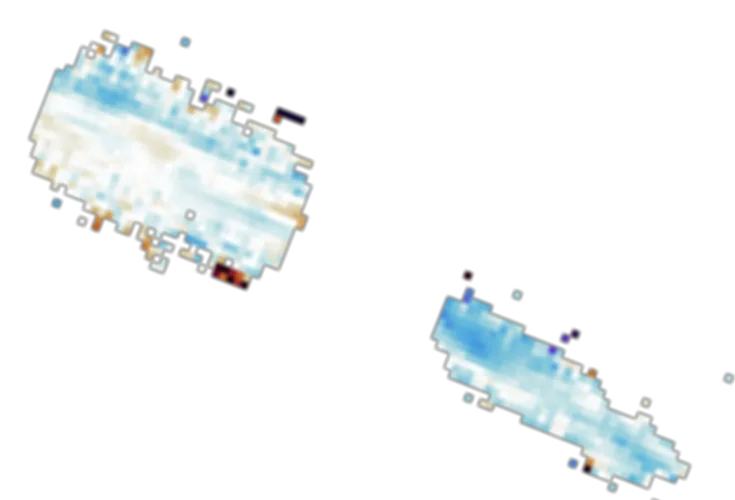
The researchers looked for the characteristic signature of shock waves in the gas spectra. When gas is heated by a shock, certain spectral lines brighten relative to others. But none of the six galaxies showed such a signature. Only a tiny fraction of pixels—less than eight percent, and less than three percent in the highest-quality data—looked suspicious, but these points were scattered randomly, like noise, rather than forming a wave front.
The astronomers then compared the gas behavior in these galaxies with that in a nearby galaxy known to host shocks. The difference was statistically significant: the distant galaxies behaved differently. They lacked the correlation between gas velocity and line brightness that betrays a shock.
The young-galaxy orchestra, it turns out, plays without percussion. That does not mean there is no energy; rather, its distribution is more complex than assumed. Now astronomers must revise the score.
The authors thank the construction crew digging a giant pit near the ISSI office in Bern for their 'constantly loud soundtrack, which kept us awake and alert while writing this paper.'