Quiet Galaxies: Why Young Stellar Systems Show No Signs of Shock Waves ✛
Context
This work sits within a landscape of searches for dark matter, dark energy, and rare astrophysical events. Neighboring studies in our archive hunt for axions, dark photons, gravitational lenses, and quantum correlations in boson decays. Against this backdrop, LEGGOS stands apart: it is not a search for new physics but a test of a long-standing astrophysical assumption. Shock waves in the interstellar medium were predicted as an important mechanism for heating and ionizing gas in actively star-forming galaxies, especially at z~2–4, where star formation and merger rates were highest. However, until now, no systematic observations with sufficient spatial resolution existed at these redshifts. The LEGGOS work fills this gap, using gravitational lensing to amplify faint signals and JWST integral field spectroscopy to map emission lines.
Methods
Six galaxies from the LEGGOS survey were observed with NIRSpec/IFS on JWST in medium and high resolution modes, allowing measurements of fluxes and line widths of Hβ, [O iii] λ5008, [O i] λ6302, Hα, [N ii] λ6585, and [S ii] λλ6718,6733 in each spatial pixel (spaxel). For each galaxy, maps of line ratios sensitive to ionization and shocks were constructed and compared with the classic diagnostic diagrams of Kewley et al. Additionally, kinematics were extracted from the Hα line and compared with MAPPINGS V shock models from the 3MdBS database, estimating shock front velocities via maximum likelihood. As a control sample, a nearby galaxy with confirmed shock excitation from the MaNGA survey was used.
Results
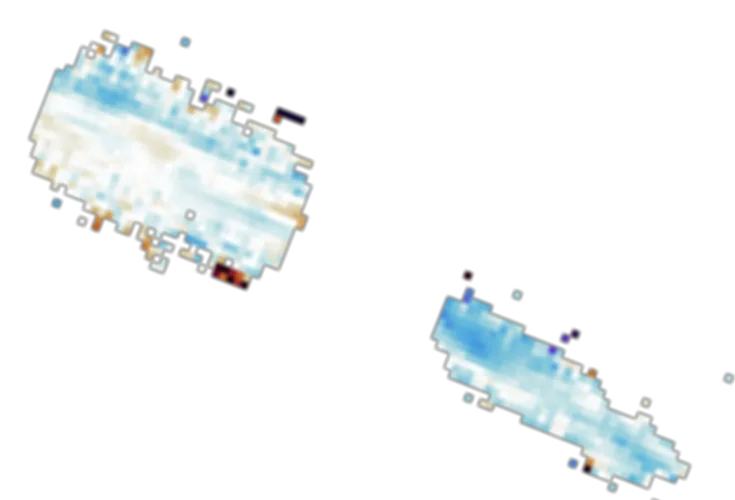
No significant shock signatures were found at any of the three scales: pixel, clump, or integrated. The fraction of pixels falling into shock diagnostic regions does not exceed 8% for any galaxy, and for objects with sufficient measurements (more than 100 pixels), it is no more than 3.3%. These pixels do not form coherent spatial structures, indicating statistical scatter rather than real shock fronts. Comparison with shock models showed that the distributions of the shock front velocity to Hα line width ratio for LEGGOS galaxies statistically differ from that of the reference shock galaxy MaNGA (p<0.05 for all but one with p=0.082 due to small sample size). No correlation between velocity dispersion and line ratios, expected for shocked gas, was found.
Implications
The result challenges the universality of shock scenarios for galaxies at z~2–4. Unlike neighboring works that search for rare signals of new physics or study individual objects, LEGGOS provides the first systematic statistics on shocks in this epoch. The absence of shock signatures despite high star formation rates implies that either energy from supernovae and stellar winds dissipates differently, or existing diagnostic criteria, calibrated on local galaxies, do not work well at high redshifts. This is an important null result that forces a rethinking of ionization models for the interstellar medium in young galaxies.
Future development
The topic could develop in several directions. First, expanding the sample of lensed galaxies with JWST will test how typical the LEGGOS objects are. Second, adding ultraviolet and near-infrared diagnostics, such as C iii], He ii, and [Fe ii] lines, may reveal shocks invisible in the optical. Third, new shock models with finer parameter grids and accounting for the chemical composition typical of high redshifts will be needed.
Impact
The results will affect the interpretation of galaxy spectra during cosmic noon, models of star formation and feedback, and the calibration of diagnostic diagrams for future surveys such as Euclid and Roman.
Next steps
Immediate next steps include analyzing additional lensed galaxies from JWST archives, obtaining deep ultraviolet spectra for some objects, and developing new diagnostic criteria that account for the peculiarities of high redshifts.
Key open problems
This work directly relates to the unsolved problem of energy balance in the interstellar medium of galaxies: how exactly energy from massive stars and supernovae is redistributed and ionizes the gas. The absence of shocks in the LEGGOS sample sharpens the question of which mechanisms dominate in young galaxies and requires a reassessment of the role of shock processes in galaxy evolution.
The knowledge machine's view
This section is addressed to the author of the paper and their colleagues. Neighbouring works were found by meaning-based search across our archive, not by word overlap. We do not review: we show the field around the work.
What the work does
The LEGGOS survey is the first to systematically search for shock waves in six gravitationally lensed galaxies at z~2.37–3.625, using JWST/NIRSpec integral field spectroscopy. Analysis of emission lines, their kinematics, and comparison with shock models revealed no significant signatures: less than 8% of pixels fell into shock diagnostic regions, and they did not form coherent structures.
Where its strength is
The strength of this work lies in its systematic approach: combining the high spatial resolution enabled by lensing, multiple emission-line diagnostics, and comparison with models across several scales. This provides a solid foundation for reassessing the role of shocks in young galaxies.
Where it could go next
- It might be interesting to compare these results with studies of black hole winds, which could also contribute to the kinematics and ionization of gas in high-redshift galaxies.based on: Winds from Black Holes arXiv:2604.22922
- A natural next step is to investigate how obscured star formation affects the interpretation of emission lines, which could be important for galaxies where shocks do not dominate.based on: Oxygen Hides the Light of Newborn Stars arXiv:2602.22161
- One could also consider linking this to radio observations of star formation: they provide an independent estimate of the star formation rate and could help separate the contribution of shocks from photoionization.based on: Radio Reveals Star Birth in the Early Universe arXiv:2602.05808
Worth trying
- Test how the results change when using new diagnostic diagrams that account for the contribution of obscured star formation.
- Compare the kinematics of the ionized gas with data on winds from active galactic nuclei in similar galaxies.
- Use radio maps to pinpoint regions of active star formation and check whether they correlate with the absence of shock signatures.
Why this may matter
This could be important for understanding the energy balance in galaxies at the peak of star formation: if shocks are not universal, then the main sources of heating and ionization must be sought elsewhere.
Nearby works in our archive
- Radio Reveals Star Birth in the Early Universesimilarity 0.55
- Galaxy Mergers Open a Window for Lightsimilarity 0.55
- Tuning Into the Hum of Spinning Starssimilarity 0.55
- Red Dots: The Universe's Neutrino Cannonssimilarity 0.55
- Hunting the Invisible at the Heart of the Milky Waysimilarity 0.54
- The Hidden Light of Young Galaxiessimilarity 0.54
- Winds from Black Holessimilarity 0.54
- Oxygen Hides the Light of Newborn Starssimilarity 0.53
The archive is sparse around this work: the closest review is only 0.55, against a usual 0.64. It looks like few have drilled nearby.
The authors thank the construction crew digging a giant pit near the ISSI office in Bern for their 'constantly loud soundtrack, which kept us awake and alert while writing this paper.'
Key numbers
- maximum fraction of pixels with shock signatures: 7.89% (for SGAS1527 via [O i]/Hα, but only 38 pixels)
- fraction of shock pixels for galaxies with >100 measurements: no more than 3.23%
- redshifts of the galaxies: 2.37–3.625
- number of galaxies in the sample: 6
- significance threshold for the KS test: p < 0.05