Lasercooling is a technique that uses laser light to reduce the kinetic energy of atoms or molecules, thereby lowering their temperature to near absolute zero. This method has revolutionized atomic physics, enabling the creation of Bose-Einstein condensates and precise atomic clocks. It is a cornerstone of modern quantum optics and precision measurement.
History
Lasercooling was first proposed in the 1970s by Theodor Hänsch and Arthur Schawlow, and independently by David Wineland and Hans Dehmelt. The first experimental demonstration was achieved in 1985 by Steven Chu and colleagues, leading to the 1997 Nobel Prize in Physics.
How it works
The technique relies on the Doppler effect: photons from a laser are absorbed by atoms moving toward the light source, imparting momentum that slows the atom. By arranging multiple laser beams in all directions, atoms are slowed regardless of their motion. Repeated absorption and spontaneous emission cycles dissipate kinetic energy, cooling the atoms to microkelvin temperatures. Additional techniques, such as magneto-optical traps, confine the cooled atoms for study.
In practice
Lasercooling is used in atomic clocks, quantum computing, and precision sensors, including the GPS satellites that rely on ultra-precise timekeeping.
Fun fact
Lasercooling can bring atoms to temperatures just a few billionths of a degree above absolute zero, colder than the average temperature of deep space.
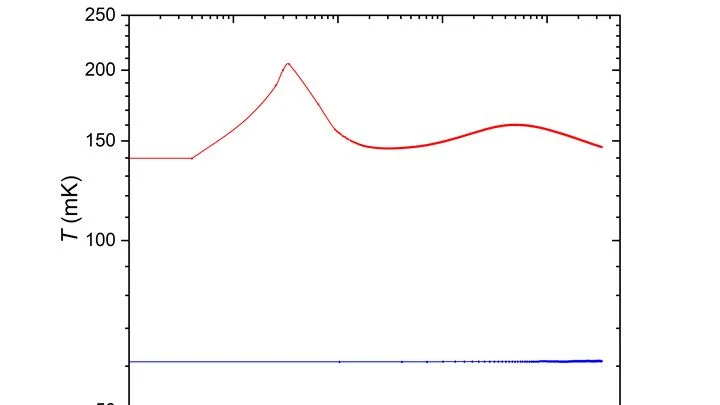
A quantum lab is like a kitchen where the chef waits a day for the stove to cool down. Superconducting qubits only work at temperatures of a few hundredths of a kelvin, and each 'cool, measure, warm up' cycle eats a whole day. A team of engineers built a fridge the size of a melon, weighing 3 kg, that does the job in just two hours.
A laser beam strikes a thin target hidden inside layers of another material. Within billionths of a second, the material is compressed to a density of 25 grams per cubic centimeter, as if a piece of lead became more than twice as heavy without moving an inch.
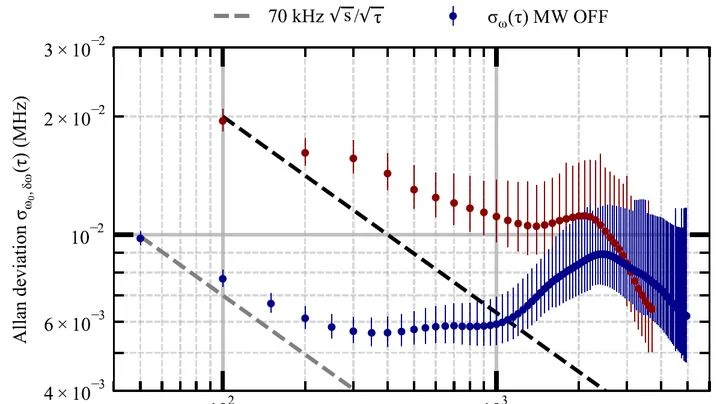
Earth's magnetic field is not constant: it trembles from the solar wind, from distant thunderstorms, and from the subway running nearby. To notice these tremors, you need an instrument that doesn't tremble itself. Physicists have built such an instrument from ytterbium atoms cooled to nearly absolute zero.
A radio receiver the size of a palm can measure signal power more accurately than expensive lab benches. Inside, there are no coils or antennas, just a glass head and a cloud of rubidium atoms cooled to near absolute zero.
A light field, like a neat waffle iron, presses a regular pattern of bright and dark regions into space. Atoms get stuck in the brightest spots as if in tiny dimples: that's an optical lattice. It's a favorite tool for physicists who want to study quantum behavior of matter in its pure form.
The race for fusion energy is like trying to bottle a lightning bolt. For decades, physicists have struggled to recreate on Earth the processes that power the Sun. The main challenge is getting light nuclei to fuse despite their mutual repulsion, while extracting more energy than was spent heating and confining the plasma.
A laser beam can do more than heat things up: it can also calm motion. When light enters a mirror trap, it exerts pressure on the mirrors, and if you tune the beam's color just right, that pressure becomes a gentle braking force. This is how tiny mechanical vibrations are cooled to nearly absolute zero.
The Sun is a giant cauldron where light struggles through a thick layer of scorching matter. On its way out, photons (light particles) constantly bump into atoms and lose energy. How strongly matter holds back light is called "opacity," and it determines how quickly heat escapes.
Iron is one of the main culprits for opacity in the Sun's interior.
Catching a single molecule in a beam of light and nearly stopping its motion is like trying to hold a dandelion fluff in a gust of wind. A particle that's too hot slips out of the trap, so physicists first tame its thermal jitters with laser cooling.
The authors applied a technique called Sisyphus cooling to strontium hydroxide (SrOH) molecules.
The vacuum is not as empty as it seems. If an observer moves with acceleration, the vacuum around them heats up: this was predicted by William Unruh back in the 1970s. The effect is akin to black hole radiation, but in flat space.
A laser isn't just about light. If you make a particle oscillate like a pendulum and those oscillations sustain themselves, you get a phonon laser. Sounds complicated, but the idea is simple: instead of light waves, the device emits orderly waves of mechanical vibrations — phonons.
The world's most accurate pendulum isn't a steel rod: it's a tiny atomic nucleus. The isotope thorium-229 has a special excited state: to nudge the nucleus into it, you need surprisingly little energy — about what an ultraviolet laser delivers.
A pendulum that almost nothing can knock off balance (not shaking, not heat, not magnetic fields) because it is hidden in the very heart of the atom. That is the kind of pendulum physicists used when they first switched on a nuclear clock. Previously, the best clocks, optical ones, relied on electron transitions.
Tiny magnets inside atoms, nuclear spins, can 'freeze' for long minutes in a cold crystal. This hinders the quick tuning of quantum sensors: everything takes too long to reach the desired state. Physicists have found a way to nudge them with light.
The light bulb turns on only in the room where you need it. That's roughly how photoactivatable drugs work: they 'switch on' only where light is directed, leaving the rest of the body untouched. This is especially important in cancer treatment: conventional chemotherapy hits all dividing cells indiscriminately, causing severe side effects.
Imagine trying to examine a snowflake without letting it melt or get damaged. That's roughly the challenge facing scientists who want to study individual proteins — the tiny molecular machines of life. In solution, a protein constantly jiggles and clumps with its neighbors, and in an electron microscope, the beam destroys it.
Two tiny dust grains hover at the crossing of laser beams. Each is held by its own 'tweezer'—a focused beam that keeps the particle from falling. Inside a mirrored cavity, light bounces between the walls, and its oscillations are coupled to the trembling of the grains.
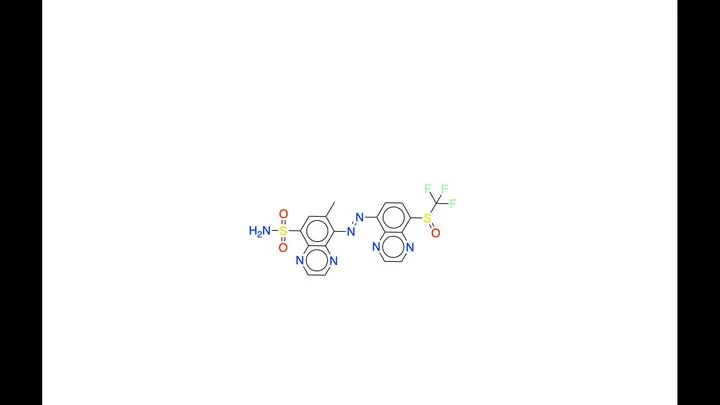
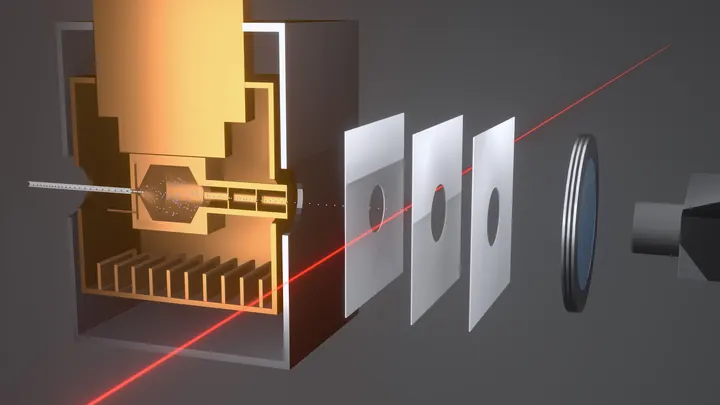
An ordinary aluminum pot on a stove doesn't emit molecules you can catch with light. But if you take aluminum and an aluminum salt, heat them together in a small oven, you get a stream of aluminum fluoride molecules, like steam from a kettle's spout, except instead of water droplets, tiny particles fly out.
Water in a cup cools down in minutes. Gas in a room spreads evenly in seconds. But if you trap atoms in a tube as thin as a laser beam and give them a good kick, they will take several seconds to "cool" toward equilibrium — an eternity by atomic standards.
Lasers usually heat things up. But in some crystals, light can carry heat away, like a teapot cooling under a bright lamp. In diamond, this job falls to defects: spots where a nitrogen atom replaces carbon, with a vacancy nearby.
Diamond is the hardest natural material, and working with it usually feels like a sculptor using a jackhammer: rough, with cracks and chips. But electronics demands jeweler-like precision, because diamond conducts heat superbly, withstands high temperatures, and can work in quantum devices.
A steady laser beam is like a taut string: if it vibrates even a little, the music turns into cacophony. In a quantum computer, the laser holds atoms in a trap, and any frequency jitter ruins the computation. That's why laser setups used to occupy entire tables, and tuning took weeks.
Gas is nearly invisible, but it has a temperature, and you can read it from how the gas 'shadows' the thermal background. In the experiment, a camera looks at a warm screen through a jet of carbon dioxide. If the gas is cooler than the background, it appears as a dark spot; if warmer, it appears bright.
Quantum materials are like finicky flowers: they only bloom in the cold. At room temperature, they hide their unusual properties, but when deeply cooled, they become superconductors or change their magnetic behavior. To understand how they work, you need to examine their atoms in the very cold where these properties reside.
Ultracold molecules are a promising material for quantum computing, but assembling them into a neat array, like eggs in a carton, is no easy feat. A method has been proposed to load molecules one by one into optical tweezers or lattices directly from a gas. The molecules immediately end up in the calmest state of motion.
At 0.1 K, just three-tenths of a degree above absolute zero, matter stops following the usual rules. Helium becomes superfluid: it flows without friction, seeps through cracks, and behaves like one giant quantum liquid. Seeing what happens inside such cold is a challenge at the edge of possibility.
A tiny cloud of 300,000 ytterbium atoms, cooled to near absolute zero, was shuttled along a light track 34 centimeters long, like transporting a fragile cargo over a bumpy road without shaking it apart.
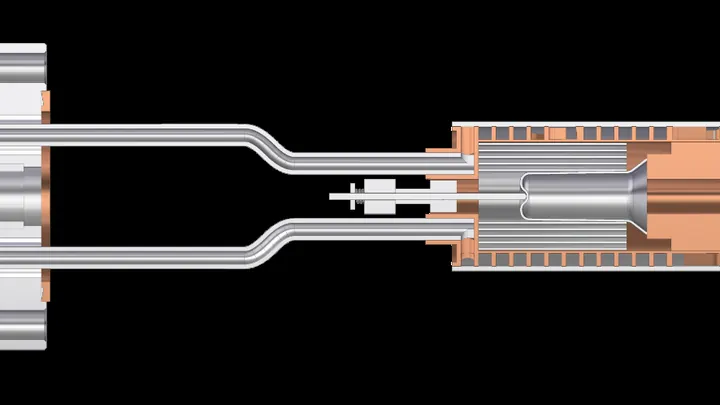
Your kitchen fridge cools everything to a single temperature. But in labs where quantum phenomena are studied, you often need two different levels of cold at once. Previously, that meant assembling two separate cooling circuits — bulky and heavy.
Light from tiny perovskite crystals is like a choir performance, where voices sound sometimes solo, sometimes in a tight duet. Previously, such a duet could only be heard under extreme cooling, nearly to the chill of outer space. Now the choir sings at room temperature.
At the bottom of lunar craters, where sunlight never reaches, an eternal cold reigns — about minus 240 degrees Celsius. In these icy pockets, known as permanently shadowed regions, plans are underway to install a mirror resonator made of monolithic silicon.
Light and matter in the tiny world obey laws that are hard to compute even on a supercomputer. Physicists build special "quantum simulators"—setups where cold atoms play the roles of particles and fields. But until now, such simulators could only depict the field in its simplest form: as if it were either present or absent.
A calcium ion in a magnetic trap resembles a tiny ball that constantly trembles from heat. To make it freeze, physicists usually hit it with lasers from several sides. But in the new experiment, a single beam aimed along the trap's axis sufficed.
First, the ion is cooled the usual way — the laser slightly slows its motion, like a headwind slowing a runner.
Light from an ordinary bulb is a stream of individual photons, like drops from a faucet. But there is also light where photons come in pairs, like twins walking together. Such grouped light has long been desired for measuring distances and imaging objects hidden around corners. But sources of this light were either too dim, or their flashes too short for ordinary detectors to catch.
An ordinary laser amplifies light into a bright beam. Run the process in reverse, and you get an anti-laser — a device that sucks in light without a trace. But such a machine is finicky: even a slight disorder can ruin the absorption.
Physicists have found a way to make the anti-laser invulnerable.
Cooling usually brings order: water freezes into ice. But in the quantum world, order takes unexpected forms. Experimenters cooled polaritons — particles that are both light and matter — to near absolute zero.
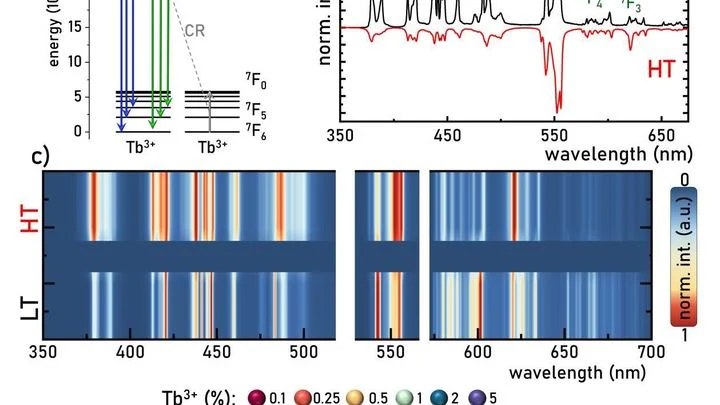
A piece of material glows blue. Heat it up, and the glow turns green, as if someone flipped a switch at a traffic light. That's how the new luminescent thermometer described in the paper works.
Inside the material are terbium ions — a rare-earth metal that knows how to shine. At room temperature, they emit blue light.
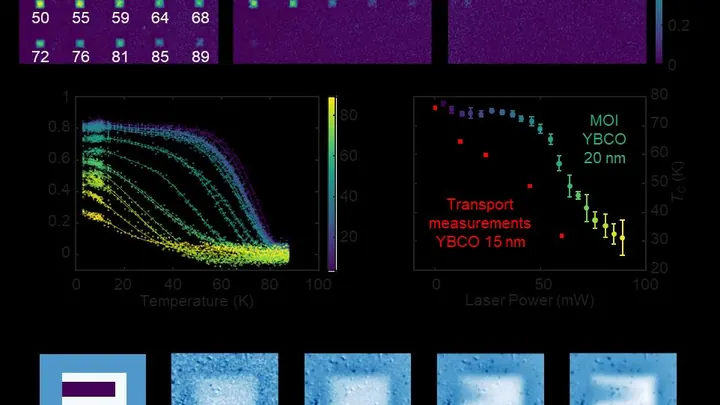
A laser beam, like a fine chisel, burns oxygen out of a superconducting film. Where oxygen becomes scarce, the material stops conducting electricity without resistance. The researchers used this trick to draw patterns on the film that alter its properties.
Five charged calcium atoms hover in a trap, held by electric fields. Laser cooling saps their excess energy, and they line up into a tiny pyramid with a square base. But this pyramid doesn't stay put: every now and then it flips over, as if someone tosses it into the air and catches it upside down.
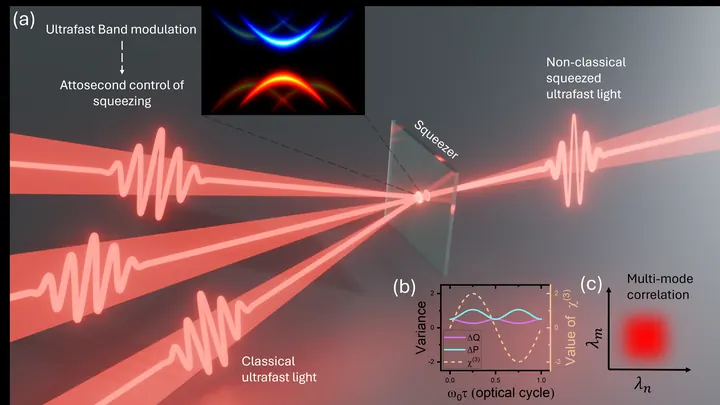
Ordinary light always jitters a bit: its brightness and color fluctuate, like the air in a balloon after a tap. In 'squeezed' light, these fluctuations are redistributed — as if you squeeze the balloon from one side, making it thinner here and thicker there, but the total volume stays the same.