Monte Carlo simulation is a computational technique that uses random sampling to obtain numerical results for problems that might be deterministic in principle but are too complex for exact analytical solutions. The name comes from the Monte Carlo Casino in Monaco, reflecting the role of chance in the method. It is used across physics, from modeling the passage of particles through detectors to calculating properties of quantum field theories on a lattice, where direct analytical calculations are impossible.
History
The method was developed during the Manhattan Project in the 1940s by Stanislaw Ulam, John von Neumann, and Nicholas Metropolis, who coined the name. It was first applied to neutron diffusion problems.
How it works
The core idea is to set up a model of the system, then repeatedly draw random samples from the relevant probability distributions, run the model with those samples, and aggregate the outcomes. For example, to estimate the average energy of a particle in a potential, you would randomly sample positions and velocities according to the Boltzmann distribution, compute the energy for each, and average. The law of large numbers ensures that as the number of samples grows, the average converges to the true value. The accuracy improves only as the square root of the number of samples, so clever variance-reduction techniques are often needed.
In practice
Used in particle physics to simulate detector responses, in cosmology to model structure formation, and in condensed matter physics to study phase transitions via lattice models.
Fun fact
The first Monte Carlo calculation was done on the ENIAC computer in 1948, using a random number generator based on a roulette wheel.
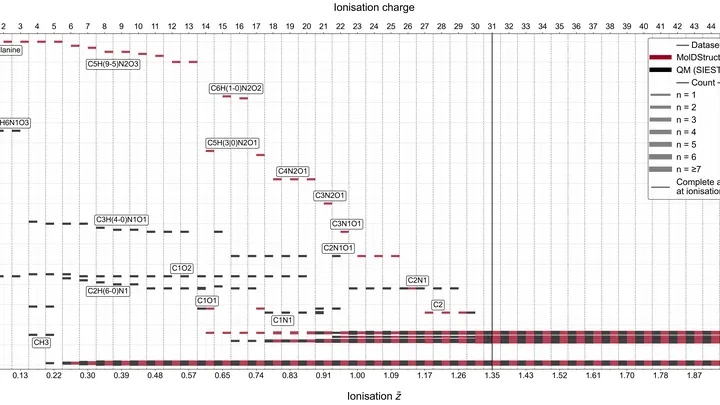
A tennis ball hits a sandcastle. The castle crumbles, but by where and how far the grains of sand fly, you can guess the castle's shape. That's roughly how the method of exploding proteins with X-rays works. The laser beam is so powerful that the protein molecule loses electrons and flies apart into charged fragments, like the castle under the ball's impact.
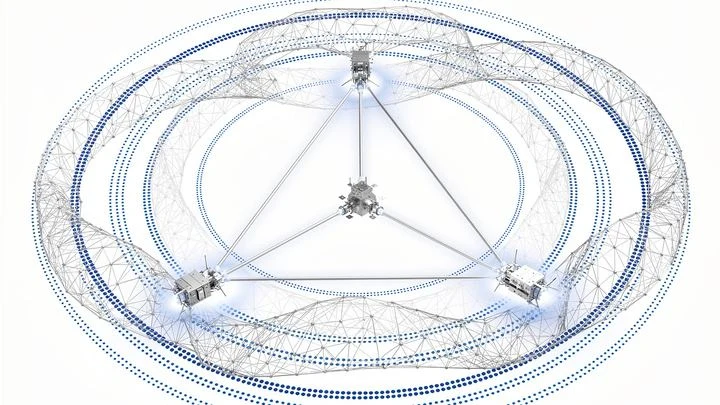
The Universe is not silent: it is filled with a continuous gravitational-wave hum. In a decade, the LISA space observatory will tune its "ears" to the millihertz range, and the richest source will be our Galaxy — tens of thousands of white dwarf pairs whirling in a frantic dance.
When a building collapses, steel rebar turns into a chaotic magnetic compass. Entropy, a measure of disorder, increases, but it's this very disorder that points to voids where people might be.
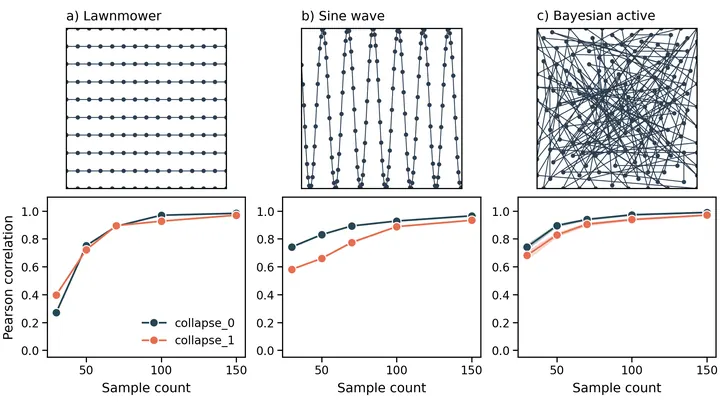
In a hall with a hundred instruments, a symphony is playing, but the conductor is hidden behind a screen. The scientist hears only the notes played by the instruments and wants to understand who sets the rhythm. Scientific data resembles such an orchestra: we record instrument readings but do not see the hidden mechanisms that drive them.
Cosmic rays are particles from deep space, accelerated to colossal energies. Smashing into the atmosphere, they trigger particle showers with radio waves. These waves are fingerprints, revealing the energy and direction of the intruder.
When matter is compressed to pressures of millions of atmospheres and heated to thousands of degrees, it is neither solid nor gas. This warm dense state is like the interiors of giant planets or the moment of a meteorite impact. You can't look inside directly, but you can shine X-rays and see how they scatter off electrons.
The helium-5 nucleus is like an overtightened string: touch it, and it falls apart into helium-4 and a neutron. Catching such a decay and measuring its rate is no easy task. Standard calculation methods stumble over mathematical noise.
The researchers took a reliable approach to describing nuclear forces and added a clever trick — analytic continuation.
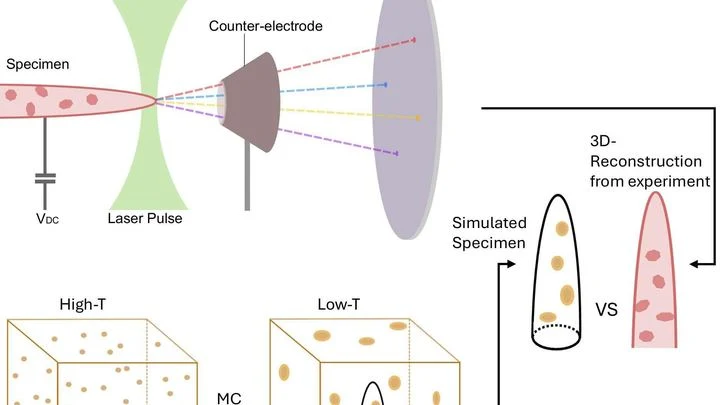
A seven-metal alloy is like a team where every player is pulling the blanket their own way. Atoms of iron, cobalt, nickel, aluminum, titanium, tantalum, and vanadium can either fall into a strict pattern or scatter into random positions. This determines whether the material will be as strong as steel or as light as aluminum.
In a tropical forest, the dry season gives way to the rainy season, and with the weather, the rules of life change: some animals go into hibernation, while others come out of hiding. Likewise, in complex systems, from climate to economics, the links between processes are not set in stone. They depend on a hidden "regime" that itself switches from time to time.