Submillisecond Pulsars: Why Don't They Exist? ✛
Context
The question of the minimum possible rotation period of a neutron star has been debated since the discovery of the first millisecond pulsar in 1982. Related works in the archive focus on individual aspects: masses and rotation of neutron stars, pulsars in globular clusters, pulsars with white-dwarf companions, methods for detecting pulsars in noise, gravitational-wave background, magnetar quiescence at 12 seconds, too-fast pulsars, and Crab glitches. This review stands out for its systematic approach: it combines empirical data, statistical analysis, and theoretical calculations to assess why submillisecond pulsars have not been found, concluding that their absence is an intrinsic property of the population, not a result of observational selection.
Methods
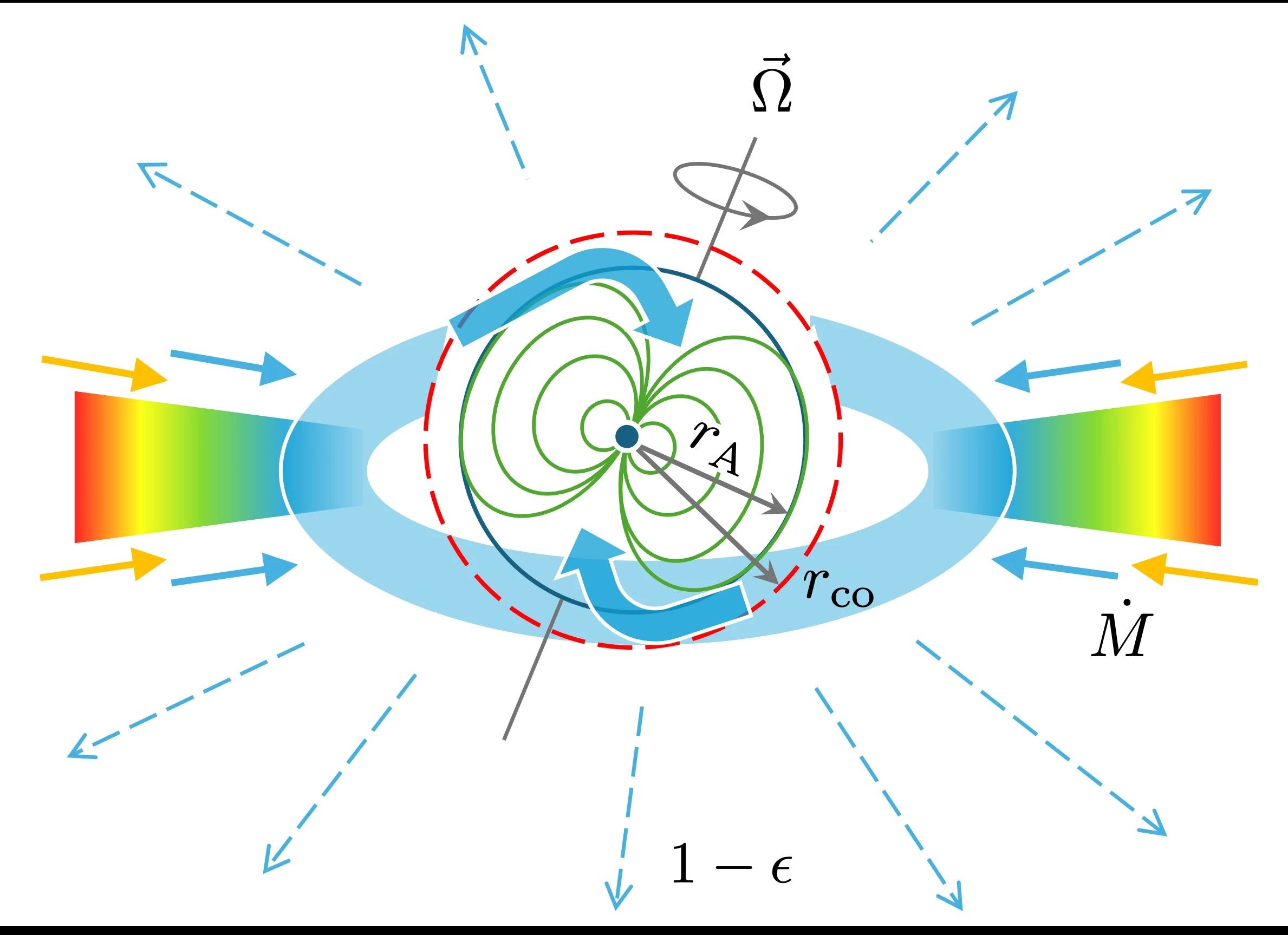
The authors compiled a sample of 694 radio pulsars with periods from 1.396 to 9.900 ms and 51 X-ray millisecond pulsars. They applied extreme value theory (generalized Pareto distribution) to estimate the probability of a pulsar with a period below 1 ms. To test observational selection, they injected 40,000 artificial submillisecond pulsars into real MeerKAT survey data (L-band and UHF) and ran them through standard search pipelines (peasoup and presto) with the PICS classifier. Theoretically, they calculated equilibrium spin periods, minimum accreted mass, spin-up time, and subsequent spin-down for various magnetic field strengths and accretion rates.
Results
Statistical analysis shows that the conditional probability density for periods below 1 ms is effectively zero: a submillisecond pulsar would be an extremely rare outlier. Selection modeling revealed reduced sensitivity at short periods due to scattering and dispersion smearing, but bright submillisecond pulsars with signal-to-noise ratio >30 could not have been missed. The main result: to reach a period of 1 ms, a neutron star must accrete at least 0.25 solar masses, and for 0.6 ms, more than 0.5 solar masses. With realistic accretion efficiency of 20–30%, this requires a donor of 2–4 solar masses, but such stars live too short and transfer mass too quickly to spin up the neutron star to submillisecond periods. Even if a submillisecond pulsar forms, it will spin down to a period >1 ms within a few hundred million years, unless its magnetic field is weaker than $10^7$ G.
Implications
This work unifies disparate studies into a coherent picture: submillisecond pulsars are not forbidden by equilibrium spin or magnetospheric physics, but their formation is suppressed by astrophysical constraints. Unlike related works that focus on individual mechanisms (gravitational waves, equation of state, selection), here it is shown that the key factor is inefficient accretion and the short lifetimes of massive donors. This shifts the focus from exotic constraints to more mundane aspects of stellar evolution.
Future development
The topic could advance through deeper X-ray observations of bright atoll sources and transients with high time resolution, as well as optical searches with subsecond resolution. Improved kinematic corrections (parallaxes, proper motions) will allow more precise measurements of magnetic fields of the fastest pulsars and test whether they reach values below $10^7$ G. Future gravitational-wave observatories (Einstein Telescope, Cosmic Explorer) could test whether gravitational radiation limits spin at the ~716 Hz limit.
Impact
The results affect population synthesis of compact binaries and predictions for gravitational-wave sources, as well as our understanding of the equation of state of dense matter.
Next steps
Conduct deep X-ray observations of bright atoll sources with high time resolution; improve kinematic corrections to measure weak magnetic fields in the fastest millisecond pulsars.
Key open problems
Connection to unresolved problems in neutron star astrophysics: what is the mechanism of magnetic field decay during accretion and can it lead to fields weaker than 10^7 G; what is the true accretion efficiency in low-mass X-ray binaries; do quark stars exist that could spin faster than neutron stars.
The knowledge machine's view
This section is addressed to the author of the paper and their colleagues. Neighbouring works were found by meaning-based search across our archive, not by word overlap. We do not review: we show the field around the work.
What the work does
The authors compiled a sample of nearly 700 radio pulsars and 51 X-ray millisecond pulsars, applied extreme value theory, and injected artificial submillisecond pulsars into MeerKAT data to assess selection effects. They showed that the probability of a pulsar with a period <1 ms is extremely low, and its formation would require accretion of more mass than typical donors can provide; even if formed, such a pulsar would quickly spin down.
Where its strength is
The strength of this work lies in systematically combining statistical analysis of the observed sample, modeling of observational selection, and theoretical evolutionary calculations, which allows separating intrinsic astrophysical limits from selection effects.
Where it could go next
- It might be interesting to compare these conclusions with work on the role of mass, rather than spin, in shaping neutron star magnetic fields: if submillisecond pulsars do form, their magnetic evolution could differ from predictions.based on: Neutron Star's Sleeping Volcano: How Mass, Not Spin, Gives Birth to Magnetic Monsters arXiv:2607.17556v1
- Related research on pulsars that spin down too quickly may help refine how fast a submillisecond pulsar would transition to the normal millisecond range and whether it could be caught in the transitional phase.based on: The Cosmic Top That Brakes Too Fast arXiv:2607.18219
- Since the authors modeled survey sensitivity, it may be useful to look at methods for extracting pulsars from noise: they could suggest how to search for short-period signals in noisy data or in cases of scattering.based on: How to Fish a Pulsar Out of the Noise arXiv:2603.10347
Worth trying
- Investigate whether submillisecond pulsars might appear as transient X-ray sources with short bursts, similar to accreting millisecond pulsars.
- Assess whether a submillisecond pulsar could be detected via gravitational-wave emission if it has a small asymmetry.
- Search for submillisecond periods in existing survey data using more sensitive algorithms, for example, based on machine learning.
Nearby works in our archive
- The Hidden Pulsar in a Globular Clustersimilarity 0.58
- The Unheard Hum of Neutron Starssimilarity 0.56
- Silent Beacons in Spacesimilarity 0.55
- Neutron Star Tango: Mass and Spinsimilarity 0.55
- The Crab Pulsar: Glitches on Schedulesimilarity 0.54
- Neutron Star's Sleeping Volcano: How Mass, Not Spin, Gives Birth to Magnetic Monsterssimilarity 0.53
- How to Fish a Pulsar Out of the Noisesimilarity 0.52
- The Cosmic Top That Brakes Too Fastsimilarity 0.52
The archive is sparse around this work: the closest review is only 0.58, against a usual 0.64. It looks like few have drilled nearby.
The fastest known pulsar, PSR J1748-2446ad, spins 716 times per second — faster than a kitchen blender. If it were the size of Earth, a point on its equator would move at about 0.24 times the speed of light.
In Robert Forward's novel "Dragon's Egg," a neutron star spins so fast that creatures live on its surface perceiving time differently. A submillisecond pulsar would be an even more extreme object, but physics shows such stars cannot exist for long.
Key numbers
- fastest measured period: 1.396 ms (PSR J1748-2446ad)
- number of known millisecond pulsars: 694 radio pulsars
- minimum accreted mass for 1 ms period: 0.25 solar masses
- typical accretion efficiency: 20–30%
- required donor mass for submillisecond pulsar: 2–4 solar masses