A magnetar is a type of neutron star with a surface magnetic field of 10⁹–10¹¹ tesla (for comparison, the record artificial field is only 10³ T). Inside is a superfluid neutron flux, superconducting protons, and a solid crust. Activity is powered by stored magnetic energy: crust fractures (starquakes) release up to 10⁴⁰ J within fractions of a second as gamma-ray flares. Magnetic braking explains periodic pulsations and X-ray emission.
History
On March 5, 1979, satellites detected a burst from object SGR 0526-66 – subsequently the first identified magnetar. The concept of a magnetar was introduced by Robert Duncan and Christopher Thompson in 1992 to explain repeating gamma-ray bursts with a soft spectrum. In 1998, the detection of pulsations from the anomalous X-ray pulsar 1E 2259+586 confirmed the model: a field of about 6×10⁹ T. Today, more than 30 magnetars are known, including SGR 1806-20, whose 2004 flare was the brightest extrasolar gamma-ray event.
How it works
The strong magnetic field is generated by an alpha-omega dynamo: differential rotation (omega effect) and convective twist (alpha effect) in a rapidly rotating (milliseconds) protoneutron star. Upon cooling, the field is frozen into the superconducting proton fluid. Ohmic dissipation and ambipolar diffusion lead to field decay, heating, and crust deformations. Magnetohydrodynamic instabilities and magnetic reconnection cause gamma-ray flares. The magnetosphere is filled with plasma; rotation induces an electric field, accelerating particles to relativistic energies and producing non-thermal emission. Maxwell's equations describe the field structure.
In practice
Studying magnetars tests theories of gravity and quantum electrodynamics under extreme conditions and helps explain the nature of fast radio bursts.
Fun fact
If a magnetar were at the Moon's distance, its field would erase data from magnetic media. Twice as close, it would attract iron objects with a force far exceeding human muscles.
At night, a lighthouse on a rock doesn't go dark, but sometimes the keeper draws the curtains over the lamp. The light is still there, just less of it. Something similar happened to the X-ray pulsar 4U 0114+65: it didn't disappear, it merely dimmed its emission.
A pulsar is a neutron star that captures material from a neighboring star and emits X-ray pulses with every rotation.
A beacon at the edge of the galaxy blinks without a schedule: sometimes silent for years, sometimes emitting hundreds of flares in a single day. Such a beacon needs a watchman who never sleeps and never gets distracted.
A beacon at the edge of the galaxy blinks without a schedule: sometimes silent for years, sometimes emitting hundreds of flares in a single day. Such a beacon needs a watchman who never sleeps and never gets distracted.
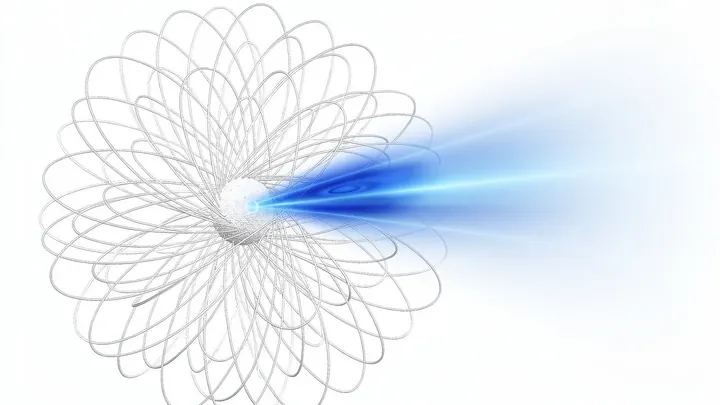
Pulsar PSR J0614-3329 spins 318 times per second. A point on its equator moves at about 10% of the speed of light. From a distance, the star looks like a lighthouse spinning so fast that its beam blurs into a continuous ring.
Radio waves from a distant pulsar travel through the interstellar medium, encountering invisible magnetic structures the size of the distance from the Sun to Earth. One such structure is a current sheet, where the magnetic field abruptly changes direction, like a compass needle flipping from north to south.
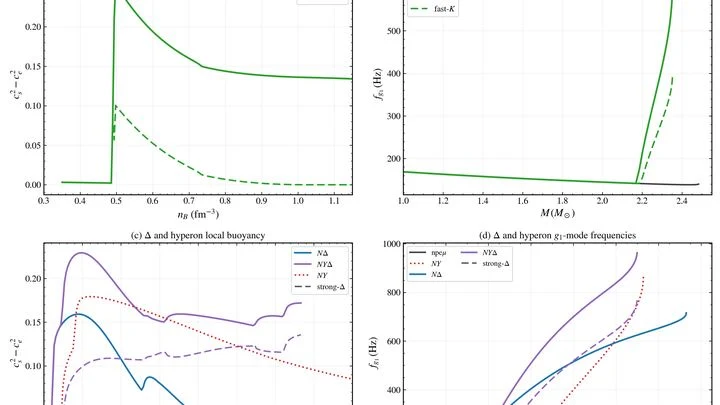
A neutron star is what remains after a massive star explodes. Its matter is compressed so tightly that a teaspoonful would weigh billions of tons. Under such conditions, protons and neutrons can rearrange, and new particles (hyperons, similar to neutrons but containing a 'strange' quark) can appear.
A sculptor shapes mountains from magnetic fields and heat, but the stone resists. A neutron star, the ultra-dense remnant of a supernova explosion, in a binary system pulls matter from its companion star. This infalling matter heats the star's crust unevenly, while the magnetic field tugs from within.
A sculptor shapes mountains from magnetic fields and heat, but the stone resists. A neutron star, the ultra-dense remnant of a supernova explosion, in a binary system pulls matter from its companion star. This infalling matter heats the star's crust unevenly, while the magnetic field tugs from within.
A lighthouse doesn't flash steadily but in short, bright pulses. The neutron star in the system 4U 1323-62 is such a lighthouse in the X-ray range. It pulls gas from a companion star, and when enough material accumulates on its surface, a thermonuclear explosion occurs — an X-ray burst.
A lighthouse doesn't flash steadily but in short, bright pulses. The neutron star in the system 4U 1323-62 is such a lighthouse in the X-ray range. It pulls gas from a companion star, and when enough material accumulates on its surface, a thermonuclear explosion occurs — an X-ray burst.
A lighthouse flashes for a fraction of a second and goes dark again. The MeerKAT telescope in South Africa catches such flashes in the radio band. During its observations, it picked up 27 new sources that no one had seen before. Neutron stars are the remnants of exploded stars, compressed to the size of a city.
The light of a distant lighthouse does not go out all at once: first it flares brightly, then slowly fades into darkness. That is how the X-ray pulsar 4U 0115+63 behaves — a neutron star that periodically brightens when gas from a companion ordinary star falls onto it.
A chef tastes tiny morsels from different edges of the plate and tries to reconstruct the recipe of a complex dish. Each morsel offers only a hint of flavor, and the samples are a bit blurred — too much salt here, not enough sugar there. That's roughly how nuclear physicists study the matter inside neutron stars — the densest objects in the universe after black holes.
A cosmic "caliper" will soon measure a neutron star to within a hundred meters. For an object a couple dozen kilometers across, that's like measuring the thickness of a human hair from a kilometer away.
A neutron star is the remnant of an exploded supernova.
Two stars circle each other, gradually drawing closer. Their dance loses energy, and that energy escapes into space — in the form of gravitational waves, and sometimes other fields.
In the distant Cigar Galaxy, there is an unusual beacon. It doesn't shine in the usual sense: its rays are born in a scorching cloud around a black hole that is devouring matter from a companion star. Such objects are called ultraluminous X-ray sources. Their X-ray brilliance is so intense that it outshines entire galaxies.
This cloud, the corona, is like a boiling cauldron.
Deep inside molecular clouds hide natural amplifiers — cosmic masers. They work like lasers but in the radio band: excited molecules collectively emit waves of a single frequency, creating a bright beam. The catch is that these molecules often have several ways to shed energy.
A star's radius drops by a thousand kilometers. Not because its mass increased, but because its own magnetic field squeezed the crust like an invisible corset.
10¹⁵ Gauss — that's the magnetic field found on some white dwarfs. It is billions of times stronger than what a compass shows on Earth. A white dwarf is not a star in the usual sense, but a cooled core the size of a planet. Inside, gravity opposes the pressure of degenerate electrons.
A star's radius drops by a thousand kilometers. Not because its mass increased, but because its own magnetic field squeezed the crust like an invisible corset.
A supernova explosion blasts off the outer layers of a dying star. What remains is the core — a neutron star, packed into a sphere the size of a city. The existence of such stars was predicted back in 1934 by Fritz Zwicky.
Radio astronomy began with the mysterious noise caught by the antenna of Karl Jansky and the rhythmic pulses that Jocelyn Bell Burnell playfully called 'little green men'.
A neutron star is a boiling cauldron the size of a city but with the mass of one and a half Suns. Deep inside, matter is squeezed so hard that atomic nuclei lose their meaning. Strange forms of matter are born there: a kaon condensate (similar to a superfluid) and neutron stars with hyperons (heavy particles).
In June 2024, the CHIME radio telescope recorded over 700 radio bursts per hour from source FRB 20240114A. Such a hyperactive repeater releases in one hour nearly all the magnetic energy of a typical magnetar (a neutron star with an ultra-strong field).
In August 2019, the LIGO and Virgo detectors picked up gravitational waves from the merger of two compact objects in a binary star. One weighed 23 solar masses — a standard black hole. The other came in at 2.5–2.67 M⊙.
A neutron star is the collapsed core of a massive star, squeezed to the size of a city. A teaspoon of its material weighs as much as a mountain. But inside this superdense sphere, a surprise may lurk: under unimaginable pressure, neutrons break apart into quarks, giving the star a new, more compact core.
An inflatable balloon with magnetic field lines drawn on it with a marker is a simple model of how a weak magnetic field behaves in an expanding universe. While the balloon is small, the lines lie obediently on the rubber and don't hinder its stretching. That's roughly how a field fills ready-made space without arguing with its geometry.
Deep inside a neutron star, matter is squeezed so tightly that familiar protons and neutrons give way to new players. Hyperons are born there — particles that harbor a strange quark.
The interiors of neutron stars are a realm of degenerate matter. Here, protons condense into a superconducting condensate, threaded by quantum vortices. Imagine tiny magnetic tops: each carries a quantum of magnetic flux and glides through the electron fluid.
The flash lasts a thousandth of a second, but in that instant it releases as much energy as the Sun emits in a day. Such signals, fast radio bursts, have been caught by telescopes since 2007, and their source remains a mystery. A new study offers an elegant answer: it's all about a cosmic amplifier.
Inside planets and stars, in rotating oceans of plasma, turbulent flows, Coriolis forces, and magnetic tension collide. The central question is how the energy of this chaos crystallizes into a stable magnetic framework that can last billions of years.
Two ultradense spheres, each the size of a city, whirl in a dance. Their masses are less than the Sun's, but inside them is matter compressed to unimaginable limits. One sphere is a neutron star; the other is a strange star, made entirely of quarks — the elementary particles that build up protons and neutrons.
A neutron star is a city squeezed to the size of a metropolis, where matter is packed to the limit. At the very center of such a city, a redevelopment may begin: familiar neutrons and protons give way to quark plasma — free quarks, the building blocks of almost everything around us.
A teaspoon of neutron star matter weighs as much as a mountain. But this mountain may have an invisible twin.
Deep inside a neutron star, ordinary matter is compressed to unimaginable densities. There, protons and neutrons can dissolve into a quark soup.
Space is threaded with magnetic fields. They exist around galaxies, stars, and even in nearly empty voids — the vast empty spaces between galaxy clusters. It's usually thought that fields are amplified from weak 'seed' fields by turbulence, much like a dynamo. But the origin of the seed fields themselves has remained a puzzle.
Somewhere deep in space, a radio beacon flashes for a fraction of a second, and then goes dark. Such signals are called fast radio bursts. They come from other galaxies and last from microseconds to milliseconds.
Active galactic nuclei (AGN) are the universe’s powerhouses: their X-ray coronae blaze millions of times hotter than stellar atmospheres. But what strikes the spark? A ten-day X-ray campaign by the XRISM and XMM-Newton satellites, aimed at NGC 3783, provided the answer: it’s actual thunderstorms.
A collision of two neutron stars is a cosmic forge where the heaviest elements of the periodic table are hammered out in seconds. In 2017, detectors picked up gravitational waves from such a merger, and telescopes saw a flash — a kilonova.