The hydrogen line, also known as the 21-cm line, is a spectral feature emitted by neutral hydrogenatoms when their electron spin flips from parallel to antiparallel relative to the proton spin. This transition is extremely rare, but the vast amount of hydrogen in the universe makes it a powerful tool for astronomy. It is used to map the distribution of neutral hydrogen in galaxies, study the structure of the Milky Way, and probe the early universe during the cosmic dark ages.
History
The 21-cm line was predicted by Hendrik van de Hulst in 1944 and first detected by Harold Ewen and Edward Purcell in 1951. It has since become a cornerstone of radio astronomy.
How it works
The 21-cm line arises from the hyperfine splitting of the hydrogen ground state. When an atom emits a photon at 1420 MHz, it reveals the presence and velocity of neutral hydrogen gas. By measuring Doppler shifts, astronomers can trace the rotation of galaxies and the motion of gas clouds. In stellar atmospheres, the hydrogen line is used to diagnose temperature, density, and pressure conditions, as its strength and shape depend on these parameters.
In practice
The hydrogen line is used in radio astronomy to map galactic structure, in cosmology to study the epoch of reionization, and in astrophysics to characterize stellar atmospheres.
Fun fact
The 21-cm line is so faint that a typical hydrogenatom emits such a photon only once every 10 million years, yet it is detectable across the universe due to the sheer number of atoms.
When stars are born in a galaxy, they make hydrogen glow, like a neon sign, but on a cosmic scale. This light could tell us a lot about how many stars are forming, but on its way to us, it passes through cosmic dust. Dust is like a fogged-up window: it dims the glow and alters its color.
One hundred forty parsecs, a distance light traverses in four and a half centuries, separate us from the Taurus molecular cloud. Within its depths hide dark condensations: prestellar cores, where gas and dust slowly contract under their own weight.
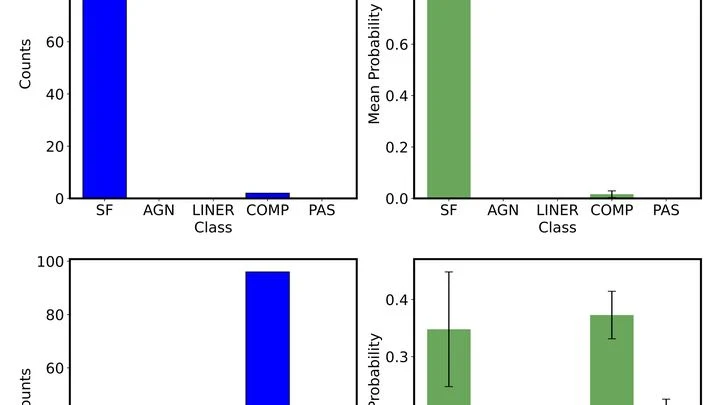
A galaxy is not just a sprinkle of stars. At the center of many, something shines brighter than billions of suns: hot gas falling into a black hole. The color of this glow reveals what kind of life the galaxy leads — quietly birthing stars or violently consuming matter.