The main method is transmission spectroscopy: during transit (the planet passing across the star's disk), some starlight is filtered through the upper layers of the atmosphere. Atoms and molecules absorb radiation at characteristic wavelengths, creating a spectral fingerprint. From this, the presence of water vapor, carbon dioxide, methane, as well as temperature and pressure can be determined.
History
The first successful analysis of an exoplanet atmosphere was performed by David Charbonneau's group in 2001 using the STIS spectrograph on the Hubble telescope. Sodium at 589 nm was detected on planet HD 209458 b. Later, the Spitzer infrared telescope and the Kepler space observatory led by William Borucki enabled statistical studies of hundreds of hot Jupiters. With the launch of JWST, the era of detailed chemical analysis of Earth-like planet atmospheres began.
How it works
During transit, the fraction of radiation blocked by the planet is (R_p/R_s)^2, and the thin atmospheric shell adds about 2R_p·h/R_s^2 to the absorption, where h is the effective height of the atmosphere. This height is given by the scale height H = kT/(μg), where k is Boltzmann's constant, T is temperature, μ is mean molecular mass, and g is gravitational acceleration. Absorption at specific wavelengths follows the Bouguer–Lambert–Beer law; the depth of spectral lines reflects the abundance of the corresponding chemical elements. Light curves at different wavelengths are recorded photometrically, and spectral resolution allows identification of molecular bands of H₂O, CO, CO₂, CH₄, etc.
In practice
Searching for signs of life and assessing planetary habitability by detecting water, oxygen, or methane in the atmospheric spectrum.
Fun fact
On exoplanet KELT-9b, the dayside is heated to 4600 K — hotter than many stars — and iron and titanium vapors float in its atmosphere.
The JWST space telescope aimed its lens at the scorching rocky world 55 Cancri e, and spotted a dense gas envelope. But the cooler TRAPPIST-1 b, which orbits a dim red dwarf, showed no envelope: just bare rock. The picture came out upside down: hot planets hold onto atmospheres, while cooler ones lose them.
A telescope stares at a star for many nights in a row. Somewhere in the stream of light hides a tiny dip in brightness — an Earth-sized planet briefly blocking part of the star. Such a dip lasts a few hours and repeats once a year or less. Catching it is like hearing a single quiet click in a noisy hall.
The night sky is full of deceptive lights. Astronomers were searching for galaxies that ignited in the first few hundred million years after the Big Bang: their light has traveled to us for nearly 13 billion years. Six faint smudges were selected from images taken by the Hubble and Spitzer space telescopes.
Two stars circle each other like dancers who come together and drift apart. Over time, one swells, and its outer layers spill onto its neighbor. The star that receives foreign matter looks no different from a single star, but its surface remembers everything.
A flashlight beam cuts through fog. The denser the fog, the more the light scatters and the later it reaches your eye. A similar principle works with fast radio bursts — mysterious, super-powerful pulses from distant galaxies. As their radio waves travel through space, they interact with free electrons — particles stripped from atoms.
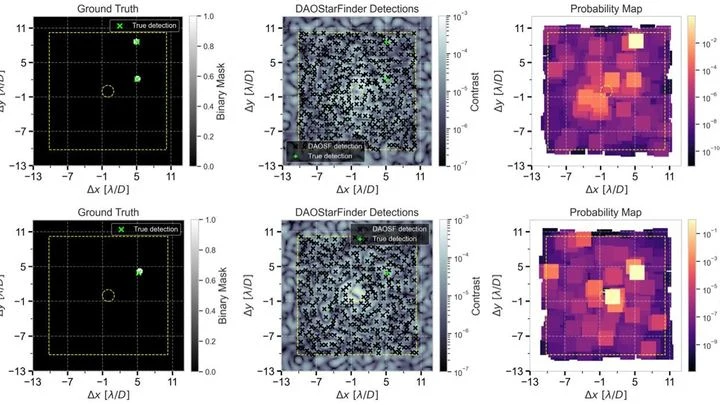
Photographing an exoplanet orbiting another star is like trying to spot a firefly in front of a spotlight. Earth's atmosphere is constantly churning, which makes stars appear as dancing speckles through a telescope.
A planet in the habitable zone is no guarantee of life. Like a conductor leading an orchestra, a star dictates the tempo and character of planetary atmosphere evolution over billions of years.
380 thousand years after the Big Bang, the universe cooled enough for light to decouple from plasma. That cosmic microwave background still pervades space, like the first chord of a symphony, the echo of a fiery beginning.
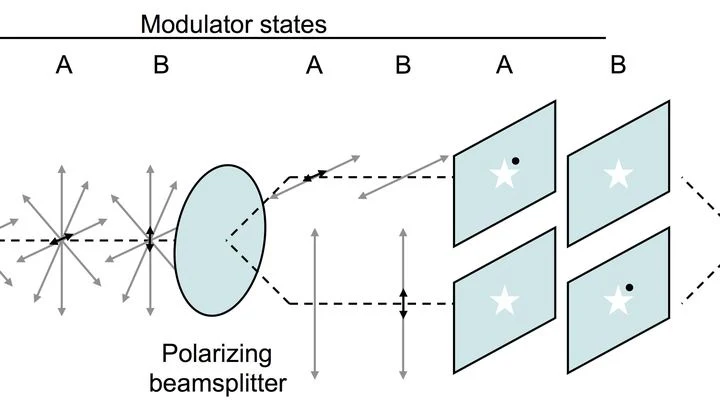
Night on La Palma. The 4.2-meter William Herschel Telescope is aimed at Venus. At the focus is the experimental polarimeter ExPo, designed to catch the ghostly light of exoplanets.
A pebble on a streambed lies still as sunlight sparkles dance on the water's surface. In astronomy, the contrast is similar: a real exoplanet is the stone, while myriad speckles (patches of scattered starlight) are the ripples trembling in instruments.
The optical sky background is a cosmic palimpsest, where light from billions of unresolved galaxies is layered, each layer corresponding to a different epoch. Until now we could only distinguish the brightest "letters"—individual stars and nearby galaxies.
The cameras of a self-driving car capture light like telescopes aimed at a distant galaxy. Each frame is a fragmented observation; together they must form a map of the road ahead.
The computer, like an astronomer, doesn't just stitch images together: it generates several possible bird's-eye views and compares them to real data.
When the JWST telescope breaks the light of a distant exoplanet into a spectrum, it reads a chemical chronicle. But this chronicle is not a monolithic truth; it's an atmosphere constantly rewritten by the star's radiation.
In 2024, the team led by David Charbonneau pointed the Magellan telescope with the WINERED spectrograph at LHS 1140. During transit, high-resolution spectroscopy caught the absorption line of metastable helium at 10833 Å.
The light of a distant star carries within it the silent hum of the atmospheres of planets orbiting it. For a long time, capturing it was like trying to make out a whisper over a roaring waterfall. But with the advent of the 39-meter Extremely Large Telescope (ELT) and the ANDES spectrograph with a resolution of 100,000, this task is no longer hopeless.
A spotlight blazes straight into your eyes, and a few steps away a tiny firefly flickers. That's roughly what it's like hunting for an Earth-like planet around a neighboring star: the planet is a hundred million to ten billion times fainter than its star, and in the sky they almost merge into a single point.
The Zone of Avoidance is the most stubborn gap in our knowledge of the local Universe, like pages blotted out with ink in an ancient chronicle. Up to 20% of the extragalactic sky is reliably hidden behind dense cosmic dust and swarms of stars in the Milky Way's disk.
A cosmological map is like a snapshot of ripples on water: from it you can reconstruct what stone was thrown. The stone is the properties of the universe — how much ordinary matter it contains, how much dark matter, how fast it is expanding. The ripples are the pattern of galaxies that telescopes measure.
Hundreds of light-years away, there's a planet that looks like a giant mirror. LTT9779b reflects most of the light that hits it — far more than you'd expect from a Neptune-sized body. Astronomers have long debated what makes it so shiny: a thick carbon-rich haze or a layer of clouds.
The James Webb Space Telescope has helped settle the debate.
Dark matter is the invisible scaffold that holds galaxies together. But how did it come to be? The standard answer: particles of dark matter once stopped colliding and "froze out" in the amount we see today. However, there's a trickier path — UFO, or ultra-fast freeze-out.
Here, everything is like coffee that cools down and then heats up again as you carry it through a cold corridor.
A world where a year lasts just one and a half Earth days, and the star in its sky is hundreds of times larger than our Sun. This is KELT-9 b — a gas giant heated to temperatures at which iron vaporizes. Its atmosphere is not just hot; it is literally boiling away into space, like steam rising from a giant cauldron.
Some 158 light-years away, around the dim star TOI-6894, a red dwarf, a planet moves leisurely. Its year lasts less than two Earth days, yet it is a cool world with an equilibrium temperature around 420 K, just a bit warmer than a sauna.
A scorching rocky planet is like a pot of boiling soup, except its lid is the atmosphere. Gases escape from the magma, wrap the world in a thick blanket, and in turn influence how quickly the celestial body cools. For GJ 1132 b, which orbits so close to its star that a year lasts just one and a half Earth days, this connection is especially important.
The planet WASP-121 b is a gas giant, heated to 2500°C. It always faces its star with one side, like a globe frozen under a lamp. But as it passes in front of the star's disk, its rotation reveals different facets to us — as if that globe were slowly turned, letting us peer into every corner.
Think of a baby mobile: figurines dangling on threads, twitching at even a whisper of breeze. In the same way, planets on very wide orbits barely cling to their star's gravity, and they feel the faintest gravitational drafts. Astronomers have proposed turning such planets into detectors of dark matter.
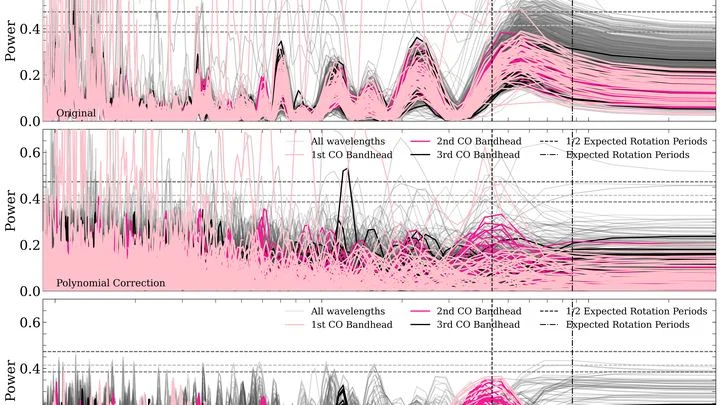
In the attic, you find an old, worn suitcase. From the stickers and scratches, you can guess where it's been. Astronomers have long searched for a similar 'sticker' for planets, and thought they found it in carbon monoxide molecules. Ordinary carbon monoxide consists of a carbon-12 atom and an oxygen atom.
Deep underground, in the thickness of granite, detectors catch rare visitors from space — muons. These particles are born high in the atmosphere when cosmic rays slam into air nuclei. They make it to the underground lab thanks to their enormous speed, close to the speed of light.
Civilizations in the Universe are separated not just by distance, but by the vast gulf of time. Hunting for their traces is like archaeology: instead of palace ruins, we find clouds of cosmic dust.
When astronomers peer at distant worlds, they often don't see crisp lines of water vapor or methane, but a blurry silhouette, as if the planet has thrown on a thick veil. This veil, a haze of organic particles, behaves like a temperamental photographic plate: it darkens under harsh ultraviolet light, revealing hidden chemical patterns.
A star's light curve is not chaotic noise, but a text written by pulsations, spots, and the steady glow of a thermonuclear furnace. Any planet slipping across the disk leaves a typo in this text: a tiny dip in brightness lasting hours.
A kindergarten where some kids are busy making sandcastles while others are already assembling building blocks. That's roughly what the V1298 Tau system looks like: it's only 20 million years old — by cosmic standards, it just left the nursery. Several planets orbit it, and two of them, b and e, turned out to be surprisingly different.
The MethaneSAT satellite scans for leaks of метана — a gas that's invisible but packs a powerful planetary warming punch. Its "nose" is a спектрометр, a device that spots the subtlest color changes in light passing through the atmosphere — the telltale sign of methane.
When a planet slips behind the edge of its star, the star backlights the planet's atmosphere, just as a setting sun illuminates clouds on the horizon. This brief moment, lasting only minutes, carries the imprint of the gases through which the starlight has passed.
The cosmic microwave background is the afterglow of the Big Bang, which we see at millimeter wavelengths. But it also has a long-wavelength tail extending into the radio range.
The first exoplanet was discovered around an unusual cosmic lighthouse — a neutron star known as a pulsar. These ultra-dense remnants of dead stars spin at tremendous speeds and emit precise radio pulses.
A pot of boiling lava, sealed with a thick lid of gas. That's roughly what sub-Neptunes look like — planets that are common around other stars but absent in our own solar system. Beneath a thick hydrogen atmosphere sloshes a molten magma ocean.
Beyond Neptune, in the icy belt, astronomers watched as object (612533) 2002 XV93 momentarily occulted a distant star. Using метод прохождений (when a planet dims the star's light for a second, like a fly in front of a lamp), Уильям Боруки and Дэвид Шарбонно determined: the light not only dimmed but also shifted…
Steam over a boiling pot slightly tints the light of a flashlight: it blocks some colors and lets others through. That's roughly how we study the air of distant planets.
The hunt for life on distant planets is like diagnosing a rare disease with a test of unknown accuracy. A single positive result means nothing: maybe it's a glitch? We search the atmospheres of exoplanets (worlds around other stars) for traces of water and other compounds, but any signal could be a false alarm.
Light from a distant star seeps through a planet's gaseous envelope, and astronomers try to guess what that envelope is made of. That's how we study the atmospheres of worlds we can never touch. When a planet passes in front of its sun's disk, its gaseous veil briefly intercepts some of the rays.